- Animals
- ›Arthropods
- ›Hexapods
- ›Insects
- ›Winged and Once-winged Insects
- ›Flies
- ›Nematoceran Flies
- ›Mosquitoes and Midges
- ›Culicoidea
- ›Mosquitoes
- ›Culicine Mosquitoes
- ›Aedini
- ›Aedes
- ›Ochlerotatus
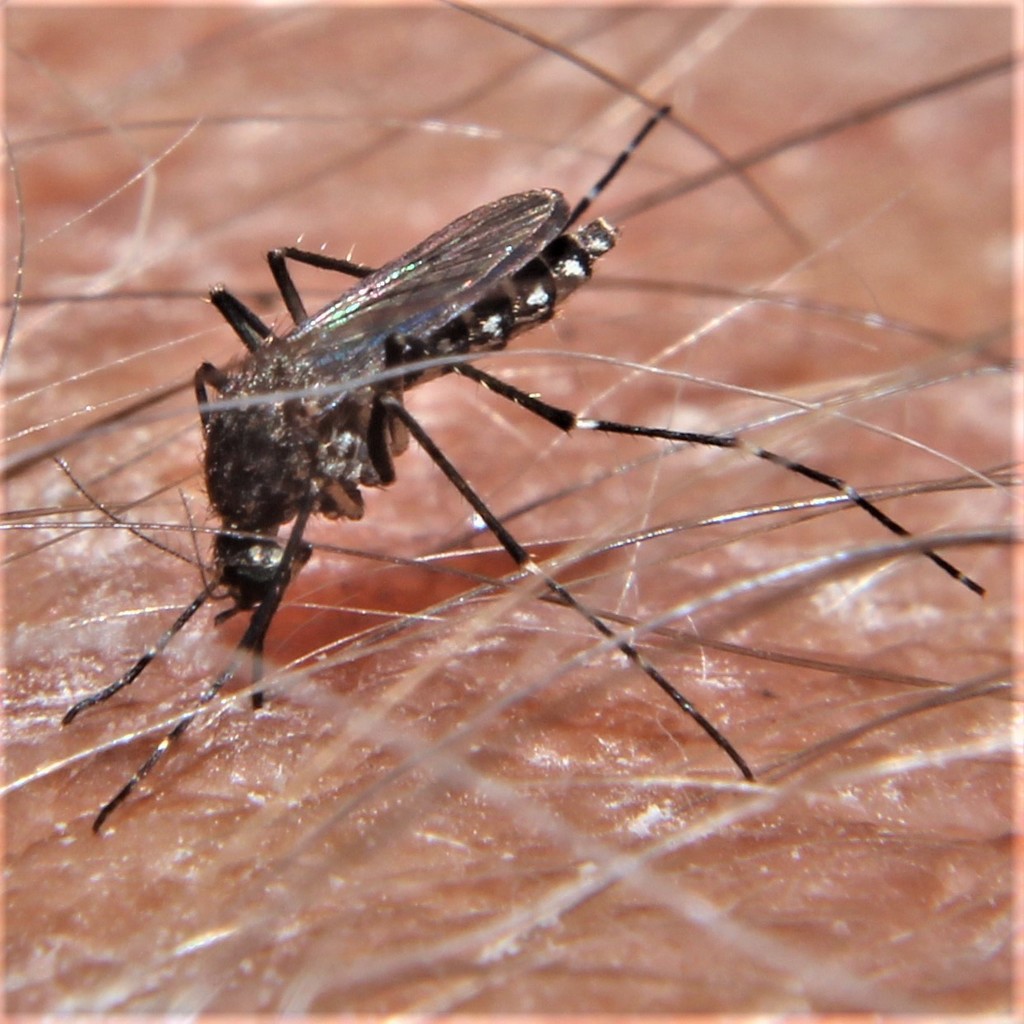
Black Saltmarsh Mosquito
Aedes taeniorhynchus
Aedes taeniorhynchus, or the black salt marsh mosquito, is a mosquito in the family Culicidae. It is a carrier for encephalitic viruses including Venezuelan equine encephalitis and can transmit Dirofilaria immitis. It resides in the Americas and is known to bite mammals, reptiles, and birds. Like other mosquitoes, Ae. taeniorhynchus adults survive on a combination diet of blood and sugar, with females generally requiring a blood meal before laying eggs.
This mosquito has been studied to investigate its development, physiological markers, and behavioral patterns, including periodic cycles for biting, flight, and swarming. This species is noted for developing in periodic cycles, with high sensitivity to light and flight patterns that result in specific wingbeat frequencies that allow for both species detection and sex distinction.
From the article Aedes taeniorhynchus on Wikipedia (CC BY-SA), quoted section by section
Description
Ae. taeniorhynchus adults are mostly black with areas of white banding. A single white band appears at the center of the proboscis, multiple white bands span the distal ends of the legs following the leg joints, and the last hind leg joints are completely colored white. Ae. taeniorhynchus wings are long and narrow with scaled wing veins. Experimental investigation of evolutionary coloration of Ae. taeniorhynchus yielded negative results. Mosquitoes reared in conditions of darkness, backgrounds colored black, white, or green, and lighting conditions of fluorescent light or sunlight, showed no color changes in the fat body nor in the head capsule, saddle, or siphon. This lack of cryptic coloring is suggested to be due to a lack of threat to the species; because the species habitat is a temporary water source used for larval growth, this temporary environment has few predators and relatively little danger. Males and females can be distinguished based on their antennae: males have plumose (feather-like) antennae while females antennae are sparsely haired.
Noise detection. Ae. taeniorhynchus swarms can be detected through sound. Noises with frequencies between 0.3 and 3.4 kHz at sound level 21 dB are detectable across 10–50 m in distance. An individual mosquito can be heard across 2–5 cm in distance when sound level rises to 22-25 dB. …
Range & habitat
Ae. taeniorhynchus is widely distributed across North and South America, though more highly concentrated in southern regions. At the time of the fly's initial discovery the species resided in coastal regions, and then gradually moved towards the interior of the Americas. Gene flow analysis derived from microsatellite data indicated that mosquitoes located in the Galapagos Island in the Pacific Island frequently migrate between islands on an isolation by distance basis. Incidence of ports was a strong factor contributing to migration, suggesting human-aided transport contributed to inter-island migration.
Wikipedia: “Distribution”
What it does
This species of mosquito is considered a pest among humans, with Florida districts attempting to control the mosquitoes since 1927 and having spent US$1.5 million on insect control in 1951. Copper acetoarsenite, known as Paris green, is used as an insecticide for Ae. taeniorhynchus larvae at the species breeding site, since the substance acts as a toxic stomach poison. DDT, another insecticide, was also deemed to be effective against the salt marsh mosquitoes and has been used for Ae. taeniorhynchus treatment in the past. Trap-bait combinations tested against the species indicate that CDC-type traps with carbon dioxide, octenol, and heat as bait increase the trapping success of Ae. taeniorhynchus. Humans have also tried to limit biting from Ae. taeniorhynchus because it flies very fast, and they start the blood extraction quickly, compared to the average mosquito, by wearing chemically treated protective clothing. Clothing treated with permethrin [(3-phenoxyphenyl)methyl (±) cis/trans 3-(2-dichloroethenyl)2, 2-dimethylcyclopropanecarboxylate] alongside application of deet (N,N-diethyl-m-toluamide) to the skin were shown to be extremely effective in reducing mosquito bites compared to usage of only one form of protection or no protection. The Off! Clip-on Mosquito Repellent device, which releases pyrethroid insecticide metofluthrin in vapor form, was also evaluated against Ae. …
Wikipedia: “Interactions with humans”
In human culture
According to observational field studies, Ae. taeniorhynchus carries out several behavioral trends at different stages of life. Growth and pupation of this species were found to be affected by environmental factors of nutrition, population density, salinity, light-dark, and temperature.
Eggs. Females lay eggs on dry ground, and egg hatching is triggered by the presence of water, such as rain or flooding. Egg laying yield from females, an indicator of fecundity, differs based on diet: in populations of low autogeny, rare autogenous females each laid less than 30 eggs, while egg yield was significantly higher in populations with majority autogenous females. Eggs laid in the right temperature and humidity conditions undergo embryogenesis, then stay dormant until hatching.
Larval in-stars. Upon hatching, the species progresses through 4 larval instars: the first 3 instars are affected primarily by temperature, with minor effects by salinity; the fourth instar is affected by all environmental factors. In the fourth instar, increased food sped up development time while crowding and salinity stunted growth. Preferred temperature for all 4 instars is between 30 °C and 38 °C but average preferred temperature increases with age. The first instar prefers an average temperature of 31.8 °C and the early fourth instar prefers a temperature of 34.6°. …
Wikipedia: “Life history”
Listen
Looking for field recordings…
Where it lives
Recorded sightings
—
geo-referenced records in GBIF, from museums, herbaria and field observers.
Drag the globe to turn it. Dots are where records exist, not a range map; darker means more records.
In the stacks
Searching the stacks…
Every page naming Aedes taeniorhynchus in the Biodiversity Heritage Library →
This page is assembled live from iNaturalist, GBIF, Wikipedia, the Source Library and the Internet Archive. It is not yet part of the hand-edited codex. iNaturalist taxon 1112134.