- Animals
- ›Arthropods
- ›Hexapods
- ›Insects
- ›Winged and Once-winged Insects
- ›Flies
- ›Nematoceran Flies
- ›Mosquitoes and Midges
- ›Culicoidea
- ›Mosquitoes
- ›Culicine Mosquitoes
- ›Aedini
- ›Aedes
- ›Hulecoeteomyia
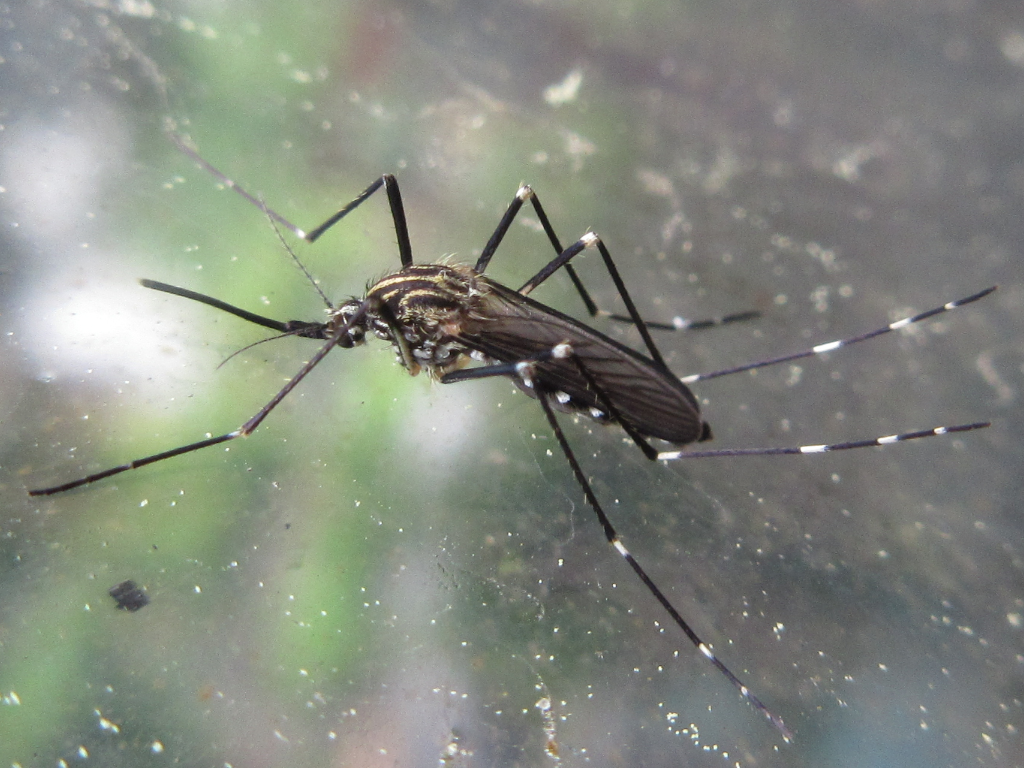
Korean bush mosquito
Aedes koreicus
Aedes koreicus, the Korean bush mosquito is a species of mosquito in the genus Aedes. The adults are relatively large with a black and white pattern on their legs and other body parts. Clear longitudinal lines on the dorsal part of the thorax distinguish it from Ae. aegypti and Ae. albopictus. The species bears close morphological, ecological, and genetic similarity to the Asian bush mosquito, Aedes japonicus, but can be physically distinguished by a pale basal band on the hind tarsomere.
From the article Aedes koreicus on Wikipedia (CC BY-SA), quoted section by section
Range & habitat
Aedes koreicus is native to northeastern China, South Korea, and southern Russia. Its similarity to Ae. japonicus suggests the same potential for invasiveness and tolerance to cooler, temperate climates found at higher altitudes. Transcriptomic and comparative genomic analyses have detected thermal adaptation genes shared between Ae. koreicus and Ae. japonicus but not with other aedines. Cold-resistant dormant eggs allow adults to persist from late summer until autumn seasons and are believed to increase ability to establish populations in cold environments. In 2008, the species was first detected outside of its native range in an industrial area in Maasmechelen, a province of Belgium. The species was first reported in the Belluno province of Italy in 2011, but has since expanded to Genoa and the Lombardy region. Ae. koreicus has been identified in Sochi on the eastern Black Sea coast of Russia, Switzerland, and Slovenia in 2013. The species was found in southern Germany in 2015 and a population was established in western Germany in 2016. The first appearance in Hungary and the southern coast of the Crimean Peninsula was reported in 2016, in Austria in 2018, and the Republic of Kazakhstan in 2021.
Wikipedia: “Distribution and invasiveness”
What it does
Though Aedes koreicus express opportunistic host-feeding behavior, they are known to feed on human blood meals depending on their location. Depending on if they are in an urban, peri-urban, or rural area, will determine which hosts are available to feed on. Aedes koreicus feed on different species based on where they are, and which species is most locally abundant. They feed on other mammals and species such as Roe deer, which are the primary host in forested sites, whereas humans are the primary host in urban areas. Aedes koreicus typically feed on the most abundant and locally available hosts. Their feeding patterns depend on temperature, host availability, and host preference. Aedes koreicus show minimal to no evidence of mixed blood meals, meaning Aedes koreicus does not feed on multiple organisms or species over their lifetime. Aedes koreicus displays the most odd feeding patterns in comparison to the other mosquitoes in their genus. This is because other mosquitos in the Aedes genus are known to have fixed blood meals, and feed on multiple hosts throughout their lives. Aedes Koreicus feed on the most available and locally abundant. There is no singular preference for Aedes Koreicus, while other Aedes mosquitos show evidence of preferred blood meals. …
Wikipedia: “Feeding habits”
Listen
Looking for field recordings…
Where it lives
Recorded sightings
—
geo-referenced records in GBIF, from museums, herbaria and field observers.
Drag the globe to turn it. Dots are where records exist, not a range map; darker means more records.
In the stacks
Searching the stacks…
Every page naming Aedes koreicus in the Biodiversity Heritage Library →
This page is assembled live from iNaturalist, GBIF, Wikipedia, the Source Library and the Internet Archive. It is not yet part of the hand-edited codex. iNaturalist taxon 881668.