- Animals
- ›Arthropods
- ›Hexapods
- ›Insects
- ›Winged and Once-winged Insects
- ›Butterflies and Moths
- ›Hawk, Sphinx, Silk, Emperor, and Allied Moths
- ›Emperor and Giant Silk Moths
- ›Emperor Moths
- ›Bunaeini
- ›Gonimbrasia
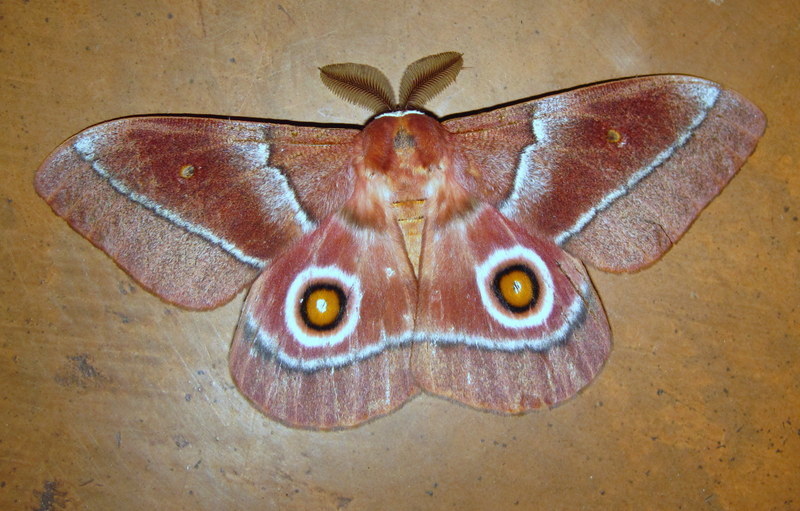
Mopane Worm
Gonimbrasia belina
Gonimbrasia belina is a species of emperor moth which is native to the warmer parts of southern Africa. Its large edible caterpillar, known as the mopane worm, madora, amacimbi, pigeon moth or masonja, feeds primarily but not exclusively on mopane tree leaves. Mopane worms are an important source of protein for many in the region. The species was first scientifically described by John O. Westwood in 1849.
From the article Gonimbrasia belina on Wikipedia (CC BY-SA), quoted section by section
What it does
Like most caterpillars, the mopane worm's life cycle starts when it hatches in the summer, after which it proceeds to eat the foliage in its immediate vicinity. As the larva grows, it moults four times in its five larval stages, after which the mopane worm is considered most desirable for harvesting. Provided that the larva has not been harvested after its fourth moult, it burrows underground to pupate, the stage at which it undergoes complete transformation to become the adult moth. This stage happens over winter, for a duration of 6 to 7 months, whereafter it emerges at the beginning of summer (November or December). The adult moths live only for three to four days, during which time they mate and lay their eggs.
Wikipedia: “Life cycle”
At the table
Mopane worms are hand-picked in the wild, often by women and children. In the bush, the caterpillars are not considered to belong to the landowner (if any), but around a house, permission should be sought from the resident. Chavanduka describes women in Zimbabwe tying a piece of bark to particular trees to establish ownership, or moving the young caterpillars to trees nearer home. When the caterpillar has been picked, it is pinched at the tail end to rupture the innards. The picker then squeezes it like a tube of toothpaste or lengthwise like a concertina, and whips it to expel the slimy, green contents of the gut.
Preserving. The traditional method of preserving mopane worms is to boil them without adding any extra water after washing and adding a significant amount of salt. They are then dried in the sun or smoked, whereby they gain extra flavour. The industrial method is to can the caterpillars (usually in brine). Tins of mopane worms can be found in rural supermarkets and markets around southern Africa.
Eating. Dried mopane worms can be eaten raw as a crisp snack. In Botswana people tend not to eat the head. Alternatively, mopane worms can be soaked to rehydrate, before being fried until they are crunchy, or cooked with onion, tomatoes and spices and then served with pap or sadza. …
Wikipedia: “As food”
Listen
Looking for field recordings…
Where it lives
Recorded sightings
—
geo-referenced records in GBIF, from museums, herbaria and field observers.
Drag the globe to turn it. Dots are where records exist, not a range map; darker means more records.
In the stacks
Searching the stacks…
Every page naming Gonimbrasia belina in the Biodiversity Heritage Library →
This page is assembled live from iNaturalist, GBIF, Wikipedia, the Source Library and the Internet Archive. It is not yet part of the hand-edited codex. iNaturalist taxon 119995.