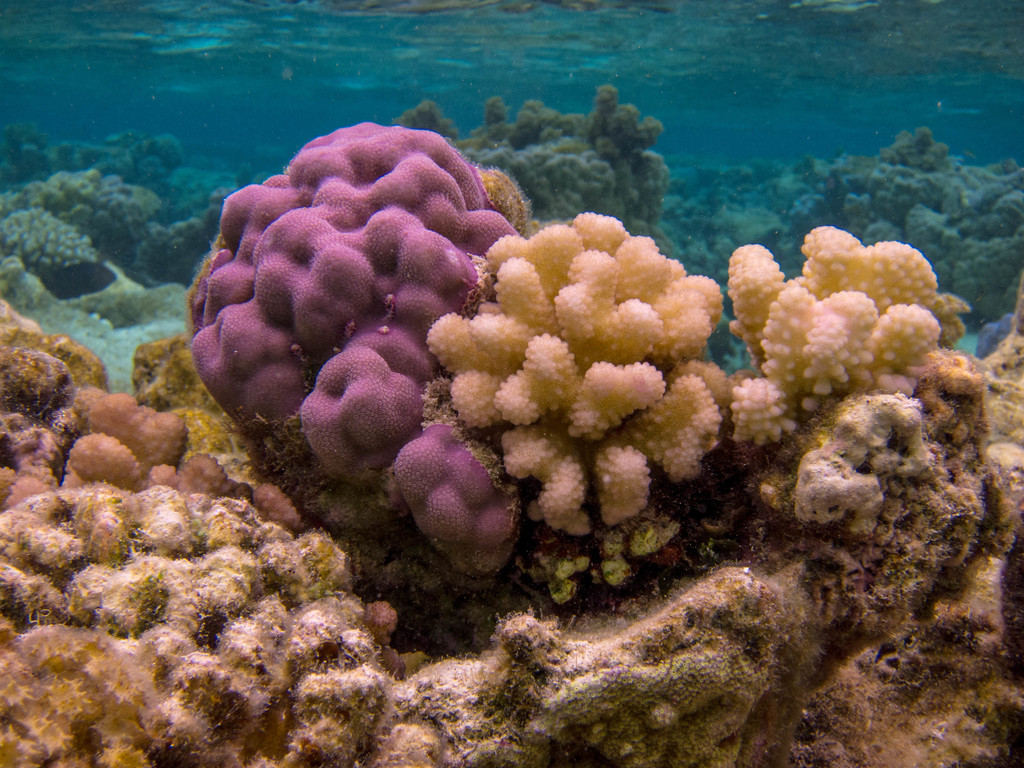
Cauliflower Coral
Pocillopora verrucosa
Pocillopora verrucosa, commonly known as cauliflower coral, rasp coral, or knob-horned coral, is a species of stony coral in the family Pocilloporidae. It is native to tropical and subtropical parts of the Indian and Pacific Oceans.
From the article Pocillopora verrucosa on Wikipedia (CC BY-SA), quoted section by section
Description
Pocillopora verrucosa is a colonial coral and grows into hemispherical clumps up to 30 cm (12 in) in diameter. The branches are 1 to 2 cm (0.4 to 0.8 in) thick and usually have clubbed tips. The surface is covered with large verrucae (wart-like growths) up to 6 mm (0.24 in) high and the corallites (the stony cups from which the polyps emerge) are 1 mm (0.04 in) in diameter. The colour of this coral varies and it may be yellowish-green, pink, brown or bluish-brown. It differs from Pocillopora damicornis in having broader, somewhat flattened, club-tipped branches and by the fact that its verrucae are more evenly sized and spaced.
Range & habitat
Pocillopora verrucosa is native to the tropical and subtropical parts of the Indian and Pacific Oceans. Its wide range extends from East Africa and the Red Sea to Japan, Indonesia, Australia, Hawaii, Easter Island and the western coast of Central America. It is found at depths down to about 54 m (177 ft) but is most common between 1 and 15 m (3 ft 3 in and 49 ft 3 in). It is a common species in most of its range and is found on fringing reefs and moderately-exposed reef fronts but is less tolerant than P. damicornis of sediment and is therefore less common in lagoons.
Wikipedia: “Distribution and habitat”
What it does
A number of predators feed on this coral. These include pufferfishes, parrotfishes and filefishes which feed on the tips of the branches and hermit crabs which scrape the skeletal tissue. Other animals feed on the soft tissues while leaving the skeleton intact including the butterflyfishes, the angelfishes and the damselfish, Stegastes acapulcoensis. Invertebrates which feed on this coral are the crown-of-thorns starfish (Acanthaster planci), Jenner's cowry (Jenneria pustulata), the sea urchin, Eucidaris galapagensis and the coral snails, Coralliophila spp.. Both the starfish and the cowry can kill a mature coral colony by stripping off the living tissue. Pocillopora spp. have several mutualistic symbionts including the crab, Trapezia sp., and certain snapping shrimps which protect it from attack by its major predator, the crown-of-thorns starfish.
Wikipedia: “Ecology”
Where it lives
Recorded sightings
—
geo-referenced records in GBIF, from museums, herbaria and field observers.
Drag the globe to turn it. Dots are where records exist, not a range map; darker means more records.
In the stacks
Searching the stacks…
Every page naming Pocillopora verrucosa in the Biodiversity Heritage Library →
This page is assembled live from iNaturalist, GBIF, Wikipedia, the Source Library and the Internet Archive. It is not yet part of the hand-edited codex. iNaturalist taxon 109875.