 NL·0691
Herbarium of the Nature Library
- Name
- Thunnus albacares
- Family
- Scombridae
- Native to
- Tropical and subtropical seas worldwide except the Mediterranean
- Habitat
- Open ocean (pelagic)
Yellowfin tuna
Thunnus albacares
Also calledAhi (Hawaiian) · Kihada (Japanese) · Rabil (Spanish) · Albacore (French: thon albacore) · Tuna sirip kuning (Indonesian)
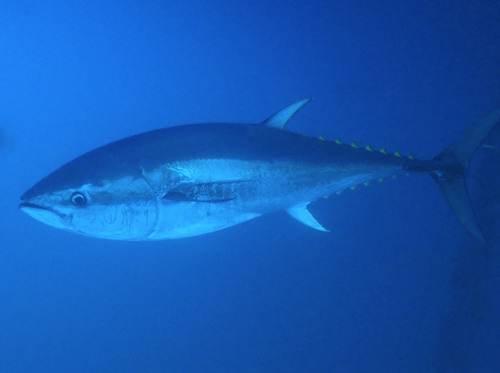
A fast, sleek tropical tuna named for its sickle-shaped golden fins. It is one of the most heavily fished tunas, filling much of the world's canned and sashimi-grade 'ahi'.
The yellowfin tuna is a species of tuna found in pelagic waters of tropical and subtropical oceans worldwide. Wikipedia
What it can do
- iCapable of fast bursts of speed in pursuit of prey
- iiPartially warm-bodied, though less so than bluefin
- iiiSchools with dolphins in the eastern tropical Pacific, a link once exploited by purse-seiners
- ivGathers in huge numbers under floating objects and fish aggregating devices
In the field
Field marks
- aVery long, scythe-like second dorsal and anal fins in large adults
- bBright yellow finlets and a golden lateral stripe
- cLong pectoral fins reaching the second dorsal
- dBelly with alternating broken vertical lines and dots
- Not to be confused with
- Bigeye tuna has a larger eye, plumper body and shorter second dorsal and anal fins; bluefin has short pectorals. Young yellowfin and bigeye are very hard to separate.
- Where to see it
- Offshore sportfishing from Hawaii, Mexico's Revillagigedo Islands, the Maldives and Gulf of Mexico oil rigs
- When
- Year-round in the tropics
Life & habits
- Diet
- Flying fish, squid, small tunas, crustaceans
- Habitat
- Warm surface waters above the thermocline, mostly in the upper 100 m
- Size
- Commonly 1.5 m; up to ~2.4 m and 200 kg
- Lifespan
- About 7–9 years
Forms large schools mixed by size with skipjack and dolphins, and drives baitfish to the surface in feeding frenzies.
Where it lives
Recorded sightings
—
geo-referenced records in GBIF, from museums, herbaria and field observers.
Native range
Tropical and subtropical seas worldwide except the Mediterranean
Drag the globe to turn it. Dots are where records exist, not a range map; darker means more records.
In the old herbals & bestiaries
No plate in the Source Library names this exact species, so these show its closest relatives as the old naturalists drew them: same genus, or the same kind of animal. Click a plate to read the page it came from, with translation.

Commentaries on the Six Books of Dioscorides
Relative · Pietro Andrea Mattioli · 1560 · p.323

Commentaries on the Six Books of Dioscorides on Medical Matter
Relative · Pietro Andrea Mattioli · 1563 · p.308

Commentaries on the Six Books of Pedanius Dioscorides on Medical Matter
Relative · Pietro Andrea Mattioli · 1565 · p.514
In the stacks
Searching the stacks…
Every page naming Thunnus albacares in the Biodiversity Heritage Library →
Marginalia
In Hawaii 'ahi' has long been eaten raw in poke; the US 'dolphin-safe' label of 1990 was born from yellowfin purse-seine fisheries that netted dolphins.
Curiosity
Its species name comes from Portuguese albacora; the same word gave English 'albacore', now the name of a different tuna.
Kinship


Photographs: iNaturalist contributors under the licences shown. Records: GBIF.org. Historical plates: Source Library (CC BY-SA 4.0; originals public domain). Summary text: Nature Library editors and Wikipedia (CC BY-SA). Medicinal and edibility notes are historical and educational, not advice. iNaturalist taxon 69675.