 NL·0690
Herbarium of the Nature Library
- Name
- Scomber scombrus
- Family
- Scombridae
- Native to
- North Atlantic on both sides; Mediterranean and Black seas
- Habitat
- Continental shelf, Open ocean (pelagic)
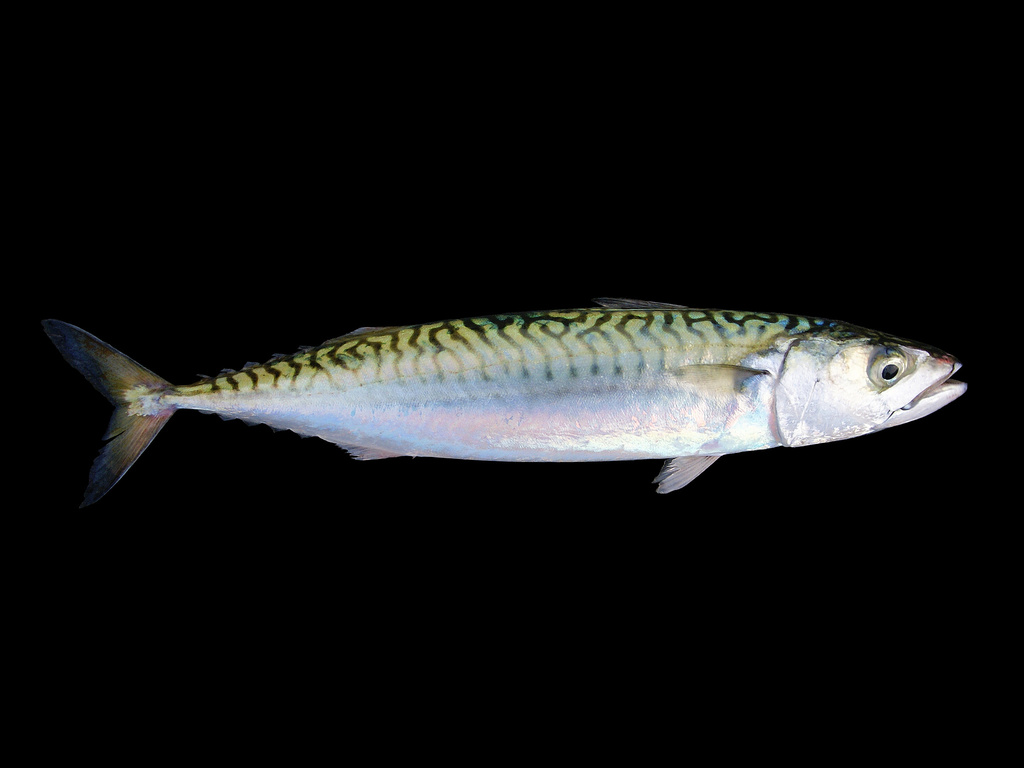
Atlantic mackerel
Scomber scombrus
Also calledCaballa (Spanish) · Maquereau (French) · Makreel (Dutch) · Uskumru (Turkish) · Makrell (Norwegian)
A fast, striped schooling fish of the North Atlantic that lacks a swim bladder and must swim constantly. Its oily flesh is grilled, smoked and canned throughout Europe.
The Atlantic mackerel, also known as Boston mackerel, Norwegian mackerel, Scottish mackerel or just mackerel, is a species of mackerel found in the temperate waters of the Mediterranean Sea, the Black Sea, and the northern Atlantic Ocean, where it is extremely common and occurs in huge shoals in the epipelagic zone down to about 200 m (660 ft). It spends the warmer months close to shore and near the ocean surface, appearing along the coast in spring and departing with the arrival of colder weather in the fall and winter months. During the fall and winter, it migrates out into deeper and more southern water, seeking warmer temperatures. Wikipedia
What it can do
- iHas no swim bladder, so it can change depth rapidly
- iiMigrates in huge schools between spawning and feeding grounds
- iiiA northward shift of its summer feeding range into Icelandic and Faroese waters triggered the 'mackerel war' over quotas from 2010
In the field
Field marks
- aIridescent green-blue back with 20–30 wavy black bars
- bSilvery-white belly without spots
- cTwo well-separated dorsal fins and 5 finlets above and below the tail
- dTorpedo body with small keels on the tail base
- Not to be confused with
- Atlantic chub mackerel (Scomber colias) has dusky spots on the belly and a swim bladder; horse mackerel has a row of bony scutes along the lateral line.
- Where to see it
- Cornwall, Brittany and Norwegian coasts in summer; Gulf of Maine
- When
- Inshore summer visitor in northern Europe, roughly May–Sep
Life & habits
- Diet
- Zooplankton, krill, small fish
- Habitat
- Shelf waters in the upper 200 m
- Size
- Usually 30 cm; up to 60 cm
- Lifespan
- Up to about 20 years
Overwinters in deeper water and moves inshore in summer, where schools drive baitfish to the surface.
Where it lives
Recorded sightings
—
geo-referenced records in GBIF, from museums, herbaria and field observers.
Native range
North Atlantic on both sides; Mediterranean and Black seas
Drag the globe to turn it. Dots are where records exist, not a range map; darker means more records.
In the old herbals & bestiaries
Woodcuts and engravings matched from the Source Library’s scanned books by name. Plates marked “relative” show a close kin rather than this exact species. Click a plate to read the page it came from, with translation.

Worksop Bestiary
Anonymous · 1185 · p.89

History of Animals, Book II: On Oviparous Quadrupeds
Conrad Gessner · 1586 · p.475

History of Animals, Book I: On Viviparous Quadrupeds
Conrad Gessner · 1554 · p.48

De Indiae utriusque re naturali et medica
Willem Piso · 1658 · p.462

Books on Marine Fishes
Guillaume Rondelet · 1554 · p.255

History of Animals, Book II: On Oviparous Quadrupeds
Conrad Gessner · 1586 · p.44

Ten Books of Exotic Things
Carolus Clusius · 1605 · p.394
In the stacks
Searching the stacks…
Every page naming Scomber scombrus in the Biodiversity Heritage Library →
Marginalia
In 17th-century London mackerel was allowed to be sold on Sundays because it spoils so fast; Cornish handline fishing for mackerel is centuries old.
Curiosity
The phrase 'mackerel sky' for rippled cirrocumulus clouds comes from the fish's barred back.
Kinship



Photographs: iNaturalist contributors under the licences shown. Records: GBIF.org. Historical plates: Source Library (CC BY-SA 4.0; originals public domain). Summary text: Nature Library editors and Wikipedia (CC BY-SA). Medicinal and edibility notes are historical and educational, not advice. iNaturalist taxon 118678.