 NL·0559
Herbarium of the Nature Library
- Name
- Numida meleagris
- Family
- Numididae
- Native to
- Sub-Saharan Africa; introduced and domesticated widely
- Habitat
- Savanna, Grassland, Farmland
On eBird ↗
Helmeted Guineafowl
Live sightings near you, the range map, bar charts of when it is seen, and Macaulay Library photos and recordings.
Helmeted guineafowl
Numida meleagris
Also calledKanga (Swahili) · Impangele (Zulu) · Gewone tarentaal (Afrikaans) · Pintade de Numidie (French) · Gallina de Guinea (Spanish)
A noisy, polka-dotted gamebird with a bony casque, living in flocks across African savanna. Domesticated in Africa and carried to Europe and the Americas, it is now kept and eaten worldwide.
The helmeted guinea fowl is the best known of the guinea fowl bird family, Numididae, and the only member of the genus Numida. It is native to Africa, mainly south of the Sahara, and has been widely introduced, as a domesticated species, into the West Indies, North America, Colombia, Brazil, Australia and Europe. Wikipedia
What it can do
- iEats ticks and insects, and is kept on farms partly for pest control
- iiFlocks raise loud alarms that warn other animals of predators
- iiiCan run fast and roosts in trees at night
In the field
Field marks
- aSlate-grey plumage covered in white spots
- bBony, horn-coloured casque on top of the head
- cBare blue and red head with wattles
- dRounded, humped body
- Voice
- A harsh, grating 'kek-kek-kek-krrrr' alarm and a rhythmic 'buck-wheat' call; flocks are very noisy.
- Not to be confused with
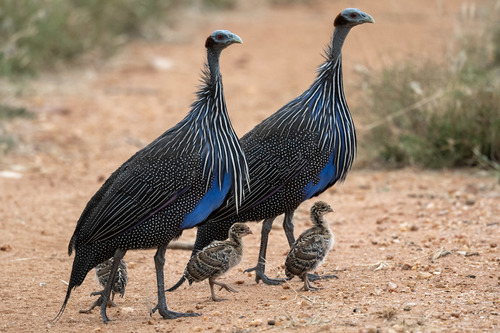
- Crested guineafowl has a curly black crest instead of a casque. Vulturine guineafowl has a long, slim body, cobalt breast and a bare head with no casque.
- Where to see it
- Almost any savanna reserve in East and southern Africa; Kruger, Serengeti, Etosha
- When
- Resident year-round
Listen
Looking for field recordings…
Life & habits
- Diet
- Seeds, bulbs, insects, ticks, snails
- Habitat
- Savanna, grassland, farmland and scrub
- Size
- 53–58 cm; 1.3 kg
Flocks of dozens or even hundreds walk in long lines, calling raucously; they flee by running rather than flying.
Where it lives
Recorded sightings
—
geo-referenced records in GBIF, from museums, herbaria and field observers.
Native range
Sub-Saharan Africa; introduced and domesticated widely
Drag the globe to turn it. Dots are where records exist, not a range map; darker means more records.
In the old herbals & bestiaries
No plate in the Source Library names this exact species, so these show its closest relatives as the old naturalists drew them: same genus, or the same kind of animal. Click a plate to read the page it came from, with translation.


In the stacks
Searching the stacks…
Every page naming Numida meleagris in the Biodiversity Heritage Library →
Marginalia
Greek myth said the sisters of the hero Meleager wept for him and were turned into guineafowl, their tears becoming the white spots, hence 'meleagris'. Romans knew it as the Numidian hen.
Curiosity
The turkey's genus name Meleagris was borrowed from the classical name of the guineafowl, a legacy of early European confusion between the two birds.
Kinship

Photographs: iNaturalist contributors under the licences shown. Records: GBIF.org. Historical plates: Source Library (CC BY-SA 4.0; originals public domain). Summary text: Nature Library editors and Wikipedia (CC BY-SA). Medicinal and edibility notes are historical and educational, not advice. iNaturalist taxon 1428.