 NL·0701
Herbarium of the Nature Library
- Name
- Aptenodytes forsteri
- Family
- Spheniscidae
- Native to
- Coast and sea ice of Antarctica
- Habitat
- Sea ice, Southern Ocean
On eBird ↗
Emperor Penguin
Live sightings near you, the range map, bar charts of when it is seen, and Macaulay Library photos and recordings.
Emperor penguin
Aptenodytes forsteri
Also calledPingüino emperador (Spanish) · Manchot empereur (French) · Dì qǐ'é (Chinese) · Kaiserpinguin (German)
The largest penguin, and the only animal that breeds on Antarctic sea ice through the polar winter. Males incubate a single egg on their feet for about two months without eating.
The emperor penguin is the tallest and heaviest of all living penguin species and is endemic to Antarctica. The male and female are similar in plumage and size, reaching 100 cm (39 in) in length and weighing from 22 to 45 kg. Feathers of the head and back are black and sharply delineated from the white belly, pale-yellow breast and bright-yellow ear patches. Wikipedia
What it can do
- iDives to over 500 m (record 564 m) and holds its breath over 27 minutes
- iiMales fast for up to ~115 days during courtship and incubation
- iiiHuddles of thousands rotate so each bird takes turns in the warm centre
- ivSurvives temperatures below −40 °C and winds over 140 km/h
In the field
Field marks
- aLargest penguin, up to about 1.2 m tall
- bBlack head and back, white belly
- cPale yellow ear patches fading into a whitish upper breast
- dPinkish-orange stripe on the lower bill
- Voice
- Loud, trumpeting contact calls; each bird's call is individually recognisable
- Not to be confused with
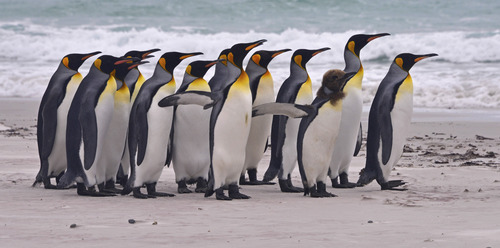
- King penguin is smaller and slimmer with bright orange, comma-shaped ear patches that are enclosed in black.
- Where to see it
- Snow Hill Island colony in the Weddell Sea (by icebreaker and helicopter) and Atka Bay; rarely reached by tourists
- When
- Breeds through the Antarctic winter; chicks visible Oct–Dec
Listen
Looking for field recordings…
Life & habits
- Diet
- Fish, krill and squid
- Habitat
- Fast sea ice around Antarctica; forages in open water
- Size
- Up to 1.2–1.3 m; 22–45 kg
- Lifespan
- Around 20 years
In the dark of winter, males huddle in tight masses, shuffling so that no bird stays on the cold edge for long.
Where it lives
Recorded sightings
—
geo-referenced records in GBIF, from museums, herbaria and field observers.
Native range
Coast and sea ice of Antarctica
Drag the globe to turn it. Dots are where records exist, not a range map; darker means more records.
In the old herbals & bestiaries
No plate in the Source Library names this exact species, so these show its closest relatives as the old naturalists drew them: same genus, or the same kind of animal. Click a plate to read the page it came from, with translation.


In the stacks
Searching the stacks…
Every page naming Aptenodytes forsteri in the Biodiversity Heritage Library →
Marginalia
In 1911 Edward Wilson, Apsley Cherry-Garrard and Henry Bowers made 'the worst journey in the world' in Antarctic winter to collect emperor eggs at Cape Crozier.
Curiosity
Satellite images of the brown guano stains on ice have revealed previously unknown colonies.
Kinship
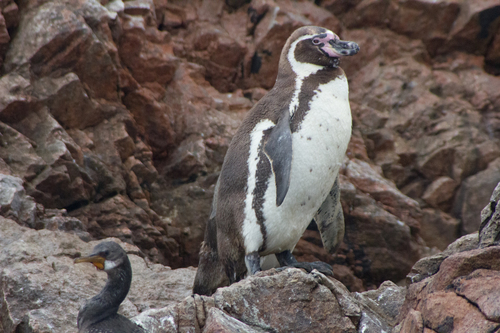

Photographs: iNaturalist contributors under the licences shown. Records: GBIF.org. Historical plates: Source Library (CC BY-SA 4.0; originals public domain). Summary text: Nature Library editors and Wikipedia (CC BY-SA). Medicinal and edibility notes are historical and educational, not advice. iNaturalist taxon 3820.