- Plants
- ›Vascular Plants
- ›flowering plants
- ›monocots
- ›Agaves, Orchids, Irises, and Allies
- ›Orchids
- ›Orchidoid Orchids
- ›Orchideae
- ›Orchidinae
- ›Orchis
- ›Orchis
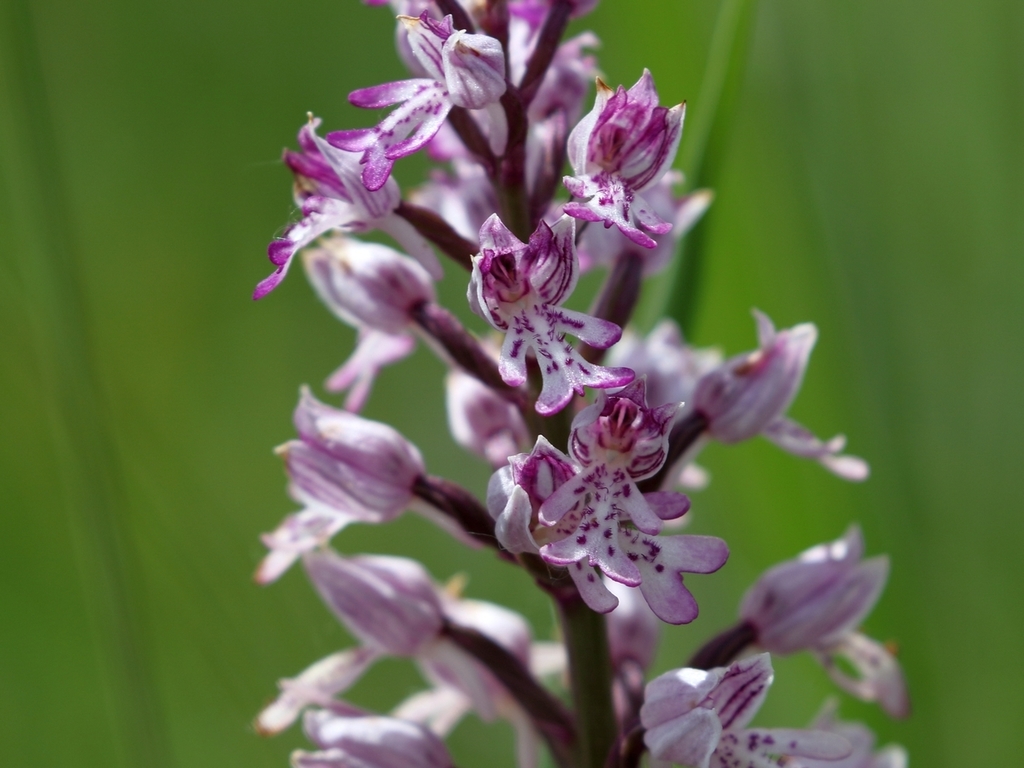
Military Orchid
Orchis militaris
Orchis militaris, the military orchid, is a species of orchid native to Europe. It is the type species of the genus Orchis.
From the article Orchis militaris on Wikipedia (CC BY-SA), quoted section by section
Description
This plant grows to a height of 20 to 50 cm with a robust stem with rather drawn up oblong basal leaves. The inflorescence forms a purplish dense cone consisting of from 10 to 40 flowers. In each flower the sepals and side petals are gathered together to form a pointed "helmet" (whence it gets its name), a lilac colour outside and a veined purple colour inside. The central tongue finishes in two lobes separated by a tooth. Depending on the location, it flowers from April to June.
Range & habitat
It is well distributed around Europe, reaching as far north as southern Sweden, but rather rare in the Mediterranean areas. It extends east across the Palearctic to Siberia. It prefers full light on a dry calcareous substrate, for example, unfertilized lawns, meadows, edges and light woods up to 2000 m in altitude. It is extremely rare in Britain and a protected species, occurring only at the Rex Graham nature reserve in Suffolk and the Chiltern Hills in Buckinghamshire.
Wikipedia: “Distribution and habitat”
At the table
Orchis militaris contains the nutritious polysaccharide glucomannan, and is one of the original species of orchid whose ground-up roots are used to make the drink salep.
Wikipedia: “Uses”
Where it lives
Recorded sightings
—
geo-referenced records in GBIF, from museums, herbaria and field observers.
Drag the globe to turn it. Dots are where records exist, not a range map; darker means more records.
In the old herbals & bestiaries

In the stacks
Searching the stacks…
Every page naming Orchis militaris in the Biodiversity Heritage Library →
This page is assembled live from iNaturalist, GBIF, Wikipedia, the Source Library and the Internet Archive. It is not yet part of the hand-edited codex. iNaturalist taxon 131605.