
Orchids
Orchidaceae
Orchids are plants that belong to the family Orchidaceae (), a diverse and widespread group of flowering plants with blooms that are often colourful and fragrant. Orchids are cosmopolitan plants, living in diverse habitats on every continent except Antarctica. The world's richest diversity of orchid genera and species is in the tropics. Many species are epiphytes, living on trees. The flowers and their pollination mechanisms are highly specialized, attracting insect pollinators by colour, pattern, scent, pheromones, and sometimes by mimicking female insects. Orchids have very small seeds, relying on fungal partners for germination. Some orchids have no leaves, either photosynthesizing with their roots or relying entirely on fungal partners for food.
Orchidaceae is one of the two largest families of flowering plants. It contains about 28,000 currently accepted species in around 700 genera. That represents some 6–11% of all species of seed plants. Horticulturists run many orchid societies around the world; they have produced many hybrids and cultivars.
6 branches of this family, most-observed first

Orchidoid Orchids
subfamilyOrchidoideae

Lower Epidendroid Orchids
subfamilyEpidendroideae

Higher Epidendroid Orchids
subfamilyVandoideae

Slipper Orchids
subfamilyCypripedioideae

Pogonias and vanilla orchids
subfamilyVanilloideae
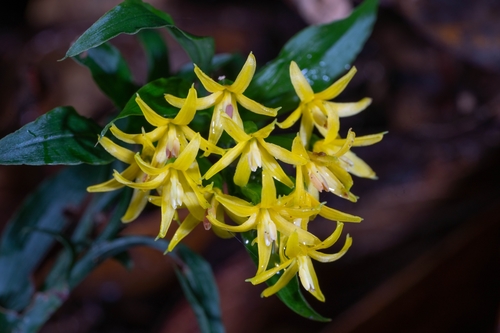
Apostasioid Orchids
subfamilyApostasioideae
Where it lives
Recorded sightings
—
geo-referenced records in GBIF, from museums, herbaria and field observers.
Drag the globe to turn it. Dots are where records exist, not a range map; darker means more records.
In the old herbals & bestiaries

In the stacks
Searching the stacks…
Every page naming Orchidaceae in the Biodiversity Heritage Library →
This page is assembled live from iNaturalist, GBIF, Wikipedia, the Source Library and the Internet Archive. It is not yet part of the hand-edited codex. iNaturalist taxon 47217.