- Plants
- ›Vascular Plants
- ›flowering plants
- ›monocots
- ›Agaves, Orchids, Irises, and Allies
- ›Orchids
- ›Lower Epidendroid Orchids
- ›Neottieae
- ›Neottia
- ›Listera
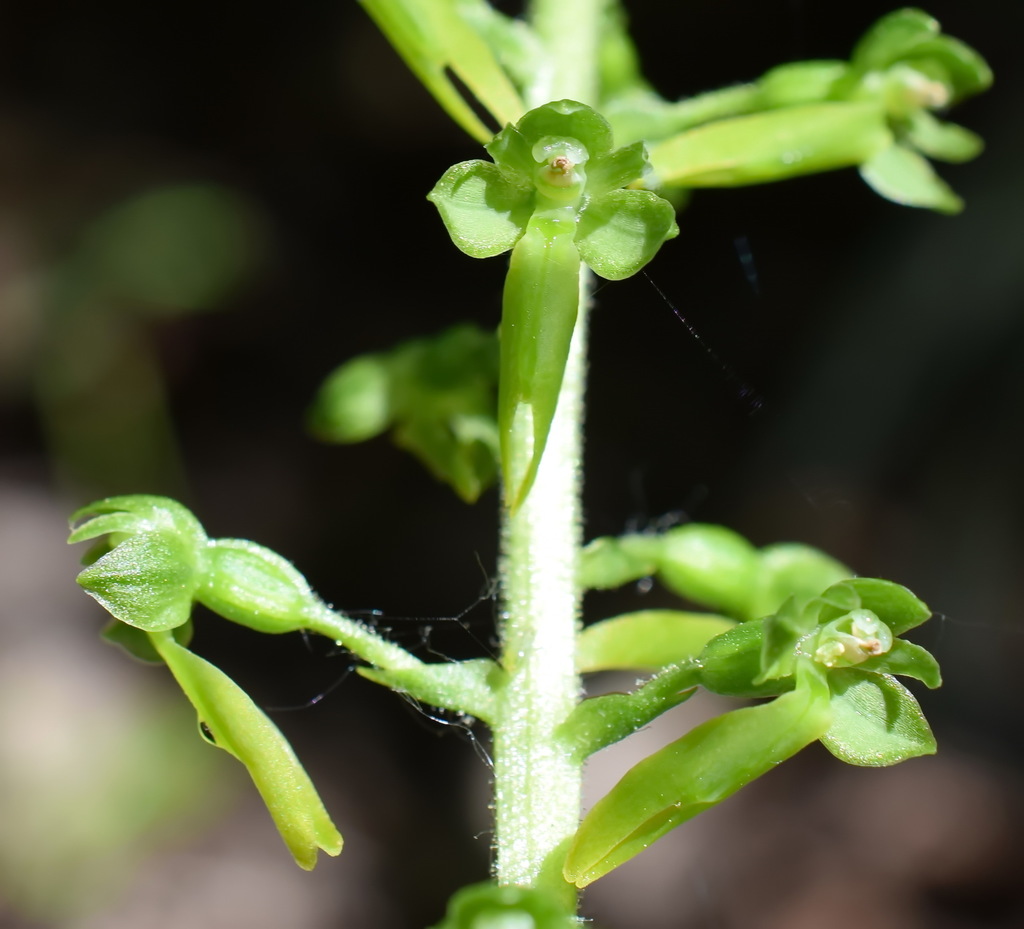
Common Twayblade
Neottia ovata
Neottia ovata (formerly Listera ovata), the common twayblade or eggleaf twayblade, is a terrestrial orchid widespread across much of Europe and Asia.
From the article Neottia ovata on Wikipedia (CC BY-SA), quoted section by section
Description
The flowering stems are typically 20–60 cm (7.9–23.6 in) tall, occasionally up to 75 cm (30 in). There are two large opposite basal leaves, 5–20 cm (2.0–7.9 in) long. A variable number of flowers is borne on the stems, usually more than 15 but less than 100. The flowers are small and yellowish-green in colour. The sepals and the two side petals form a fairly open hood, 5–6 mm (0.2 in) long; the labellum or lip (the central petal) is 7–15 mm (0.3–0.6 in) long and is divided at the end into two lobes. Due to its slender profile, small flowers and green colour this species can be hard to spot.
Range & habitat
Found across much of Europe including the British Isles, as well as Siberia, Central Asia, Southwest Asia and the Himalayas. It has been introduced into Ontario, Canada, where it has been called the eggleaf twayblade. Neottia ovata grows in a variety of habitats: woods, meadows, dune-slacks and moorland.
Wikipedia: “Distribution and habitat”
What it does
The flower of Neottia ovata is well accessible for a wide range of insects. It is above all pollinated by parasitic wasps, sawflies and beetles. The pollinia lie free on top of the gutter-shaped rostellum, an organ that is filled with viscid fluid. When an insect touches the sensitive tip of the rostellum, the viscid fluid is ejected and glues the pollinia to the visitor's body. Fruit set is quite high. Over 60 species of mycorrhizal fungi have been indicated to form associations with N. ovata.
Neottia ovata is one of the most common European orchid species, and this is partially explained by it being less species-selective both in terms of pollinators and mycorrhizal partners. It is also an inconspicuous species, blending in to vegetation, which saves it from being picked by humans, a fate endangering many of the showier orchid species. Despite its relative success, there is evidence that populations are declining.
Wikipedia: “Ecology”
Where it lives
Recorded sightings
—
geo-referenced records in GBIF, from museums, herbaria and field observers.
Drag the globe to turn it. Dots are where records exist, not a range map; darker means more records.
In the old herbals & bestiaries

In the stacks
Searching the stacks…
Every page naming Neottia ovata in the Biodiversity Heritage Library →
This page is assembled live from iNaturalist, GBIF, Wikipedia, the Source Library and the Internet Archive. It is not yet part of the hand-edited codex. iNaturalist taxon 341154.