- Plants
- ›Vascular Plants
- ›flowering plants
- ›Dicots
- ›Nances, Willows, and Allies
- ›Passionfruit Family
- ›Turneroideae
- ›Turnera
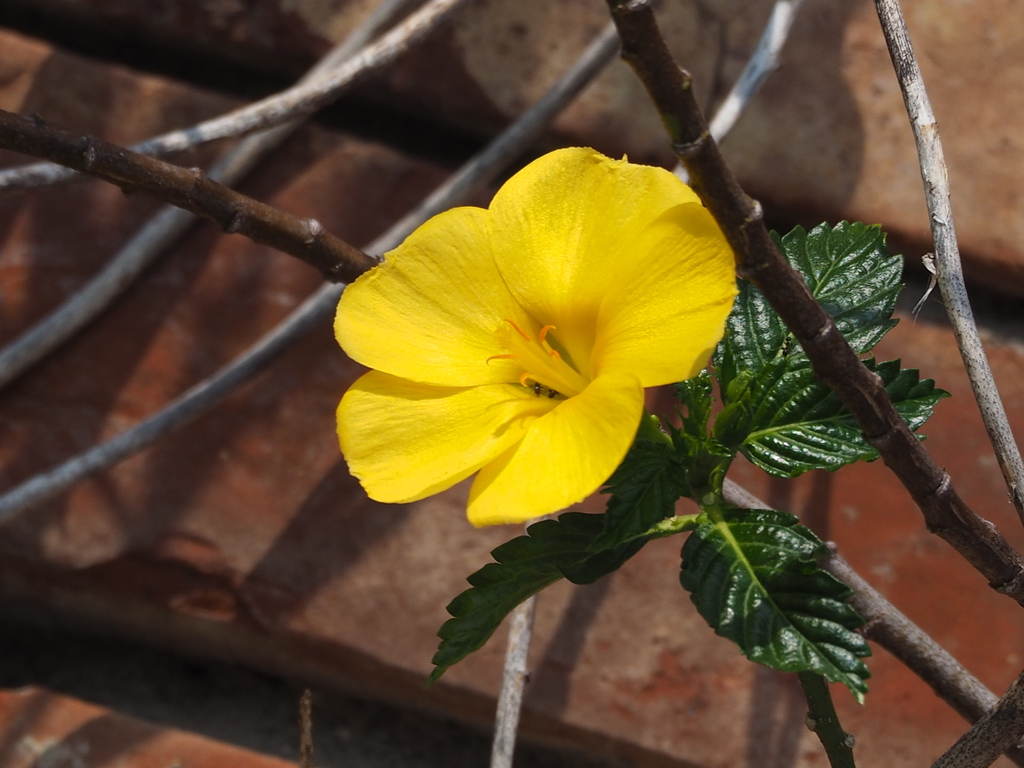
Yellow alder
Turnera ulmifolia
Turnera ulmifolia, commonly known as the ramgoat dashalong, yellow alder, Cuban buttercup or West Indian holly, is a species of flowering plant in the family Passifloraceae. It is native to Mexico, Central America, the Caribbean, and parts of northern South America and southern Florida. The plant is widely cultivated as an ornamental in tropical and subtropical regions, and has become naturalized worldwide.
The species is sometimes confused with the closely related Turnera diffusa (damiana), leading to misidentification in horticultural and herbal trade.
From the article Turnera ulmifolia on Wikipedia (CC BY-SA), quoted section by section
Description
Turnera ulmifolia is a perennial subshrub or small shrub that typically grows 0.5–1.5 m tall. The stems are erect and become woody at the base with age. The leaves are alternate, elliptic to lanceolate, and usually 2–10 cm long, with serrated margins and a slightly rough surface. The plant produces solitary bright yellow flowers in the leaf axils. Each flower has five petals and five sepals, with numerous stamens surrounding the central pistil. The flowers are short-lived: they typically open early in the morning around sunrise and wilt or close by midday, lasting only a few hours. The fruit is a small capsule containing several seeds which are released when the capsule splits open at maturity.
Range & habitat
The native range of Turnera ulmifolia extends from Mexico and Central America through the Caribbean to northern South America and southern Florida. The species commonly grows in open, sunny habitats including roadsides, coastal scrub, disturbed areas, grasslands, and forest clearings. It tolerates poor soils and drought conditions and can grow in cracks of pavement, walls, and rocky substrates. Due to its ornamental use, it has been introduced and naturalized in tropical regions worldwide, including parts of Africa, Asia, and the Pacific islands.
Wikipedia: “Distribution and habitat”
What it does
The flowers provide nectar for a variety of pollinators including bees and butterflies. The plant is capable of self-pollination but also benefits from insect pollination. Larvae of certain butterflies, including the tawny coster (Acraea terpsicore), feed on the leaves. Seeds may be dispersed by ants and other insects that collect and transport them from fallen fruits, aiding the plant’s spread in suitable habitats.
Wikipedia: “Ecology”
In medicine
Phytochemical studies of Turnera ulmifolia have identified flavonoids, alkaloids, tannins, and other polyphenols.
Wikipedia: “Phytochemistry”
How it is grown
Turnera ulmifolia is widely cultivated as an ornamental shrub due to its bright yellow flowers, drought tolerance, and ability to bloom for long periods in warm climates. It grows best in full sun and well-drained soils and is easily propagated by seeds or cuttings. Because it readily self-seeds and tolerates disturbed environments, it can escape cultivation and become naturalized.
Wikipedia: “Cultivation”
Where it lives
Recorded sightings
—
geo-referenced records in GBIF, from museums, herbaria and field observers.
Drag the globe to turn it. Dots are where records exist, not a range map; darker means more records.
In the old herbals & bestiaries

In the stacks
Searching the stacks…
Every page naming Turnera ulmifolia in the Biodiversity Heritage Library →
This page is assembled live from iNaturalist, GBIF, Wikipedia, the Source Library and the Internet Archive. It is not yet part of the hand-edited codex. iNaturalist taxon 170055.