- Plants
- ›Vascular Plants
- ›flowering plants
- ›Dicots
- ›Nances, Willows, and Allies
- ›Red Mangrove Family
- ›Rhizophora
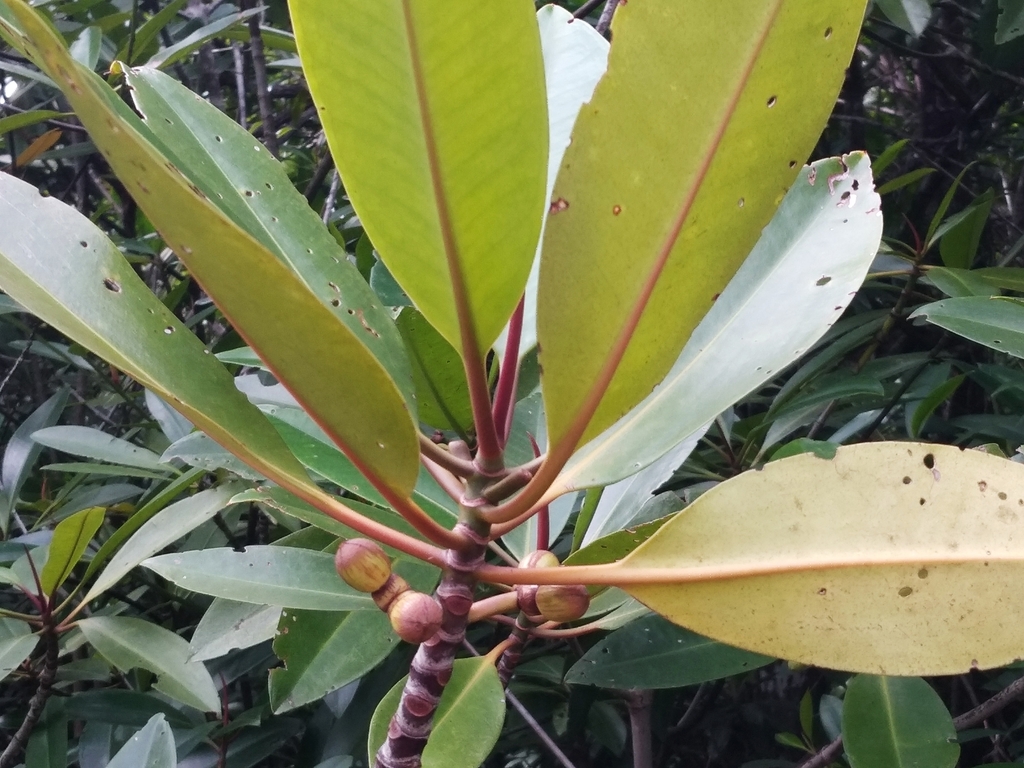
Tall-stilt Mangrove
Rhizophora apiculata
The tall-stilt mangrove (Rhizophora apiculata) is a species of flowering plant distributed throughout Southeast Asia and the western Pacific islands.
It is located exclusively in the mangrove ecosystem due to an affinity to wet, muddy and silty sediments. Due to the high salt concentrations of the soils in these environments, it has mechanisms (ultrafiltration) in place to reduce the likely impacts associated with increased salt in plant physiology (drying plant material down causing increased evapotranspiration). Rhizophora apiculata and R. mucronata are used to make charcoal in the charcoal kilns of Kuala Sepetang in Perak, Malaysia. Rhizophora apiculata is used within mangrove plantation specifically for wood, and charcoal production in many parts of Thailand.
From the article Rhizophora apiculata on Wikipedia (CC BY-SA), quoted section by section
Description
The shrub size depends on geographical factors (climate and soil specifically). On average a mature R. apiculata shrub reaches between 5–8 metres in height although it has the potential to reach up to 30–40 metres.
Trunk. The dimensions of the trunk depend on the age of the plant. When mature, the diameter reach 50 cm, and is typically dark grey. The trunk size is highly dependent on the nutrients within the soil as they will be the underlying factor for growth since water is not usually a limiting factor in its habitats.
Leaves. The openings established by the cork warts enable a pathway for air to be trapped within the aerenchyma that is then stored. The air after being stored is heated by the sun causing the air to expand and enlarge the leaf. Aerenchyma in plants are integral for growth and functionality alongside enabling roots to function in 'oxygen deprived' (anoxic) substrates. Differences in morphology between R. apiculata with vs. without cork warts can have an effect in light intake and growth potential. These differences were originally thought to be exclusive to R. apiculata. However, R. racemosa have also shown this trait. The distribution of R. apiculata plays a role in whether this adaptation will be present or not. Plants in regions north and west of the New Guinea coast have this trait, while south and east of the New Guinea coast do not.
Roots. R. …
Range & habitat
R. apiculata is found within the mangrove ecosystem; a unique and complex location known for its humid climate, saline environment, waterlogged soils and capable of tolerating salinity ranging from 2-90%.
Wikipedia: “Habitat”
At the table
R. apiculata has a wide range of commercial uses due to its availability and quality of timber. Currently there are plantations preexisting that allow for R. apiculata to be farmed and transformed into charcoal; resulting in renewable energy alongside potential income sources.
Wikipedia: “Commercial uses”
Where it lives
Recorded sightings
—
geo-referenced records in GBIF, from museums, herbaria and field observers.
Drag the globe to turn it. Dots are where records exist, not a range map; darker means more records.
In the stacks
Searching the stacks…
Every page naming Rhizophora apiculata in the Biodiversity Heritage Library →
This page is assembled live from iNaturalist, GBIF, Wikipedia, the Source Library and the Internet Archive. It is not yet part of the hand-edited codex. iNaturalist taxon 196660.