 NL·0676
Herbarium of the Nature Library
- Name
- Salvelinus alpinus
- Family
- Salmonidae
- Native to
- Circumpolar Arctic and subarctic: Canada, Alaska, Greenland, Iceland, Scandinavia and Arctic Russia; relict lake populations in the Alps, Britain and Ireland
- Habitat
- Arctic lakes, Cold rivers, Coastal Arctic waters
Arctic char
Salvelinus alpinus
Also calledIqaluk (Inuktitut) · Røye (Norwegian) · Röding (Swedish) · Bleikja (Icelandic) · Saibling (German) · Torgoch (Welsh)
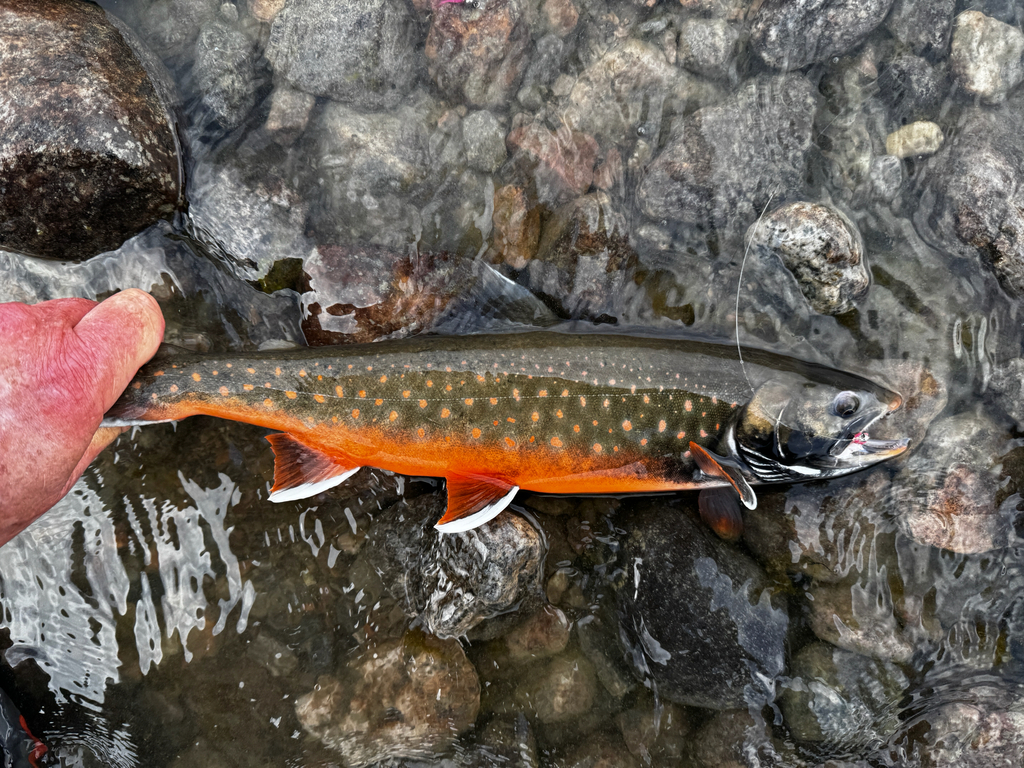
The most northerly freshwater fish on Earth, found in High Arctic lakes and rivers around the pole and as Ice Age relics in deep mountain lakes farther south. Spawning males turn a startling fiery red.
The Arctic char or Arctic charr is a cold-water fish in the family Salmonidae, native to alpine lakes, as well as Arctic and subarctic coastal waters in the Holarctic. It is the world's most northerly freshwater fish. Some populations are anadromous. Wikipedia
What it can do
- iLives in lakes that stay ice-covered for most of the year and stay close to 0 °C
- iiAnadromous populations feed at sea in the brief Arctic summer and return to fresh water for winter
- iiiA single lake can hold several distinct forms (dwarf, plankton-eating, fish-eating), as in Iceland's Thingvallavatn
In the field
Field marks
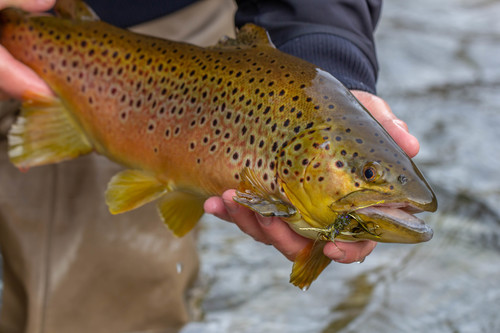
- aDark green-grey to blue back with pale pink, cream or red spots (no black spots)
- bSpawning males: belly and lower flanks bright red or orange
- cPectoral, pelvic and anal fins with a crisp white leading edge
- dSlightly forked tail; small scales
- Not to be confused with
- Brook trout (S. fontinalis) has pale worm-like markings on the back and red spots with blue halos. Lake trout (S. namaycush) is grey with pale spots, a deeply forked tail and no red belly. Dolly Varden (S. malma) is very similar and is separated by gill-raker counts and range.
- Where to see it
- Nunavut rivers (Cambridge Bay, Kugluktuk); Iceland's Thingvallavatn; Windermere (England); Swiss and Austrian alpine lakes
- When
- Anadromous runs to sea after ice-out (June–July) and back upriver in August–September; spawns September–October
Life & habits
- Diet
- Carnivore: zooplankton, insect larvae, snails, crustaceans and fish, including other char
- Habitat
- Cold, deep, clear lakes and rivers; coastal waters near river mouths
- Size
- Commonly 30–60 cm; sea-run fish to about 1 m and 15 kg
- Lifespan
- Often 10–20 years; some High Arctic fish over 40
Sea-run char move downriver after ice-out to feed in coastal waters, then swim back up in late summer to winter and spawn in lakes.
Where it lives
Recorded sightings
—
geo-referenced records in GBIF, from museums, herbaria and field observers.
Native range
Circumpolar Arctic and subarctic: Canada, Alaska, Greenland, Iceland, Scandinavia and Arctic Russia; relict lake populations in the Alps, Britain and Ireland
Drag the globe to turn it. Dots are where records exist, not a range map; darker means more records.
In the old herbals & bestiaries
Woodcuts and engravings matched from the Source Library’s scanned books by name. Plates marked “relative” show a close kin rather than this exact species. Click a plate to read the page it came from, with translation.

Books on Marine Fishes
Guillaume Rondelet · 1554 · p.801

Mark Catesby — Piscium, serpentum, insectorum (pt. 1) (1750)
Mark Catesby · 1750 · p.10

Books on Marine Fishes
Guillaume Rondelet · 1554 · p.801

History of Animals, Book II: On Oviparous Quadrupeds
Conrad Gessner · 1586 · p.712

De Piscibus Libri V et De Cetis Liber Unus
Ulisse Aldrovandi · 1661 · p.709

The natural history of Carolina, Florida, and the Bahama Islands : containing two hundred a...
Catesby, Mark, bioloog, kunstenaar · 1743 · p.12
In the stacks
Searching the stacks…
Every page naming Salvelinus alpinus in the Biodiversity Heritage Library →
Marginalia
Char from Windermere were potted in butter and sent to London as a delicacy in the 17th and 18th centuries, served in painted 'char dishes'. Inuit communities fish char with leisters (three-pronged spears) at stone weirs, called saputit, that are still used today.
Curiosity
Lake Hazen on Ellesmere Island, at about 82° N, holds char and is one of the most northerly lakes in the world with fish.
Kinship


Photographs: iNaturalist contributors under the licences shown. Records: GBIF.org. Historical plates: Source Library (CC BY-SA 4.0; originals public domain). Summary text: Nature Library editors and Wikipedia (CC BY-SA). Medicinal and edibility notes are historical and educational, not advice. iNaturalist taxon 111974.