- Animals
- ›Arthropods
- ›Hexapods
- ›Insects
- ›Winged and Once-winged Insects
- ›Butterflies and Moths
- ›Butterflies
- ›Brush-footed Butterflies
- ›Checkerspots, Anglewings, Peacocks, and Allies
- ›Checkerspots
- ›Euphydryas
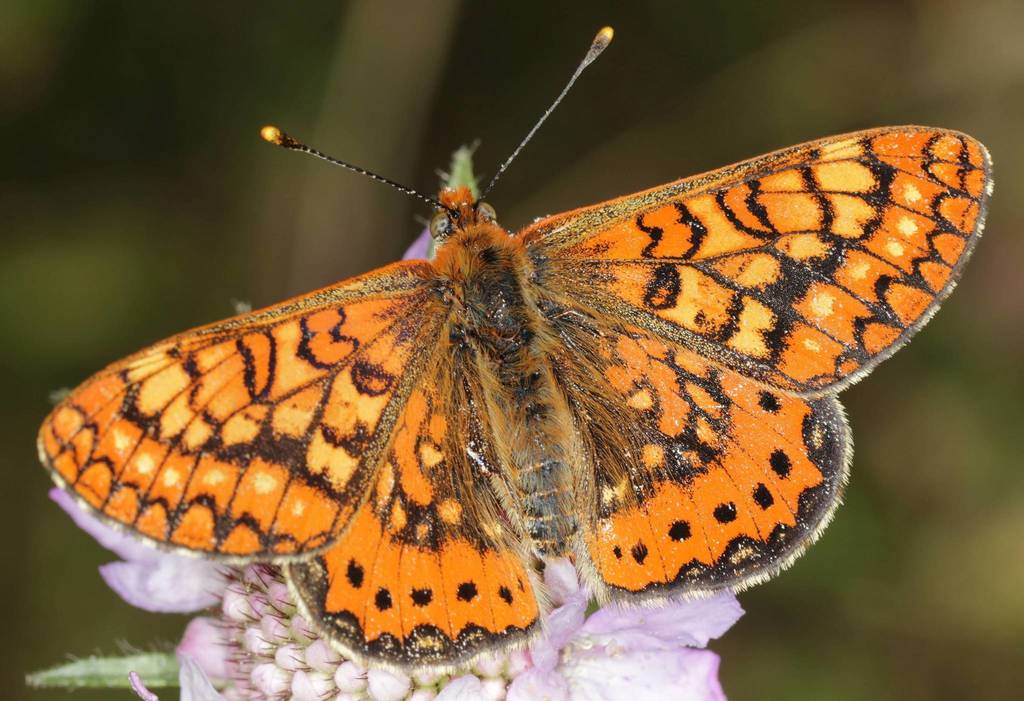
Marsh Fritillary
Euphydryas aurinia
The marsh fritillary (Euphydryas aurinia) is a butterfly of the family Nymphalidae. Commonly distributed in the Palearctic region, the marsh fritillary's common name derives from one of its several habitats, marshland. The prolonged larval stage lasts for approximately seven to eight months and includes a period of diapause over the winter. The larvae are dependent on the host food plant Succisa pratensis not only for feeding but also for hibernation, because silken webs are formed on the host plant as the gregarious larvae enter hibernation. Females lay eggs in batches on the host plant and are, like other batch-layers, selective about the location of oviposition because offspring survivorship levels for batch-layers are more tied to location selection than they are for single-egg layers.
As of 2019 the butterfly's global conservation status is considered of least concern, but it has faced rapid decline and is considered regionally vulnerable or endangered over much of its range.
From the article Marsh fritillary on Wikipedia (CC BY-SA), quoted section by section
Description
Euphydryas aurinia has a wingspan of 30–42 millimetres (1.2–1.7 in) in males. The females are usually larger than the males, with a wingspan of 40–50 millimetres (1.6–2.0 in). These small butterflies are variable in markings and colouration, with many forms and subspecies. The adult butterflies usually show a chequered pattern of brown, orange, and yellow markings. Silver markings are present on the hindwing edge. The underside of the wings is patterned with yellow, orange, and brown without any silver colouration at all. The eggs are yellow, and easily identified because of the large batch size. The larvae are black.
Range & habitat
This species is widespread in the Palearctic realm, from Ireland in the west to Yakutia in the east, and to north-west China and Mongolia in the south. The marsh fritillary is in decline in Europe and it is one of eleven butterflies covered by the United Kingdom Biodiversity Action Plan. Within the British Isles, it is more frequent in the south and west, but especially in Wales where there is a stronghold.
This species lives in calcareous grassland, in woodland clearings, in damp marshy areas (hence the common name), and in heathy grassland, dominated by tussock forming grasses, including purple moor and rush pastures. In Finland, E. aurinia has been shown to favor semi-permanent grasslands and impermanent clearcuts in the forest. Young clearcuts were preferred over old clearcuts due to the dense growth of vegetation in old clearcut forests. In the United Kingdom, two types of grasslands can be inhabited by E. aurinia: damp grasslands that are either neutral or acidophilus and dry grasslands that have an abundance of plants growing in lime-rich soil (calcicolous grasslands). These butterflies can reach an elevation of 10–2,200 metres (33–7,218 ft) above sea level. In the British Isles, the marsh fritillary is usually found in damp, heathy grasslands that are called rhos pastures, from the Welsh word rhos meaning heath. …
Wikipedia: “Distribution and habitat”
What it does
One study measuring the level of volatiles released by plants that are consumed by herbivores has shown that huge amounts of methanol and other volatile substances (monoterpenes, sesquiterpenes and lipoxygenase-derived volatile compounds) are emitted by E. aurinia caterpillars feeding on the host plant S. pratensis. Methanol is a biochemically active compound that is commonly released by metabolic activities of anaerobic bacteria.
Wikipedia: “Methanol emission from feeding”
Listen
Looking for field recordings…
Where it lives
Recorded sightings
—
geo-referenced records in GBIF, from museums, herbaria and field observers.
Drag the globe to turn it. Dots are where records exist, not a range map; darker means more records.
In the stacks
Searching the stacks…
Every page naming Euphydryas aurinia in the Biodiversity Heritage Library →
This page is assembled live from iNaturalist, GBIF, Wikipedia, the Source Library and the Internet Archive. It is not yet part of the hand-edited codex. iNaturalist taxon 207956.