 NL·0362
Herbarium of the Nature Library
- Name
- Coccinella septempunctata
- Family
- Coccinellidae
- Native to
- Europe, Asia and North Africa; introduced to North America
- Habitat
- Meadow, Farmland, Gardens, Woodland edge
Seven-spot ladybird
Coccinella septempunctata
Also calledMariquita (Spanish) · Marienkäfer (German) · Qīxīng piáochóng (Chinese) · Coccinelle (French)
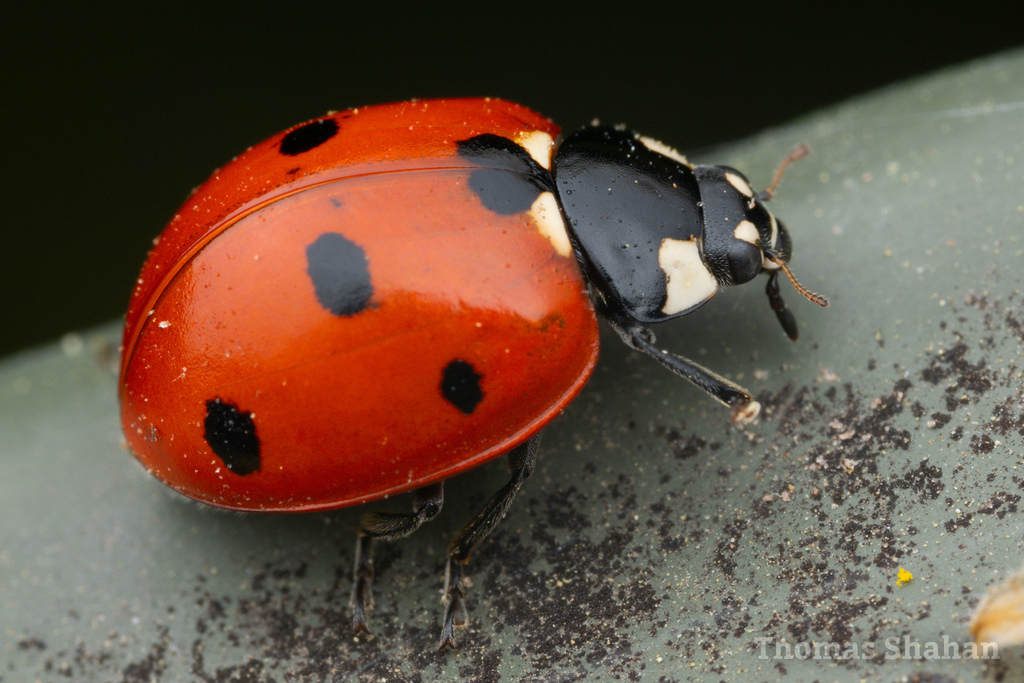
The classic red ladybird with seven black spots, a voracious predator of aphids. Gardeners welcome it as one of the oldest natural pest controls.
Coccinella septempunctata, commonly known as the seven-spot ladybird, often abbreviated C-7, is a carnivorous beetle native to Europe, most of Asia, and North Africa. It inhabits many regions with a temperate climate. The beetle has been introduced to several other areas, including North America as a biological pest control agent to combat aphid infestations. It is one of approximately 5,000 species of ladybird worldwide. Tatia Bauer states that C. septempunctata's ability to adapt to many different habitats makes it "one of the most successful aphidophagous insects". Wikipedia
What it can do
- iA single larva can eat hundreds of aphids before pupating
- iiReflex-bleeds bitter, alkaloid-laden yellow fluid from its leg joints when attacked
- iiiBright warning colours advertise its bad taste
- ivOverwinters in large aggregations
In the field
Field marks
- aRed domed wing cases with seven black spots (three on each side and one shared at the front)
- bBlack head shield with a whitish patch in each front corner
- cBlack legs
- dAbout 7–8 mm long
- Not to be confused with
- Harlequin ladybird (Harmonia axyridis) is larger and very variable, often with an M- or W-shaped mark on a white head shield and brown or orange legs. Two-spot ladybird is smaller with only two spots.
- Where to see it
- Gardens, grassland, crops and hedgerows wherever aphids are plentiful
- When
- Active Mar–Oct; overwinters as an adult in leaf litter and dense vegetation
Listen
Looking for field recordings…
Life & habits
- Diet
- Aphids and other soft-bodied insects; some pollen
- Habitat
- Grassland, crops, gardens and hedgerows
- Size
- 7–8 mm
- Lifespan
- About one year
Adults cluster in leaf litter or tussocks to hibernate through winter.
Where it lives
Recorded sightings
—
geo-referenced records in GBIF, from museums, herbaria and field observers.
Native range
Europe, Asia and North Africa; introduced to North America
Drag the globe to turn it. Dots are where records exist, not a range map; darker means more records.
In the stacks
Searching the stacks…
Every page naming Coccinella septempunctata in the Biodiversity Heritage Library →
Marginalia
Its English and German names honour the Virgin Mary ('Our Lady's bird', Marienkäfer), whose red cloak and seven sorrows the colours and spots were said to recall. It was released in the USA repeatedly to control aphids, and wild populations were established there by the 1970s.
Curiosity
Its seven spots are fixed for life; they do not indicate age, despite the folk belief.
Kinship





Fact-checked: 1 correction made to this sheet. Photographs: iNaturalist contributors under the licences shown. Records: GBIF.org. Historical plates: Source Library (CC BY-SA 4.0; originals public domain). Summary text: Nature Library editors and Wikipedia (CC BY-SA). Medicinal and edibility notes are historical and educational, not advice. iNaturalist taxon 51702.