- Animals
- ›Arthropods
- ›Hexapods
- ›Insects
- ›Winged and Once-winged Insects
- ›Butterflies and Moths
- ›Butterflies
- ›Brush-footed Butterflies
- ›Satyrs, Morphos, and Allies
- ›Alpines, Arctics, Nymphs and Satyrs
- ›Erebiina
- ›Erebia
- ›Erebia
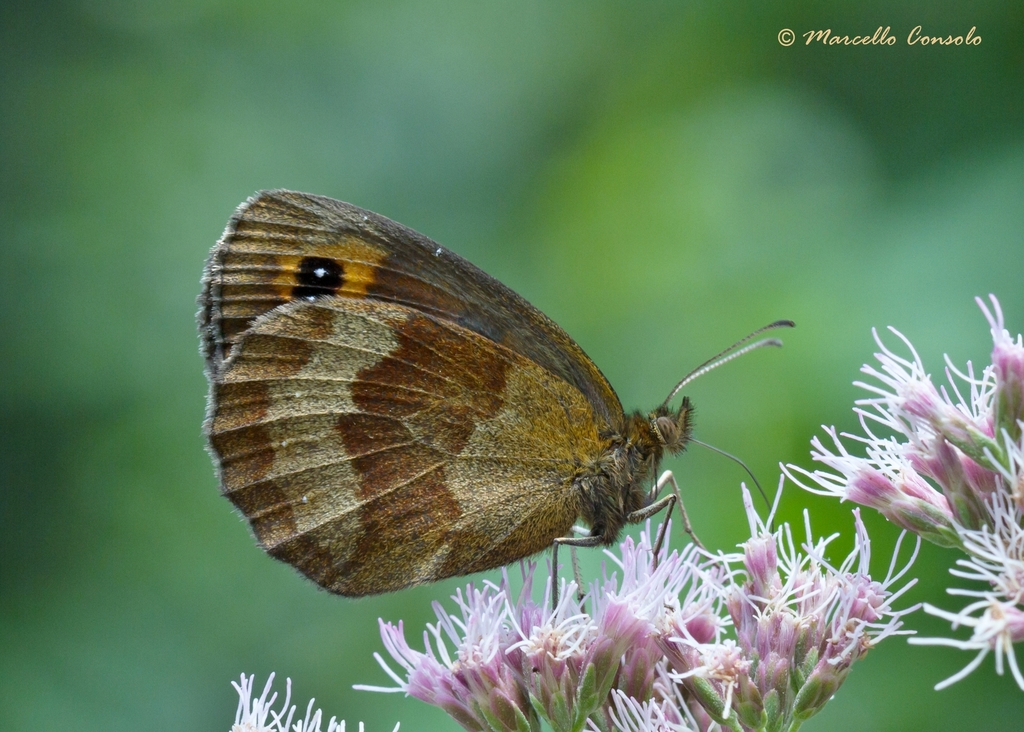
Scotch Argus
Erebia aethiops
The Scotch argus (Erebia aethiops) is a butterfly of the family Nymphalidae. In spite of its English name argus, it is not a close relation of the brown argus nor the northern brown argus.
From the article Scotch argus on Wikipedia (CC BY-SA), quoted section by section
Description
Erebia aethiops has a wingspan of 42–46 mm. Antennae are clavate (club shaped). The background colour of the wings varies from dark brown to black brown, with reddish-yellow bands, black eyespots with white pupils and greyish wing fringes, weakly chequered in the females. On the forewing there are three or four eyespots, usually two apical plus a third detached, while on the hindwings there are four or five. The underside of the hindwings shows a whitish or cream banding but there is a slightly marked sexual dimorphism. In Scotland, the subspecies caledonia has a narrower reddish-yellow band and never contains more than three small eyespots. Three black spots are present on each hindwing. The egg is oval shaped, with 20 to 28 longitudinal ribs. The mature caterpillar is yellow brown, with a brown head. The pupae are yellow brown and relatively short and compact, reaching a length of 12.5–124.5 millimetres (0.49–4.90 in). This species is rather similar to Erebia ligea, but the fringes on the edges of the upper side of the wings are more light grey, while in E. ligea they are white.Wheeler (1903) gives a short description of both species.
Range & habitat
Erebia aethiops is widespread in the Palearctic realm, including most of Europe, the Alps and Apennines, Balkans, Asia Minor, the Urals, and the Caucasus. English colonies are found at Arnside Knott and Smardale Gill both in Cumbria. This species is found in most of northern Scotland, and in western areas in south Scotland. In Europe and Russia, these butterflies prefer the edge of pine forests and tall damp grassland in hills and mountains up to 2400 m.
Wikipedia: “Distribution and habitat”
Listen
Looking for field recordings…
Where it lives
Recorded sightings
—
geo-referenced records in GBIF, from museums, herbaria and field observers.
Drag the globe to turn it. Dots are where records exist, not a range map; darker means more records.
In the stacks
Searching the stacks…
Every page naming Erebia aethiops in the Biodiversity Heritage Library →
This page is assembled live from iNaturalist, GBIF, Wikipedia, the Source Library and the Internet Archive. It is not yet part of the hand-edited codex. iNaturalist taxon 326454.