- Animals
- ›Arthropods
- ›Hexapods
- ›Insects
- ›Winged and Once-winged Insects
- ›Butterflies and Moths
- ›Butterflies
- ›Gossamer-winged Butterflies
- ›Blues
- ›Typical Blues
- ›Polyommatina
- ›Cyaniris
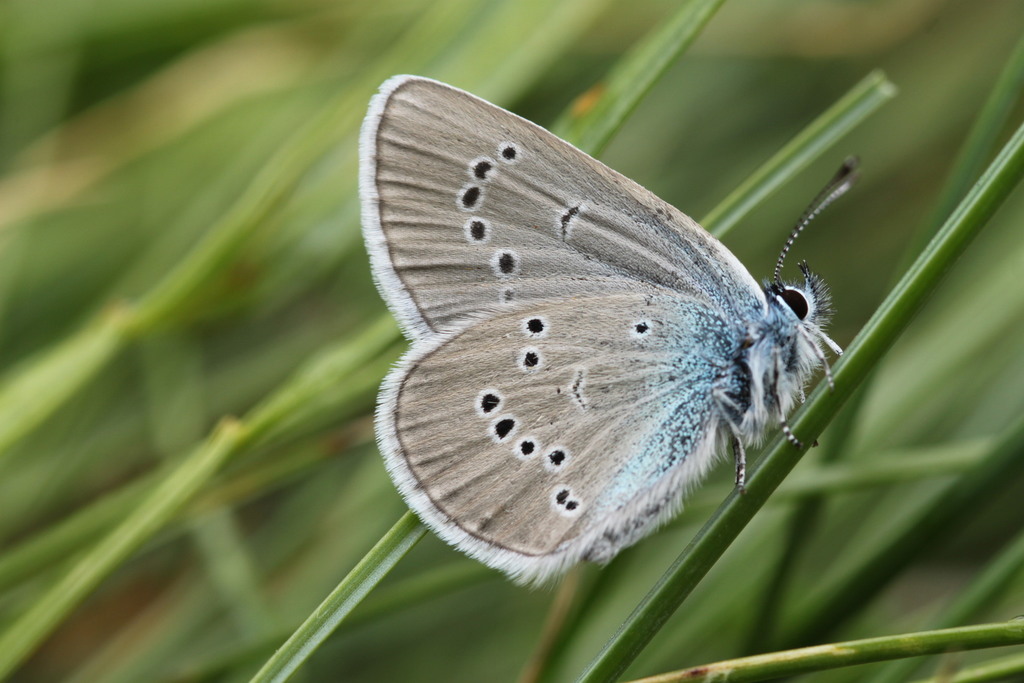
Mazarine Blue
Cyaniris semiargus
Cyaniris semiargus, the Mazarine blue, is a Palearctic butterfly in the family Lycaenidae.
From the article Cyaniris semiargus on Wikipedia (CC BY-SA), quoted section by section
Description
The wingspan of the male and female are similar, at 32–38 mm. These butterflies present a sexual dimorphism. The male Mazarine blue's wings are a deep blue with a heavy venation and are slightly larger in diameter than the female's. The upperside of the wings shows black borders and white fringes. The female Mazarine blue is brown. The underside of the wings is greyish or ocher, with a series of black spots surrounded by white and a blue scaling in the basal area.
Both sexes lack orange markings and have a dark violet or brown body colour. The butterfly has been compared to the common blue, and the Grecian Cyaniris bellis (Freyer, 1845) which has orange markings. This species is rather similar to Cupido minimus, but in the underside hindwings of the Mazarine blue the black spot in space 6 and the two spots next to it form an obtuse angle, while in C. minimus they create an acute angle. The larva is yellow green with darker lines and has fine hairs and dark brown spiracles. The pupa is olive green and attached to the food plant with a silk girdle.
Range & habitat
The Mazarine blue's population is distributed throughout continental Europe, reaching into the Arctic Circle, Morocco, and the Middle East then east across the Palearctic to Siberia and the Russian Far East. There was a large native population in Britain in the early part of the 19th century, but it disappeared before the 20th century, though single vagrants have been spotted, and some estimates of British resident extinction are as late as 1906. In 2009, UNESCO was researching a possible reintroduction of the Mazarine blue to Britain. Recently, the Mazarine blue's numbers have been declining in its European range (particularly Scandinavia) and the reason remains unclear.
Wikipedia: “Distribution”
In human culture
Mazarine is a shade of deep rich blue on late 17th- and early 18th-century export porcelain, itself derived from Cardinal Mazarin.
Wikipedia: “Etymology”
Listen
Looking for field recordings…
Where it lives
Recorded sightings
—
geo-referenced records in GBIF, from museums, herbaria and field observers.
Drag the globe to turn it. Dots are where records exist, not a range map; darker means more records.
In the stacks
Searching the stacks…
Every page naming Cyaniris semiargus in the Biodiversity Heritage Library →
This page is assembled live from iNaturalist, GBIF, Wikipedia, the Source Library and the Internet Archive. It is not yet part of the hand-edited codex. iNaturalist taxon 62439.