- Animals
- ›Arthropods
- ›Hexapods
- ›Insects
- ›Winged and Once-winged Insects
- ›Butterflies and Moths
- ›Butterflies
- ›Gossamer-winged Butterflies
- ›Blues
- ›Typical Blues
- ›Polyommatina
- ›Polyommatus
- ›Polyommatus icarus
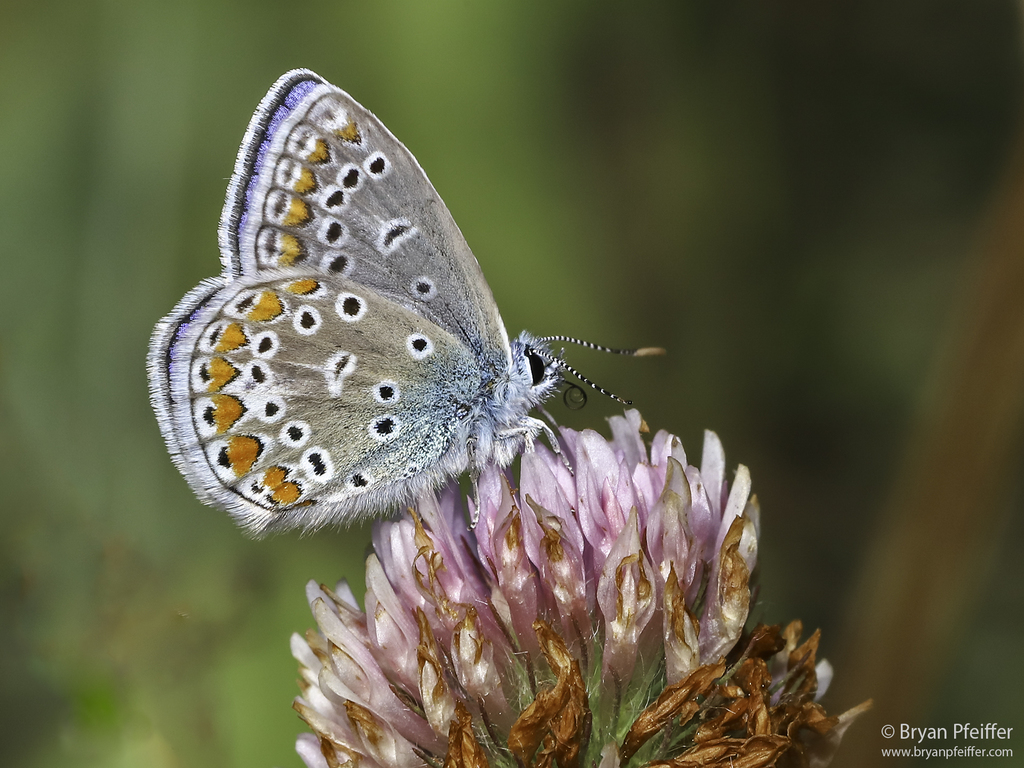
Common Blue
Polyommatus icarus
The common blue butterfly or European common blue (Polyommatus icarus) is a butterfly in the family Lycaenidae and subfamily Polyommatinae. The butterfly is found throughout the Palearctic and has been introduced to North America. Butterflies in the Polyommatinae are collectively called blues, from the coloring of the wings. Common blue males usually have wings that are blue above with a black-brown border and a white fringe. The females are usually brown above with a blue dusting and orange spots.
The Common blue was elected as the national butterfly of Israel in 2023. The contest was launched by the National Butterfly Lovers of Israel Association, with the participation of other nature organizations. A factor in the election result is that like Polyommatus icarus, the flag of Israel is blue and white.
From the article Common blue on Wikipedia (CC BY-SA), quoted section by section
Description
Polyommatus icarus has a wingspan of 28–36 millimetres (1.1–1.4 in). The dorsal side of the wings is an iridescent lilac blue, bright violet-blue, or almost hyacinth-blue with a thin black border. Females' wings are brown or black-brown with a row of red reddish yellow spots along the edges of the wings (marginal spots) and usually some blue at the base. The extent of blue and brown is extremely variable depending on location. The top of the wings in the female may be mostly blue, especially in Ireland and Scotland, but it always has red spots. The ventral side has a greyish or dust-grey base colour in the males and a more brownish hue in the females. Both sexes have a row of red or orange spots along the edge of the hindwing and extending onto the forewing, though they are generally fainter there, particularly in the males, where they are sometimes missing altogether. There are about a dozen black-centered white spots (ocelli) on the hindwing and nine on the forewing. These usually include one in the middle of the forewing cell, absent in Chapman's and Escher's blues. …
Range & habitat
The common blue butterfly is found in Europe, North Africa, the Canary Islands, and east across the Palearctic to Northern China. Recently it was discovered in Quebec, Canada. It is widespread in the British Isles. Its distribution trend shows a 15% decline since the 1970s.
U.K. and Ireland. The common blue is Britain and Ireland's (and probably Europe's) most common and most widespread blue. It is found as far north as Orkney and on most of the Outer Hebrides. A range of grassland habitats are used: meadows, coastal dunes, woodland clearings, and also many man-made habitats, anywhere their food plants are found. In spite of its ubiquitousness in the British Isles, it does not exist in the Shetland Islands.
North America. This is a recently introduced species in eastern Canada. It was discovered in Mirabel, Quebec, Canada, by Ara Sarafian, an amateur entomologist who observed the butterfly from 2005 to 2008. He contacted the Canadian National Collection of Insects in Ottawa where the butterfly was identified as Polyommatus icarus, a newly introduced butterfly to Canada and to North America. The butterfly seems to be well established and is extending its range from year to year. …
Wikipedia: “Geographic range”
What it does
As a caterpillar, the common blue eats leaves. As an adult butterfly, it feeds on wildflower nectar and excrement. The adult lives 3 weeks. Males are often very obvious as they defend territories against rivals and seek out the more reclusive females. In the south of Britain there are two broods a year, flying in May and June and again in August and September. Northern England has one brood, flying between June and September. In a year with a long warm season, there is sometimes a partial third brood in the south flying into October.
Eggs. The egg stage lasts for around eight days. The eggs are white and shaped like flattened spheres. The eggs are very small, about 0.60 millimetres (1⁄32 in). The ground color of the egg sac is pale-greenish grey, with the actual arrangement being white. Eggs are laid singly on young shoots of the food plant.
Larvae. The larvae emerge around a week or two after eggs are laid. The larvae of P. icarus feed on the underside of leaves, causing blotching. Hibernation occurs as a half-grown larvae. They are attractive to ants of genera Myrmica, Lasius, Formica, Plagiolepis, but not as much as some other species of blues. The chrysalis is olive green/brown and formed on the ground, where it is attended by ants of genera Myrmica, Lasius, Formica, Plagiolepis, which will often take it into their nests. …
Wikipedia: “Life cycle”
At the table
The larvae feed on plants from the bean family, Leguminosae. Recorded food plants are Lathyrus species, Vicia species, Vicia cracca, Oxytropis campestris, bird's foot trefoil (Lotus corniculatus), Oxytropis pyrenaica, Astragalus aristatus, Astragalus onobrychis, Astragalus pinetorum, black medick (Medicago lupulina), Medicago romanica, Medicago falcata, common restharrow (Ononis repens), wild thyme Thymus serpyllum, lesser trefoil (Trifolium dubium), Trifolium pratense and white clover (Trifolium repens).
Wikipedia: “Larval food plants”
In human culture
Named in the Classical tradition. In Greek mythology, Icarus was the son of the master craftsman Daedalus, the architect of the labyrinth of Crete.
Wikipedia: “Etymology”
Listen
Looking for field recordings…
Where it lives
Recorded sightings
—
geo-referenced records in GBIF, from museums, herbaria and field observers.
Drag the globe to turn it. Dots are where records exist, not a range map; darker means more records.
In the old herbals & bestiaries


In the stacks
Searching the stacks…
Every page naming Polyommatus icarus in the Biodiversity Heritage Library →
This page is assembled live from iNaturalist, GBIF, Wikipedia, the Source Library and the Internet Archive. It is not yet part of the hand-edited codex. iNaturalist taxon 55641.