 NL·0334
Herbarium of the Nature Library
- Name
- Rangifer tarandus
- Family
- Cervidae
- Native to
- Circumpolar: Scandinavia, Russia, Siberia, Greenland, Alaska and Canada; introduced to South Georgia (since removed) and Kerguelen
- Habitat
- Tundra, Boreal forest, Alpine
Reindeer
Rangifer tarandus
Also calledCaribou (North America; from Mi'kmaq qalipu) · Boazu (Northern Sámi) · Tuktu (Inuktitut) · Severny olen' (Russian) · Ren (Swedish) · Reno (Spanish) · Rena (Portuguese)
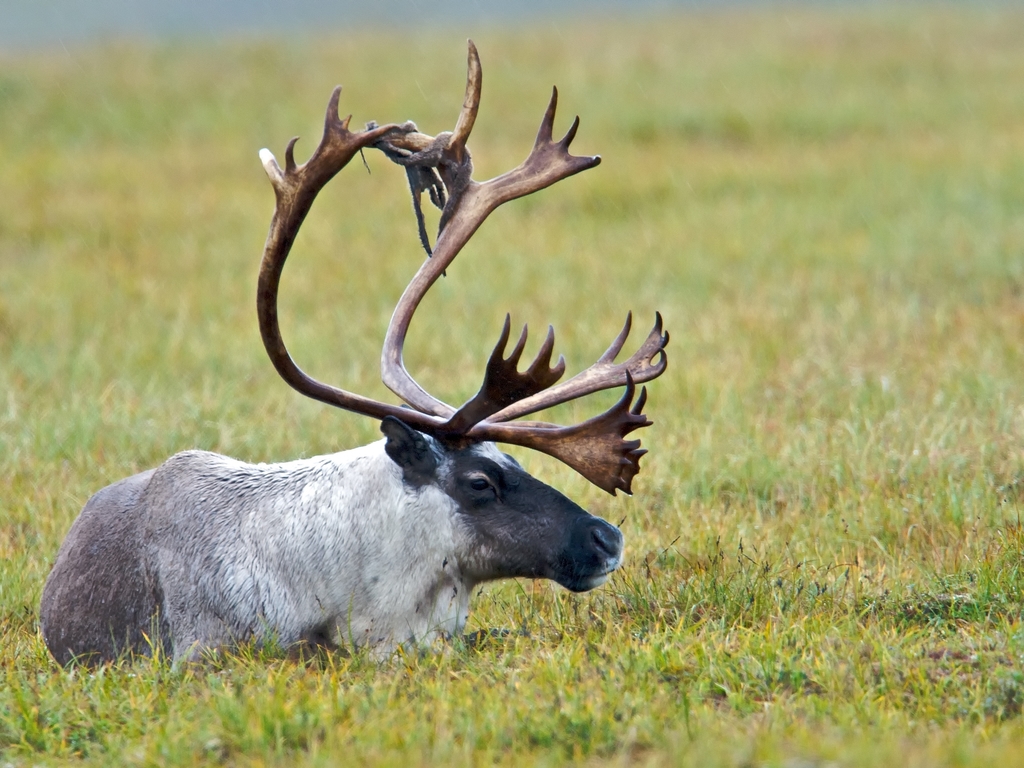
The only deer in which both sexes grow antlers, adapted to Arctic tundra and boreal forest. Wild caribou herds make some of the longest overland migrations on Earth, while domestic reindeer have been central to Sámi, Nenets and Evenki life for centuries. Many wild herds have declined steeply, and the species is listed as Vulnerable.
The reindeer or caribou is a species of deer with circumpolar distribution, native to the Arctic, subarctic, tundra, boreal, and mountainous regions of Northern Europe, Siberia, and North America. It is the only representative of the genus Rangifer. More recent studies suggest the splitting of reindeer and caribou. "All caribou and reindeer throughout the world are considered to be the same species, but there are 7 subspecies." Wikipedia
What it can do
- iSome herds travel over 1,000 km a year between winter range and calving grounds
- iiEyes see ultraviolet light, helping them spot lichen and predators against snow
- iiiIts tapetum changes from gold in summer to deep blue in winter, improving vision in the long dark
- ivDigs through snow ('cratering') with broad hooves to reach lichens
In the field
Field marks
- aBoth sexes carry long, sweeping antlers with a forward-projecting 'shovel' brow tine
- bGreyish-brown body with pale neck and white rump and tail
- cLarge, broad, concave hooves
- dSigns: lichen grazing craters in snow, trails worn through tundra; tracks crescent-shaped and almost round
- Not to be confused with
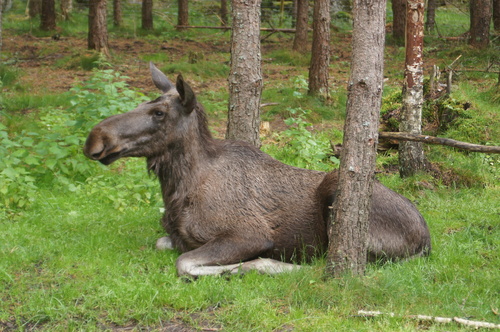
- Moose is far larger with a long overhanging muzzle and palmate antlers only on bulls. Musk ox is shaggy with horns, not antlers.
- Where to see it
- Arctic National Wildlife Refuge and Denali (Alaska); Hardangervidda and Snøhetta (Norway, wild reindeer); Finnish and Swedish Lapland (herded reindeer); Western Greenland around Kangerlussuaq
- When
- Resident or migratory: spring migration April–June; autumn rut September–October
Listen
Looking for field recordings…
Life & habits
- Diet
- Lichens ('reindeer moss', Cladonia) in winter; grasses, sedges, willow leaves and mushrooms in summer
- Habitat
- Arctic tundra, mountain plateaus and northern taiga
- Size
- Shoulder height 0.8–1.5 m; 80–180 kg (males larger)
- Lifespan
- About 15 years
Gathers in vast herds on migration and at calving grounds, where most calves are born within a few weeks in late May–June. Calves can follow their mothers within hours of birth.
Where it lives
Recorded sightings
—
geo-referenced records in GBIF, from museums, herbaria and field observers.
Native range
Circumpolar: Scandinavia, Russia, Siberia, Greenland, Alaska and Canada; introduced to South Georgia (since removed) and Kerguelen
Drag the globe to turn it. Dots are where records exist, not a range map; darker means more records.
In the old herbals & bestiaries
Woodcuts and engravings matched from the Source Library’s scanned books by name. Plates marked “relative” show a close kin rather than this exact species. Click a plate to read the page it came from, with translation.

Ortus sanitatis
1491 · p.582

Garden of Health (Hortus Sanitatis)
Jacob Meydenbach · 1491 · p.541

The Tudor Pattern Book (Herbal-Bestiary)
Anonymous · 1525 · p.87

History of Animals, Book I: On Viviparous Quadrupeds
Conrad Gessner · 1554 · p.130

History of the Northern Peoples
Olaus Magnus · 1555 · p.696

History of the Northern Peoples
Olaus Magnus · 1555 · p.682

History of All Cloven-Hoofed Quadrupeds
Ulisse Aldrovandi · 1621 · p.885

History of All Cloven-Hoofed Quadrupeds
Ulisse Aldrovandi · 1621 · p.883

The Secret Doctrine Vol. I
Helena Petrovna Blavatsky · 1888 · p.1454

Garden of Health
1507 · p.483
In the stacks
Searching the stacks…
Every page naming Rangifer tarandus in the Biodiversity Heritage Library →
Marginalia
Reindeer herding has defined Sámi culture for centuries, and Nenets herders of the Yamal peninsula still migrate with their herds over 1,000 km a year. A single reindeer first pulled Santa's sleigh in the 1821 poem 'Old Santeclaus with Much Delight'; 'A Visit from St. Nicholas' (1823, attributed to Clement Clarke Moore) raised the team to eight and named them.
Curiosity
A tendon slipping over a bone in the foot makes walking reindeer give off a clicking sound that helps herds stay together.
Kinship



Fact-checked: 1 correction made to this sheet. Photographs: iNaturalist contributors under the licences shown. Records: GBIF.org. Historical plates: Source Library (CC BY-SA 4.0; originals public domain). Summary text: Nature Library editors and Wikipedia (CC BY-SA). Medicinal and edibility notes are historical and educational, not advice. iNaturalist taxon 42199.