- Animals
- ›Arthropods
- ›Hexapods
- ›Insects
- ›Winged and Once-winged Insects
- ›Butterflies and Moths
- ›Butterflies
- ›Brush-footed Butterflies
- ›Milkweed Butterflies
- ›Tiger and Crow Butterflies
- ›Tiger Butterflies
- ›Danaus
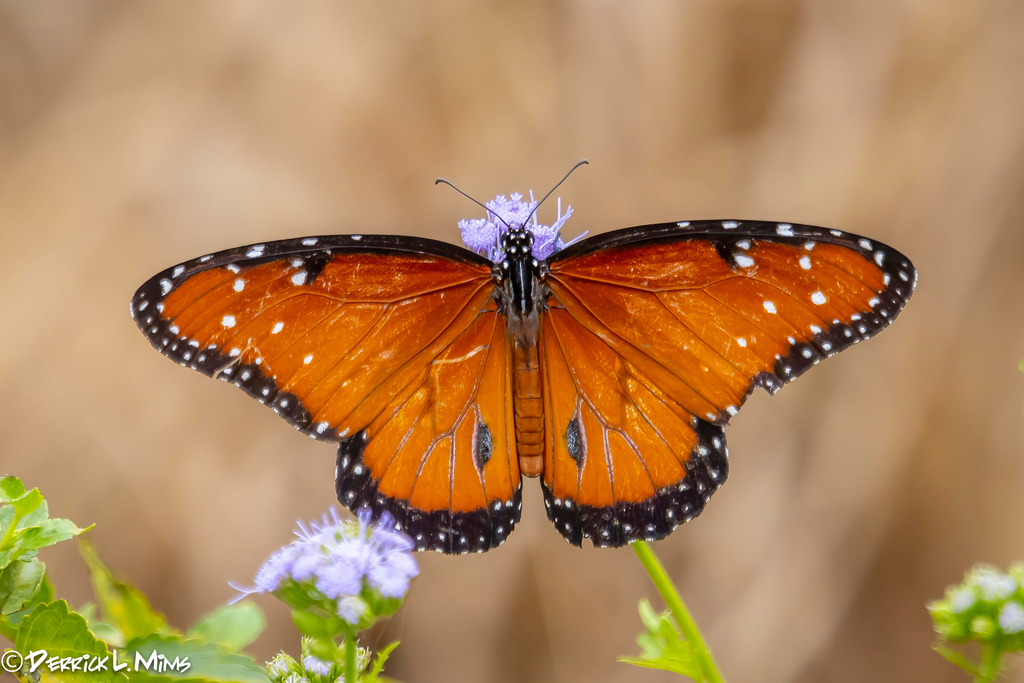
Queen
Danaus gilippus
The queen butterfly (Danaus gilippus) is a North and South American butterfly in the family Nymphalidae with a wingspan of 80–85 mm (3+1⁄8–3+3⁄8 in). It is orange or brown with black wing borders and small white forewing spots on its dorsal wing surface, and reddish ventral wing surface fairly similar to the dorsal surface. The ventral hindwings have black veins and small white spots in a black border. The male has a black androconial scent patch on its dorsal hindwings. It can be found in meadows, fields, marshes, deserts, and at the edges of forests.
This species is possibly a close relative to the similarly colored soldier butterfly (or tropical queen, D. eresimus), in any case, it is not close to the plain tiger (D. chrysippus, African queen) as was long believed. There are seven subspecies.
From the article Queen (butterfly) on Wikipedia (CC BY-SA), quoted section by section
Range & habitat
The queen belongs to a family (Danaidae) that is common to both New and Old Worlds, specifically found throughout the tropics and into the temperate regions of the Americas, Asia, and Africa. Stray specimens are found in Europe. The queen is chiefly a tropical species. In the US, it is usually confined to the southern portion of the country. It can be found regularly in peninsular Florida and southern Georgia, as well as in the southern portions of Texas, New Mexico, Arizona, and California. Occasionally, the subspecies of the queen can be found somewhat north, in Kansas, Colorado, and Utah. Periodically, a stray may be found in the Midwest, such as in Missouri. The berenice subspecies is found largely in the Southeast and the strigosus in the Southwest. The queen is also found in Cuba. It is more common in southern Central America, with numbers beginning to rise in Mexico. The queen can be found as far south as Argentina. Although the queen does not undertake dramatic migrations like the monarch, most undertake short-distance travel at tropical latitudes in areas that have a distinct dry season. During those periods, the queen will fly from lowlands to high elevations. Throughout its distribution, the queen can be found on open land, in meadows, fields, and marshes. …
Wikipedia: “Distribution and habitat”
What it does
Females lay small white eggs one at a time on larval host plants, usually members of the milkweed subfamily Asclepiadoideae. The egg hatches into a black caterpillar with transverse white stripes and yellow spots, and three pairs of long, black filaments. The caterpillar feeds on the host plant and sequesters chemicals that make it distasteful to some predators. It then goes through five instars, after which the larva finds a suitable spot to pupate. The adult emerges 7 to 10 days afterwards. The queen butterfly has multiple generations per year.
Egg. The queen butterfly oviposits one egg at a time. Each individual egg can be found on leaves, stems, and flower buds of the host. The eggs are usually pale green, ovate to conical in shape, with a flattened base and slightly truncated top, and is longitudinally ribbed with raised cross-lines between the ridges. Compared to that of the monarch butterfly, the egg of the queen butterfly is taller relative to its width.
Caterpillar. The mature queen caterpillar is darker and not as brightly colored as the monarch caterpillar. It is nearly identical to the caterpillar of Danaus chrysippus. In the larval stage, the queen is bluish-white dorsally, with a reddish-brown underside. It has three pairs of black, fleshy tentacles—one is on the head, one is on the second thoracic segment and one is on the eighth abdominal segment. …
Wikipedia: “Life cycle and morphology”
At the table
The queen larvae feed on Apocynaceae (milkweeds and dogbanes). It can survive on a number of hosts. Common plants include butterflyweed (Asclepias tuberosa) and bloodflower (Asclepias curassavica). In the West Indies, blunt-leaved milkweed (Asclepias amplexicaulis) and honey vine (Cynanchum laeve) are favored. The caterpillar has also been observed on Asclepias nivea, Calotropis procera, Asclepias humistrata, and Apocynaceae nerium. Other reported host genera include Apocynum, Cynanchum (former Sarcostemma species), Gonolobus, and Stapelia.
Wikipedia: “Larval host plants and food sources”
Listen
Looking for field recordings…
Where it lives
Recorded sightings
—
geo-referenced records in GBIF, from museums, herbaria and field observers.
Drag the globe to turn it. Dots are where records exist, not a range map; darker means more records.
In the old herbals & bestiaries

Ulyssis Aldrovandi ... Ornithologiae
Aldrovandi, Ulisse · 1610 · p.351

The natural history of Carolina, Florida, and the Bahama Islands : containing two hundred a...
Catesby, Mark, bioloog, kunstenaar · 1743 · p.75

The Natural History of Carolina Florida and Bahama Islands Vol. 2
Mark Catesby · 1743 · p.73

Mark Catesby — Piscium, serpentum, insectorum (pt. 1) (1750)
Mark Catesby · 1750 · p.73
In the stacks
Searching the stacks…
Every page naming Danaus gilippus in the Biodiversity Heritage Library →
This page is assembled live from iNaturalist, GBIF, Wikipedia, the Source Library and the Internet Archive. It is not yet part of the hand-edited codex. iNaturalist taxon 51743.