 NL·0675
Herbarium of the Nature Library
- Name
- Salmo trutta
- Family
- Salmonidae
- Native to
- Europe, North Africa (Atlas Mountains) and western Asia east to Afghanistan and the Aral basin; introduced to every continent but Antarctica
- Habitat
- Cold rivers, Mountain streams, Lakes, Coastal seas (sea trout)
Brown trout (sea trout)
Salmo trutta
Also calledTruite fario (French) · Bachforelle (German) · Trucha común (Spanish) · Sewin (Welsh, sea trout) · Forel форель (Russian) · Trota fario (Italian)
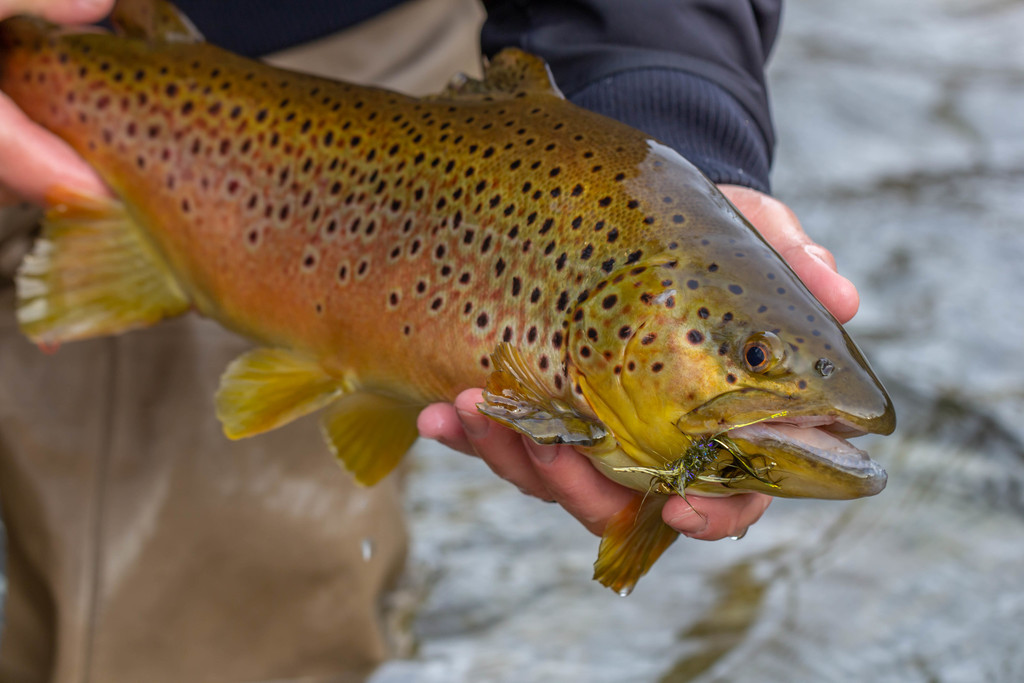
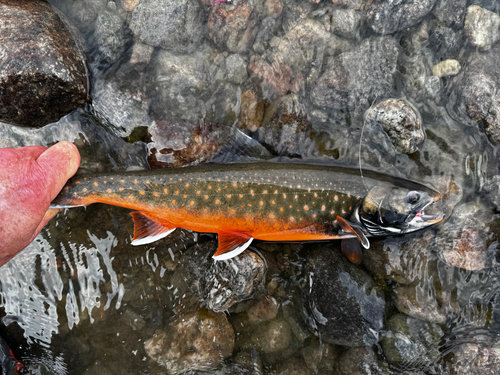
The classic fly-fishing trout of Europe, spotted in black and red. Some stay in their home stream for life, others run to sea as silver sea trout. Introduced from Europe, it now lives from Kashmir and the Himalaya to Patagonia and New Zealand.
The brown trout is a species of carnivorous ray-finned fish and the most widely distributed species of the salmonid genus Salmo, endemic to most of Europe, West Asia and parts of North Africa, and has been widely introduced globally as a game fish, even becoming one of the world's worst invasive species outside of its native range. Wikipedia
What it can do
- iOne species, three life histories: river-resident brownies, lake trout and sea trout that migrate to the ocean
- iiStrongly territorial; each fish defends a feeding lie in the current
- iiiLarge lake and sea fish become fish-eaters and can exceed 15 kg
In the field
Field marks
- aGolden-brown to olive body with large black spots and red or orange spots, often ringed with pale halos
- bAdipose fin often tipped orange-red
- cTail square-cut with few or no spots
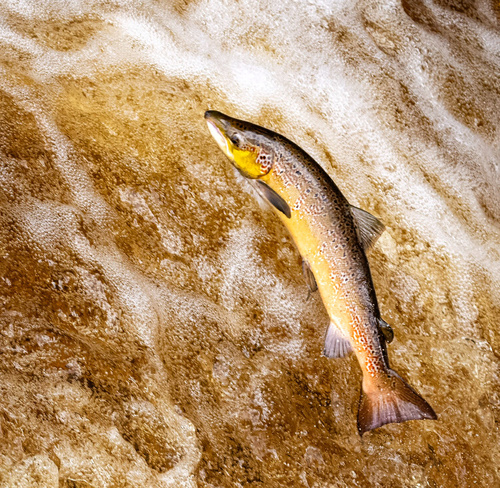
- dSea trout: silvery with X-shaped black spots, like an Atlantic salmon
- Not to be confused with
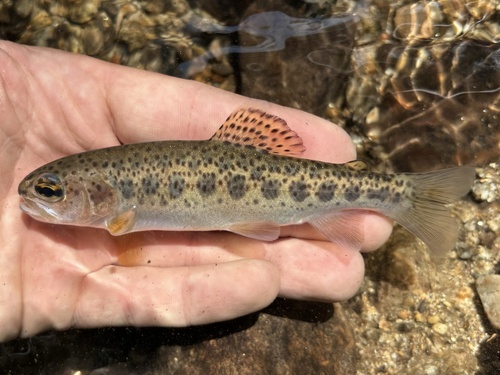
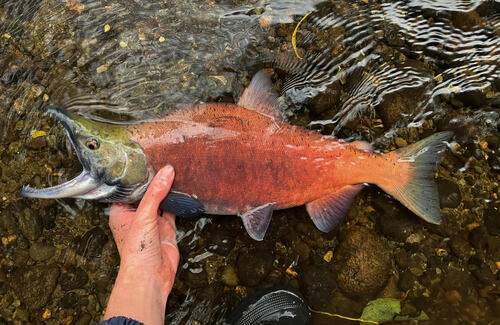
- Atlantic salmon has a slimmer tail stalk, a forked tail and a smaller mouth whose jaw ends level with the eye (in trout it reaches behind the eye). Rainbow trout has a pink band and small black spots all over the tail. Brook trout has worm-like markings on the back and white-edged lower fins.
- Where to see it
- Chalk streams of southern England (Test and Itchen); Irish loughs; Lidder and Sind valleys, Kashmir; Tasmanian Central Highlands; Taupō and Mataura, New Zealand
- When
- Resident; spawns October–January; sea trout runs June–September
Life & habits
- Diet
- Carnivore: insect larvae and adults, crustaceans, snails and fish; sea trout eat sand eels and sprats
- Habitat
- Cold, clean streams, rivers and lakes; coastal waters for sea trout
- Size
- Stream fish 20–40 cm; sea and lake trout to over 1 m
- Lifespan
- Usually 5–8 years; some lake fish over 20
Sea trout return to their home river in summer and run upstream at night. Females cut redds in the gravel of headwaters in autumn and early winter.
Where it lives
Recorded sightings
—
geo-referenced records in GBIF, from museums, herbaria and field observers.
Native range
Europe, North Africa (Atlas Mountains) and western Asia east to Afghanistan and the Aral basin; introduced to every continent but Antarctica
Drag the globe to turn it. Dots are where records exist, not a range map; darker means more records.
In the old herbals & bestiaries
Woodcuts and engravings matched from the Source Library’s scanned books by name. Plates marked “relative” show a close kin rather than this exact species. Click a plate to read the page it came from, with translation.


In the stacks
Searching the stacks…
Every page naming Salmo trutta in the Biodiversity Heritage Library →
Marginalia
Aelian, writing around AD 200, described Macedonian anglers on the river Astraeus catching 'speckled fish' with flies of red wool and cock's feathers, the earliest known account of fly fishing. Trout were brought to Kashmir from Britain in 1899, and the trout streams there are still a famous fishery.
Curiosity
Sea trout and stream-resident brown trout can be siblings: whether a young fish goes to sea depends mostly on its growth and condition, not on separate genes alone.
Kinship


Photographs: iNaturalist contributors under the licences shown. Records: GBIF.org. Historical plates: Source Library (CC BY-SA 4.0; originals public domain). Summary text: Nature Library editors and Wikipedia (CC BY-SA). Medicinal and edibility notes are historical and educational, not advice. iNaturalist taxon 47518.