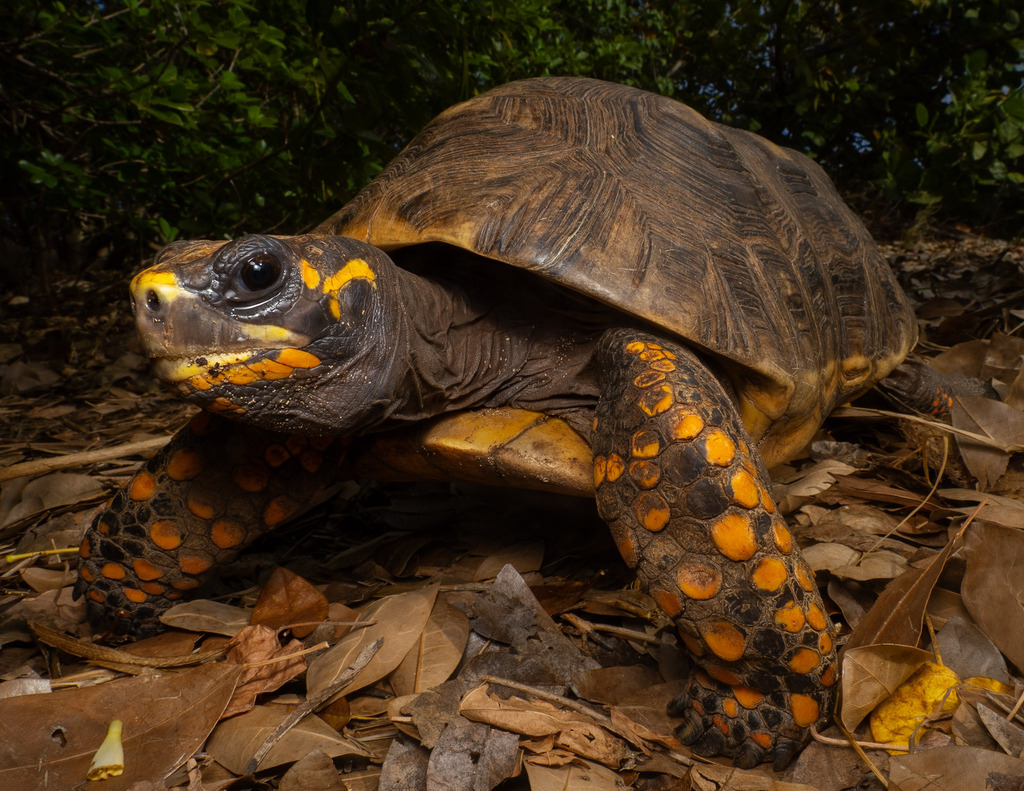
Red-footed Tortoise
Chelonoidis carbonarius
The red-footed tortoise (Chelonoidis carbonarius) is a species of tortoise from northern South America. These medium-sized tortoises generally average 30 cm (12 in) as adults, but can reach over 40 cm (16 in). They have dark-colored (nearly black), “loaf”-shaped carapaces (top shell) with a lighter patch in the middle of each scute (shell segment), and a somewhat lighter-colored plastron (underbelly). They also have dark limbs dotted with brightly-colored scales, from which they get their name, that range from pale yellow to vivid or dark red. Visible differences are noted between red-footed tortoises from varying eco-regions. They are closely related to the more easterly-distributed yellow-footed tortoise (C. denticulatus) of the Amazon Basin.
Their natural habitat ranges from savannah to forest edges around the Amazon Basin. They are omnivorous tortoises, consuming a wide assortment of plants, grasses, flowers, fruit and (notably) fungi, as well as the occasional earthworm or other invertebrate. When presented with the opportunity, many tortoises will also scavenge on carrion. They do not brumate, due to their equatorial home range, but may aestivate in the hotter, drier months.
From the article Red-footed tortoise on Wikipedia (CC BY-SA), quoted section by section
Description
Red-footed tortoises show sex, regional, and individual variations in color, shell shape, and minor anatomical characteristics. Adult carapaces are generally an elongated oval with sides that are nearly parallel, although the sides of males may curve inwards. They are fairly highly domed and smooth with a rather flat back (although the scutes may be raised or 'pyramided' in some individuals, especially captive specimens). Often, a high point over the hips is seen, with a small sloped section over the neck. The vertebral and costal scutes (the scutes along the center and sides of the carapace) are black or dark brown with a pale yellow areole in the center. The marginals (scutes along the edge of the carapace) 'tuck under' along the sides and flare slightly over the limbs. They are dark with the pale aureole along the middle of the lower edge. The nuchal scute (the marginal over the neck) is absent, and the marginals over the tail are joined as one large supracaudal. Growth rings are clearly evident in most individuals, but become worn smooth with age.
The plastron (bottom shell) is large and thick along the edges. The gulars (frontmost pair of plastron scutes) do not protrude much past the front of the carapace. …
Range & habitat
Red-footed tortoises range from southeastern Panama to Venezuela, Guyana, Suriname, and Guiana in the north; south along the Andes to the west in Colombia, Ecuador, Peru, and Bolivia; east to Brazil, and along the southern range in Bolivia, Paraguay, and possibly northern Argentina. In Panama they live from the Darien Gap to the canal. They are not evenly distributed within their range. For example, they are not often found in central Brazil or in heavily forested areas in general, and have only documented in Peru since 1985. Accurate range information is complicated by the sheer size of the range, political and geographic barriers, and confusion about where many specimens were collected. They are also found on several Caribbean Islands, although it is not always clear if they are native or brought by humans. Many of the colonies seem to have been established in the 17th century as food supplies or as pets. They are found on the former Netherlands Antilles, Trinidad, Tobago, Grenada, Barbados, St. …
Wikipedia: “Distribution and habitat”
What it does
The red-footed tortoise's climate in the northern part of the range changes little day to day and rarely gets too hot for them, so the tortoises do not need to practice any form of dormancy and can often forage all day long. The tortoises in Moskovitz's study area were most active after 3:00pm while many species from warmer climes would be most active in the morning and evening. Tortoises from the southern parts of the range experience much hotter, colder, and drier conditions than most of the range and aestivate when food becomes scarce. They may aestivate or brumate when the temperatures are low enough. Most species of tortoise spend much of their day inactive, and red-footed tortoises generally spend over 50% of the daylight hours at rest. They may rest for even longer after a large meal, with five- to ten-day stretches being common. One large specimen seems to have stayed in the same position for over a month. Resting tortoises barely move, allowing leaf litter to accumulate on them, and termites have built tunnels on the carapaces of resting red-footed tortoises.
They seek shelter in places that offer thermoregulation and protection from predators. Treefalls are a favored site, as are debris piles, burrows (especially those of the armadillo (Dasypodidae family) and agouti (Dasyprocta species)), hollow logs, holes, and heavy vegetation cover. …
Wikipedia: “Ecology and behavior”
In human culture
The genus Chelonoidis has two main subcategories based on appearance and habitat—the C. carbonarius and the C. chilensis groups. The C. carbonarius group has the closely related red- and yellow-footed tortoises that clearly share a common ancestor. The C. chilensis group features the Chaco tortoise (C. chilensis) and Galápagos tortoise (C. niger), which share similar habitats and a basic appearance, but otherwise do not seem to be closely related. The relationship between the groups is unclear. Several theories are offered to explain the relatively small number of tortoise species in South America and the relationship between them, but the fossil record is not very complete. One long-held theory is that they came from Asia using the land bridge, then spread down through North America and shared ancestors with the gopher tortoises (Gopherus species). Another holds Geochelone ancestors floated over from central Africa, taking advantage of their ability to float, resist salt water, and go without food for extended periods. DNA studies suggest that the carbonarius group may be related to the African hingeback tortoises (Kinixys species). This suggests that they might have come from Gondwana before it separated into Africa and South America some 130 million years ago. …
Wikipedia: “Evolutionary history and fossil record”
Where it lives
Recorded sightings
—
geo-referenced records in GBIF, from museums, herbaria and field observers.
Drag the globe to turn it. Dots are where records exist, not a range map; darker means more records.
In the stacks
Searching the stacks…
Every page naming Chelonoidis carbonarius in the Biodiversity Heritage Library →
This page is assembled live from iNaturalist, GBIF, Wikipedia, the Source Library and the Internet Archive. It is not yet part of the hand-edited codex. iNaturalist taxon 539039.