 NL·0017
Herbarium of the Nature Library
- Name
- Amorphophallus titanum
- Family
- Araceae
- Native to
- Equatorial rainforest of western Sumatra, Indonesia
- Habitat
- Tropical rainforest (hillsides and clearings)
Titan arum (Corpse flower)
Amorphophallus titanum
Also calledBunga bangkai (Indonesian: 'corpse flower') · Suweg raksasa (Indonesian) · Kibut (Indonesian/Sundanese) · 巨魔芋 jùmóyù (Chinese)
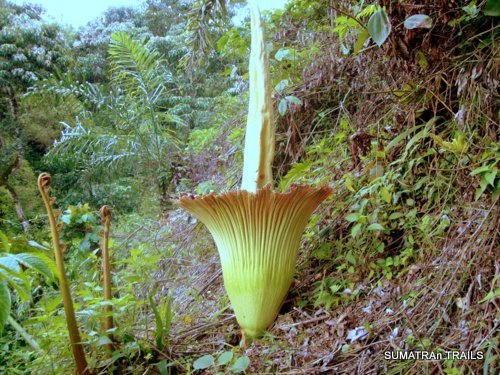
The largest unbranched inflorescence in the plant world, rising up to about 3 m from a corm that can weigh more than 150 kg. When it blooms it heats its central spike and pumps out a stench of rotting flesh to draw carrion beetles and flies through the Sumatran forest.
Amorphophallus titanum, the titan arum, is a flowering plant in the family Araceae. It has a large unbranched inflorescence, a tall single leaf branched like a tree, and a heavy tuber which enables the plant to produce the inflorescence. A. titanum is endemic to rainforests on the Indonesian island of Sumatra. Wikipedia
What it can do
- iHeats its spadix (thermogenesis) to near human body temperature, helping the scent spread
- iiReleases sulfur compounds such as dimethyl trisulfide that smell like a carcass
- iiiStores energy in a giant corm; a record corm at Edinburgh weighed 153.9 kg in 2010
- ivBetween blooms it grows a single huge leaf that can reach about 6 m, like a small tree
At the table
Not eaten. Like many aroids its tissues contain calcium oxalate crystals, which burn the mouth if eaten raw.
Fruit & seed


Fruit
Berries on the spadix base
Ripens: Months after pollination
Hundreds of olive-sized berries ripen from yellow to red.

Seed
~1–2 cm
One or two seeds per berry
- Dispersal
- Birds such as hornbills eat the berries
- Germination
- Sow fresh (seeds don't store) in warm, humid mix
Photographs from Wikimedia Commons under open licences; hover for the photographer, click for the file.
How to grow it
Hardiness (USDA zones)
Tropical only (USDA 11–12) or heated glasshouse. Survives winters down to about 4 °C.
- Light
- Bright filtered light
- Water
- High while in leaf; reduce during dormancy
- Soil
- Rich, very well-drained aroid mix
- Propagation
- Fresh seed, or leaf cuttings in specialist collections
- To harvest
- First flowering usually after 7–10 years
- Climates
- Tropical
- 1Sow fresh seed immediately in warm, humid conditions
- 2Pot the corm into progressively larger containers as it grows
- 3Keep humid and warm (24–30 °C) year-round
- 4Let the leaf die back naturally and rest the corm before regrowth
Can it grow where you are?
Where it lives
Recorded sightings
—
geo-referenced records in GBIF, from museums, herbaria and field observers.
Native range
Equatorial rainforest of western Sumatra, Indonesia
Drag the globe to turn it. Dots are where records exist, not a range map; darker means more records.
In the old herbals & bestiaries
No plate in the Source Library names this exact species, so these show its closest relatives as the old naturalists drew them: same genus, or the same kind of plant. Click a plate to read the page it came from, with translation.

Ortus sanitatis
Relative · 1491 · p.59

Introductio Generalis in Rem Herbariam
Relative · Augustus Quirinus Rivinus · 1690 · p.193

Sancai Tuhui (Vol. 106)
Relative · 王圻, 王思義 · 1609 · p.78

The Great Herbary with all the figures of the herbs
Relative · 1532 · p.223

On the Names of Plants
Relative · Hieronymus Bock (Tragus) · 1552 · p.359

Six Groups of the History of Plants
Relative · Rembert Dodoens · 1583 · p.603

Collected Illustrations of the Three Realms: Herbs
Relative · 王圻, 王思義 · 1607 · p.14

Sancai Tuhui (Vol. 106)
Relative · 王圻, 王思義 · 1609 · p.74

Thesaurus of Medical Things of New Spain, or History of Mexican Plants, Animals, and Minerals
Relative · Francisco Hernández; Nardo Antonio Recchi (ed.) · 1651 · p.926

De Indiae utriusque re naturali et medica
Relative · Willem Piso · 1658 · p.236
In the stacks
Searching the stacks…
Every page naming Amorphophallus titanum in the Biodiversity Heritage Library →
Marginalia
Italian botanist Odoardo Beccari sent seeds to Europe after finding it in 1878, and it first bloomed in cultivation at Kew in 1889. David Attenborough coined 'titan arum' for his BBC series The Private Life of Plants, finding the Latin name too rude for television.
Curiosity
The Latin name means 'giant misshapen phallus'.
Kinship


Photographs: iNaturalist contributors under the licences shown. Records: GBIF.org. Historical plates: Source Library (CC BY-SA 4.0; originals public domain). Summary text: Nature Library editors and Wikipedia (CC BY-SA). Medicinal and edibility notes are historical and educational, not advice. iNaturalist taxon 62194.