 NL·0288
Herbarium of the Nature Library
- Name
- Antilope cervicapra
- Family
- Bovidae
- Native to
- India and Nepal; extinct in the wild in Bangladesh and Pakistan (reintroduced to Lal Suhanra, Pakistan); introduced in Texas and Argentina
- Habitat
- Open grassland, Semi-arid plains, Farmland
Blackbuck
Antilope cervicapra
Also calledKālā hiran (Hindi/Urdu) · Kṛṣṇamṛga (Sanskrit) · Indian antelope
One of the fastest land mammals, a slim antelope of the Indian plains whose mature males are glossy black and white with long spiralled horns. Once among the most numerous large mammals of South Asia, it survives in protected grasslands and among communities such as the Bishnoi who refuse to harm it.
The blackbuck is a medium-sized antelope native to India and Nepal. It inhabits grassy plains and lightly forested areas with perennial water sources. Wikipedia
What it can do
- iCan run at up to about 80 km/h and sustain high speeds over long distances
- iiLeaps high in the air while fleeing ('stotting' or pronking)
- iiiMales defend small mating territories (leks) in some populations
In the field
Field marks
- aMature males: dark brown to black upperparts sharply divided from white belly; white eye-ring and chin
- bCorkscrew horns with 3–5 spiral turns (males only)
- cFemales and young males: tan-yellow above, white below, hornless
- dSigns: territorial males leave large dung middens on their patch
- Not to be confused with
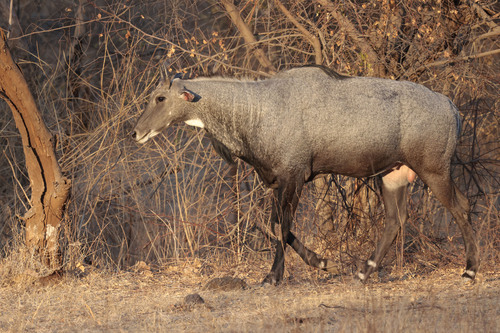
- Chinkara (Indian gazelle) is sandy, both sexes have short, near-straight ridged horns, and it has a dark side-stripe. Nilgai is far larger and grey.
- Where to see it
- Velavadar Blackbuck National Park (Gujarat); Tal Chhapar Sanctuary and Bishnoi villages around Jodhpur (Rajasthan); Point Calimere (Tamil Nadu); Ranibennur (Karnataka); Lal Suhanra National Park (Pakistan)
- When
- Resident; displays peak in the rut (roughly March–April and August–October, varying by region)
Listen
Looking for field recordings…
Life & habits
- Diet
- Grasses; also pods, flowers and crops
- Habitat
- Open short grassland and plains with little tree cover
- Size
- Shoulder height 74–84 cm; 20–57 kg; horns of males up to about 70 cm
- Lifespan
- About 10–15 years
Lives in herds of females and young with territorial males. Dominant males hold their heads up and back, horns laid along the neck, in displays to rivals.
Where it lives
Recorded sightings
—
geo-referenced records in GBIF, from museums, herbaria and field observers.
Native range
India and Nepal; extinct in the wild in Bangladesh and Pakistan (reintroduced to Lal Suhanra, Pakistan); introduced in Texas and Argentina
Drag the globe to turn it. Dots are where records exist, not a range map; darker means more records.
In the stacks
Searching the stacks…
Every page naming Antilope cervicapra in the Biodiversity Heritage Library →
Marginalia
In Hindu tradition the blackbuck is the mount of Chandra, the moon, and Vayu, and its skin was prescribed in Vedic texts for ritual seats. Its hunting by a Bollywood actor near a Bishnoi village in 1998 led to a celebrated conviction.
Curiosity
The blackbuck is the only living member of the genus Antilope, the genus that gives the antelope subfamily Antilopinae its name.
Kinship

Fact-checked: 1 correction made to this sheet. Photographs: iNaturalist contributors under the licences shown. Records: GBIF.org. Historical plates: Source Library (CC BY-SA 4.0; originals public domain). Summary text: Nature Library editors and Wikipedia (CC BY-SA). Medicinal and edibility notes are historical and educational, not advice. iNaturalist taxon 42416.