 NL·0293
Herbarium of the Nature Library
- Name
- Capra falconeri
- Family
- Bovidae
- Native to
- Northern Pakistan, eastern Afghanistan, Kashmir (India), southern Tajikistan, Uzbekistan and Turkmenistan
- Habitat
- Mountain scrub forest, Cliffs and crags, Open montane woodland
Markhor
Capra falconeri
Also calledMārkhor (Pashto/Urdu/Persian, 'snake-eater') · Rezh (Wakhi) · Mārkhōr (Balochi)
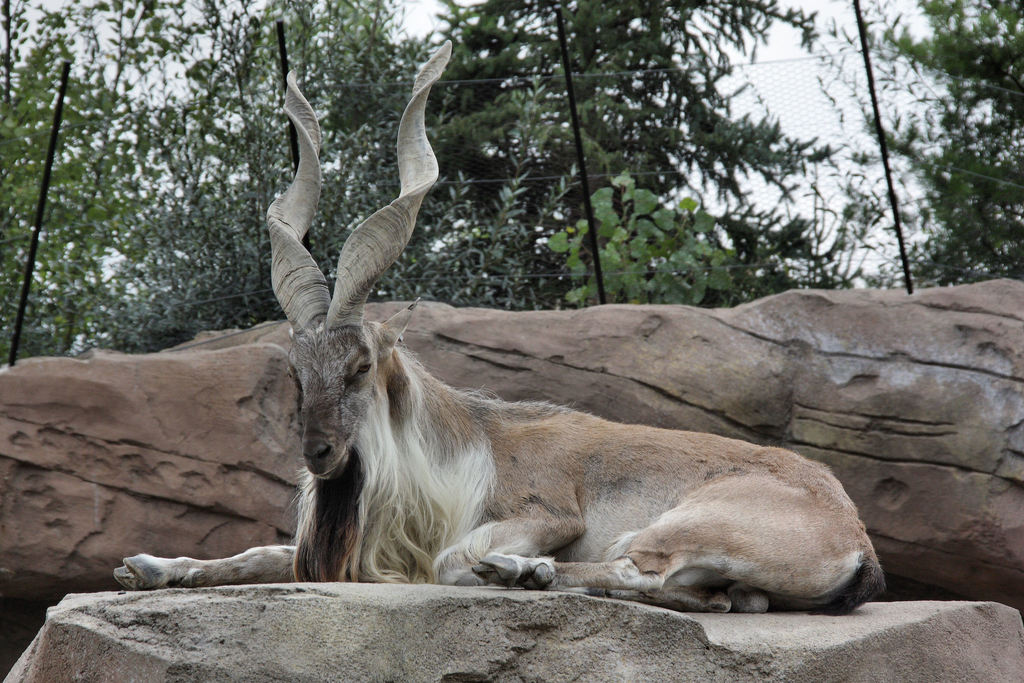
A great wild goat of the western Himalaya, Hindu Kush and Karakoram, whose males carry immense corkscrew horns and a flowing ruff. It is Pakistan's national animal and a conservation success story: community-run trophy-hunting programmes helped populations recover enough for the species to move from Endangered to Near Threatened in 2015.
The markhor is a large wild Capra species native to the mountain regions at the crossroads of Central and South Asia, including the Karakoram and Himalayas. It occurs in parts of Turkmenistan, Uzbekistan, Tajikistan, Afghanistan, Pakistan, and India. It has been listed on the IUCN Red List as Near Threatened since 2015. Wikipedia
What it can do
- iClimbs near-vertical cliffs and even into holm-oak trees to browse
- iiMales' spiralling horns can exceed 1.5 m along the curve
- iiiFeeds at high altitude in summer and descends to lower slopes in winter, tracking snowline
In the field
Field marks
- aSilhouette: stocky goat with outward-twisting corkscrew horns (males) — the spiral, not a backward arc, is diagnostic
- bAdult males have a long ruff of shaggy hair on the throat, chest and shins
- cCoat greyish-tan, paler in winter; females are reddish, short-horned and lack the ruff
- dSigns: goat-type pellet piles on ledges and cloven, blunt-tipped hoofprints on cliff paths
- Not to be confused with
- Siberian ibex has long, scimitar-shaped horns sweeping back with knobbly ridges, not corkscrews. Urial (wild sheep) have curling horns that circle beside the face and lack a goat beard.
- Where to see it
- Chitral Gol National Park and Tooshi-Shasha Conservancy, Chitral; Kargah and Gilgit-Baltistan community conservancies; Torghar Hills, Balochistan; Kazinag National Park, Kashmir
- When
- Resident; males are easiest to see near villages and lower slopes during the winter rut (November–January)
Listen
Looking for field recordings…
Life & habits
- Diet
- Grasses and herbs in spring and summer; browses leaves and twigs of oak, juniper and shrubs in winter
- Habitat
- Steep, rugged terrain with scrub or open woodland, roughly 600–3,600 m
- Size
- Shoulder height 65–115 cm; males up to about 110 kg, females much smaller
- Lifespan
- About 12–13 years in the wild
Males live apart from females and young for most of the year and join them for the winter rut, when they clash horns and rear up in contests on steep ground.
Where it lives
Recorded sightings
—
geo-referenced records in GBIF, from museums, herbaria and field observers.
Native range
Northern Pakistan, eastern Afghanistan, Kashmir (India), southern Tajikistan, Uzbekistan and Turkmenistan
Drag the globe to turn it. Dots are where records exist, not a range map; darker means more records.
In the stacks
Searching the stacks…
Every page naming Capra falconeri in the Biodiversity Heritage Library →
Marginalia
The name is popularly read as Persian 'snake-eater', and in Hindu Kush folklore markhor were said to kill snakes and leave a foam whose dried residue was used to draw out snake venom. The Torghar Conservation Project, begun by Pashtun tribesmen in 1985, is a celebrated model of community-led wildlife recovery.
Curiosity
A Pakistani markhor trophy-hunting permit has sold for more than US$100,000, with most of the fee going to the local community.
Kinship
Photographs: iNaturalist contributors under the licences shown. Records: GBIF.org. Historical plates: Source Library (CC BY-SA 4.0; originals public domain). Summary text: Nature Library editors and Wikipedia (CC BY-SA). Medicinal and edibility notes are historical and educational, not advice. iNaturalist taxon 42356.