 NL·0277
Herbarium of the Nature Library
- Name
- Ariolimax columbianus
- Family
- Ariolimacidae
- Native to
- Pacific coast of North America from south-eastern Alaska to California
- Habitat
- Temperate rainforest, Coniferous forest
Pacific banana slug
Ariolimax columbianus
Also calledLimace banane (French) · Babosa banana (Spanish)
The second-largest slug in the world, a bright yellow giant of the Pacific Northwest rainforest floor. It recycles leaf litter, dung and fungi into soil and spreads seeds and spores as it goes.
Ariolimax columbianus, the Pacific banana slug, is a species of slug found on the Pacific coast of North America. It is the second-largest species of terrestrial slug in the world, growing up to 25 centimeters (9.8 in) long. An important function of this particular species is the role it plays in seed dispersion. Wikipedia
What it can do
- iGrows to about 25 cm long
- iiThick slime protects from drying out and deters predators
- iiiSmells with tentacles and can follow slime trails to find mates
- ivHermaphrodite; both partners exchange sperm
In the field
Field marks
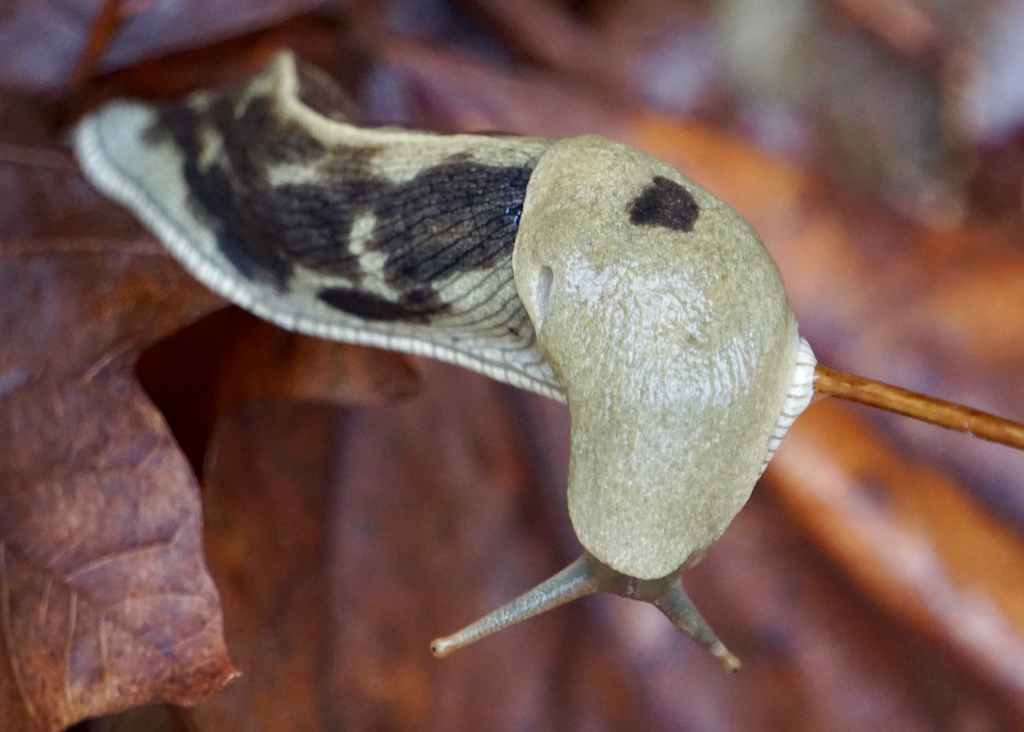
- aVery large, smooth slug
- bYellow to greenish with black spots, or olive to brown
- cSaddle-like mantle near the head with a breathing hole on the right side
- dTwo pairs of tentacles
- Not to be confused with
- Leopard slug (Limax maximus), an introduced European species, is grey with black spots or stripes and a ridge along the tail. Other Ariolimax species occupy different parts of California.
- Where to see it
- Damp trails in Olympic National Park, coastal British Columbia and the redwood parks of northern California.
- When
- Year-round in wet weather; most active in the rainy months
Life & habits
- Diet
- Leaf litter, fungi, moss, dead plants and animal droppings
- Habitat
- Moist forest floor of conifer and redwood forests
- Size
- Up to about 25 cm long
- Lifespan
- Several years
It feeds and moves mostly in cool, wet weather, retreating under logs in dry spells, and acts as a decomposer.
Where it lives
Recorded sightings
—
geo-referenced records in GBIF, from museums, herbaria and field observers.
Native range
Pacific coast of North America from south-eastern Alaska to California
Drag the globe to turn it. Dots are where records exist, not a range map; darker means more records.
In the stacks
Searching the stacks…
Every page naming Ariolimax columbianus in the Biodiversity Heritage Library →
Marginalia
Banana slugs are emblems of the Pacific Northwest forests; a related species, Ariolimax dolichophallus, is the mascot of the University of California, Santa Cruz.
Curiosity
Its eyes sit at the tips of the upper tentacles, which it pulls back into its head when touched.
Kinship

Photographs: iNaturalist contributors under the licences shown. Records: GBIF.org. Historical plates: Source Library (CC BY-SA 4.0; originals public domain). Summary text: Nature Library editors and Wikipedia (CC BY-SA). Medicinal and edibility notes are historical and educational, not advice. iNaturalist taxon 47776.