 NL·0316
Herbarium of the Nature Library
- Name
- Brachinus crepitans
- Family
- Carabidae
- Native to
- Europe, especially the south and west, east into western Asia
- Habitat
- Calcareous grassland, Dry grassland, Coastal cliffs
Bombardier beetle
Brachinus crepitans
Also calledBombardierkäfer (German) · Brachyne pétard (French) · Escarabajo bombardero (Spanish)
A small ground beetle that defends itself with a boiling chemical explosion. Two harmless liquids stored in its abdomen are mixed with enzymes in a reaction chamber, firing a hot, caustic spray with an audible pop.
Brachinus crepitans is a species of ground beetle in the Brachininae subfamily that can be found in Europe, central and west Asia, and northern Africa. Wikipedia
What it can do
- iMixes hydroquinones and hydrogen peroxide with catalase and peroxidase enzymes to produce a spray near 100 °C
- iiFires the spray in rapid pulses with an audible crack
- iiiCan aim the spray by swivelling the tip of its abdomen
In the field
Field marks
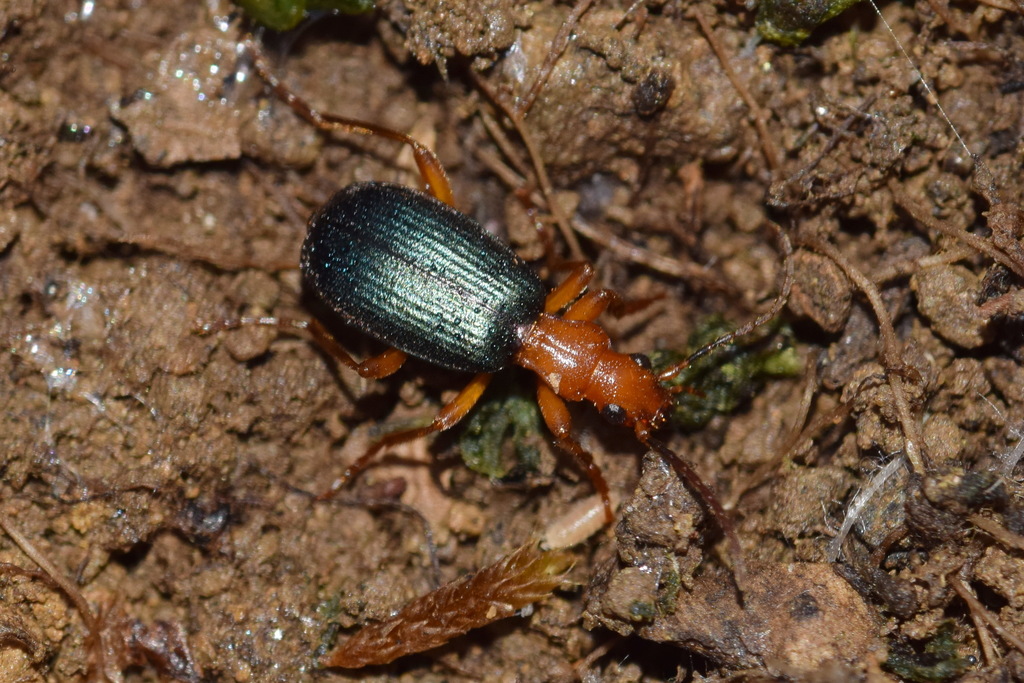
- aOrange-red head, thorax and legs
- bDark metallic blue to blue-green wing cases
- cSmall, narrow ground-beetle shape
- dOften in groups under stones in dry grassland
- Not to be confused with
- Brachinus explodens is smaller (5–7.5 mm) and very similar; a hand lens and key are needed. Other red-and-blue ground beetles (e.g. Lebia, Drypta) lack the defensive pop.
- Where to see it
- Chalk downland and dry coastal grassland in southern England and continental Europe.
- When
- Adults mainly Apr–Sep
Listen
Looking for field recordings…
Life & habits
- Diet
- Adults are predators and scavengers of small invertebrates
- Habitat
- Warm, dry, sparsely vegetated ground, often on chalk and limestone; shelters under stones
- Size
- About 6–10 mm
When grabbed by an ant, spider or frog, it blasts the attacker with hot benzoquinones.
Where it lives
Recorded sightings
—
geo-referenced records in GBIF, from museums, herbaria and field observers.
Native range
Europe, especially the south and west, east into western Asia
Drag the globe to turn it. Dots are where records exist, not a range map; darker means more records.
In the stacks
Searching the stacks…
Every page naming Brachinus crepitans in the Biodiversity Heritage Library →
Marginalia
Linnaeus named it crepitans, 'crackling', in 1758 for its explosive defence. In the late 20th century it became a famous example in debates between creationists and evolutionary biologists over how complex traits evolve.
Curiosity
High-speed X-ray imaging of bombardier beetles in 2015 showed that each spray is a rapid series of pulses, with an inlet valve to the reaction chamber closing at each blast.
Kinship






Photographs: iNaturalist contributors under the licences shown. Records: GBIF.org. Historical plates: Source Library (CC BY-SA 4.0; originals public domain). Summary text: Nature Library editors and Wikipedia (CC BY-SA). Medicinal and edibility notes are historical and educational, not advice. iNaturalist taxon 525781.