 NL·0764
Herbarium of the Nature Library
- Name
- Catharus guttatus
- Family
- Turdidae
- Native to
- Breeds across Alaska, Canada, the north-eastern US and western mountains; winters in the southern US, Mexico and Central America to Guatemala
- Habitat
- Boreal forest, Montane coniferous forest, Mixed forest, Woodland (winter)
On eBird ↗
Hermit Thrush
Live sightings near you, the range map, bar charts of when it is seen, and Macaulay Library photos and recordings.
Hermit thrush
Catharus guttatus
Also calledZorzal colirrufo (Spanish) · Grive solitaire (French)
A shy brown thrush with a rusty tail whose ethereal, echoing song is often called the most beautiful in North America. It is the only spotted thrush that commonly winters in the United States.
The hermit thrush is a medium-sized North American thrush. Wikipedia
What it can do
- iEach song begins with a long, clear note at a new pitch, followed by a cascade of flute-like phrases
- iiSong intervals follow simple harmonic ratios similar to those of human musical scales, according to a 2014 study in PNAS
- iiiSwitches from insects to fruit such as holly and dogwood in winter
In the field
Field marks
- aWarm reddish tail contrasting with olive-brown or greyish back
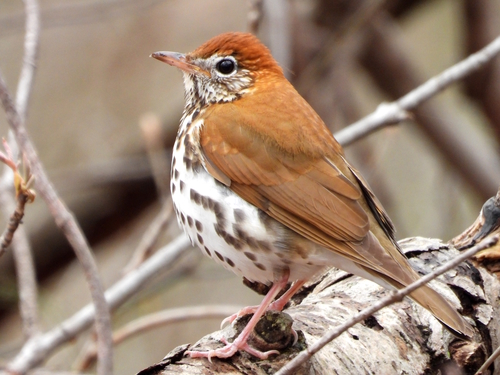
- bSpotted breast, spots smaller and smudgier than a Wood Thrush's
- cThin, complete whitish eye-ring
- dSlow tail-raising habit
- Voice
- A clear, sustained opening whistle followed by a spiralling cascade of flute-like notes, each song at a different pitch; call a low 'chuck'.
- Not to be confused with
- Swainson's Thrush has buffy 'spectacles' and a uniform brown tail. Veery is tawny with faint spots. Wood Thrush is rufous on the head, with bold round spots. Fox Sparrow has a conical bill.
- Where to see it
- Northern and mountain conifer forests in summer (e.g. Adirondacks, Green Mountains, Rockies); southern US woodlands in winter.
- When
- Summer visitor in the north, Apr–Oct; winter visitor in the south, Oct–Apr
Listen
Looking for field recordings…
Life & habits
- Diet
- Ground insects, spiders and worms; berries in winter
- Habitat
- Conifer and mixed forests when breeding; woodland understorey in winter
- Size
- 15–18 cm; 23–37 g
- Lifespan
- Banding record about 10 years
It habitually raises its tail and lowers it slowly while flicking its wings.
Where it lives
Recorded sightings
—
geo-referenced records in GBIF, from museums, herbaria and field observers.
Native range
Breeds across Alaska, Canada, the north-eastern US and western mountains; winters in the southern US, Mexico and Central America to Guatemala
Drag the globe to turn it. Dots are where records exist, not a range map; darker means more records.
In the old herbals & bestiaries
No plate in the Source Library names this exact species, so these show its closest relatives as the old naturalists drew them: same genus, or the same kind of animal. Click a plate to read the page it came from, with translation.

History of Animals, Book I: On Viviparous Quadrupeds
Relative · Conrad Gessner · 1554 · p.913

Historiae Animalium Liber III: De Avium Natura
Relative · Conrad Gesner · 1555 · p.762

Historiae Animalium Liber III: De Avium Natura
Relative · Conrad Gesner · 1555 · p.768

A voyage to the islands Madera Barbados Jamaica Vol. 1
Relative · Hans Sloane · 1707 · p.620

History of Animals, Book I: On Viviparous Quadrupeds
Relative · Conrad Gessner · 1554 · p.907

Noah's Ark
Relative · Athanasius Kircher · 1675 · p.137

The Natural History of Carolina, Florida and the Bahama Islands, Vol. 1
Relative · Mark Catesby · 1777 · p.107

The Natural History of Carolina, Florida and the Bahama Islands, Vol. 1
Relative · Mark Catesby · 1777 · p.110

The Secrets of Albertus Magnus on the Nature of Women and the Virtues of Herbs
Relative · Albertus, Magnus, Heiliger · 1604 · p.74
In the stacks
Searching the stacks…
Every page naming Catharus guttatus in the Biodiversity Heritage Library →
Marginalia
In Walt Whitman's elegy for Abraham Lincoln, 'When Lilacs Last in the Dooryard Bloom'd' (1865), a hermit thrush sings from the swamp; it is Vermont's state bird.
Curiosity
Its genus name Catharus comes from Greek katharos, 'pure' or 'clean'.
Kinship

Fact-checked: 1 correction made to this sheet. Photographs: iNaturalist contributors under the licences shown. Records: GBIF.org. Historical plates: Source Library (CC BY-SA 4.0; originals public domain). Summary text: Nature Library editors and Wikipedia (CC BY-SA). Medicinal and edibility notes are historical and educational, not advice. iNaturalist taxon 12890.