 NL·0765
Herbarium of the Nature Library
- Name
- Hylocichla mustelina
- Family
- Turdidae
- Native to
- Breeds in eastern North America; winters from southern Mexico to Panama
- Habitat
- Deciduous forest, Mixed forest, Tropical lowland forest (winter)
On eBird ↗
Wood Thrush
Live sightings near you, the range map, bar charts of when it is seen, and Macaulay Library photos and recordings.
Wood thrush
Hylocichla mustelina
Also calledZorzal moteado (Spanish) · Grive des bois (French)
A plump, cinnamon-backed thrush of eastern forests with bold black spots on a white breast. Its flute-like song is one of the most celebrated sounds in North American nature, produced partly by singing two notes at once.
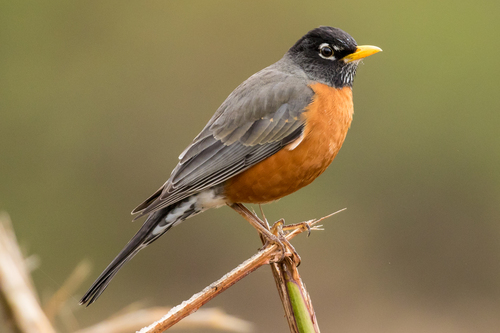
The wood thrush is a North American passerine bird in the family Turdidae and is the only species placed in the genus Hylocichla. It is closely related to other thrushes such as the American robin and is widely distributed across North America, wintering in Central America and southern Mexico. The wood thrush is the official bird of the District of Columbia. Wikipedia
What it can do
- iIts two-sided syrinx lets it sound two independent notes simultaneously, harmonising with itself
- iiMigrates at night across or around the Gulf of Mexico
- iiiForages by flicking through leaf litter for invertebrates
- ivRelies on calcium-rich prey such as snails when laying eggs
In the field
Field marks
- aBright cinnamon-rufous upperparts, brightest on the crown and nape
- bWhite underparts with large, round black spots
- cBold white eye-ring
- dPlump, short-tailed thrush shape
- Voice
- A three-part song: soft introductory notes, a liquid flute-like 'ee-oh-lay', then a trilled, buzzy flourish that may contain two notes at once; call a rapid 'pit-pit-pit'.
- Not to be confused with
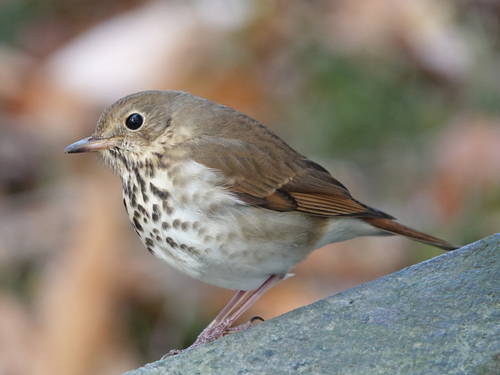
- Hermit Thrush has a rufous tail contrasting with a browner back and smaller spots. Veery has only faint spotting. Brown Thrasher has a long tail, yellow eyes, wing bars and streaks rather than round spots.
- Where to see it
- Shady deciduous forest across the eastern US — e.g. Great Smoky Mountains, Shenandoah, Rock Creek Park in Washington DC; dusk is the best time to hear it.
- When
- Summer visitor, late Apr–Sep
Listen
Looking for field recordings…
Life & habits
- Diet
- Leaf-litter insects, spiders, snails and earthworms; fruit before migration
- Habitat
- Moist, mature deciduous and mixed forest with a shrubby understorey
- Size
- 18–21 cm; 40–50 g
- Lifespan
- Banding record about 9 years
It often adds white material — paper, plastic or birch bark — to the base of its nest.
Where it lives
Recorded sightings
—
geo-referenced records in GBIF, from museums, herbaria and field observers.
Native range
Breeds in eastern North America; winters from southern Mexico to Panama
Drag the globe to turn it. Dots are where records exist, not a range map; darker means more records.
In the old herbals & bestiaries
No plate in the Source Library names this exact species, so these show its closest relatives as the old naturalists drew them: same genus, or the same kind of animal. Click a plate to read the page it came from, with translation.

History of Animals, Book I: On Viviparous Quadrupeds
Relative · Conrad Gessner · 1554 · p.913

Historiae Animalium Liber III: De Avium Natura
Relative · Conrad Gesner · 1555 · p.762

Historiae Animalium Liber III: De Avium Natura
Relative · Conrad Gesner · 1555 · p.768

A voyage to the islands Madera Barbados Jamaica Vol. 1
Relative · Hans Sloane · 1707 · p.620

History of Animals, Book I: On Viviparous Quadrupeds
Relative · Conrad Gessner · 1554 · p.907

Noah's Ark
Relative · Athanasius Kircher · 1675 · p.137

The Natural History of Carolina, Florida and the Bahama Islands, Vol. 1
Relative · Mark Catesby · 1777 · p.107

The Natural History of Carolina, Florida and the Bahama Islands, Vol. 1
Relative · Mark Catesby · 1777 · p.110

The Secrets of Albertus Magnus on the Nature of Women and the Virtues of Herbs
Relative · Albertus, Magnus, Heiliger · 1604 · p.74
In the stacks
Searching the stacks…
Every page naming Hylocichla mustelina in the Biodiversity Heritage Library →
Marginalia
Henry David Thoreau praised its song repeatedly in his journals as the finest of any bird, and it has been the official bird of the District of Columbia since 1938.
Curiosity
Breeding Bird Survey counts show the wood thrush has declined by roughly half since the 1960s, largely through forest fragmentation and wintering-habitat loss.
Kinship


Fact-checked: 1 correction made to this sheet. Photographs: iNaturalist contributors under the licences shown. Records: GBIF.org. Historical plates: Source Library (CC BY-SA 4.0; originals public domain). Summary text: Nature Library editors and Wikipedia (CC BY-SA). Medicinal and edibility notes are historical and educational, not advice. iNaturalist taxon 13270.