 NL·0177
Herbarium of the Nature Library
- Name
- Coprinus comatus
- Family
- Agaricaceae
- Native to
- Cosmopolitan in temperate regions; Europe, Asia, North America, and introduced elsewhere
- Habitat
- Grassland, Lawns, Roadsides, Disturbed ground
Shaggy ink cap (shaggy mane)
Coprinus comatus
Also calledJi tui gu 鸡腿菇 (Chinese, 'chicken-leg mushroom') · Schopf-Tintling (German) · Coprin chevelu (French) · Lawyer's wig (English)
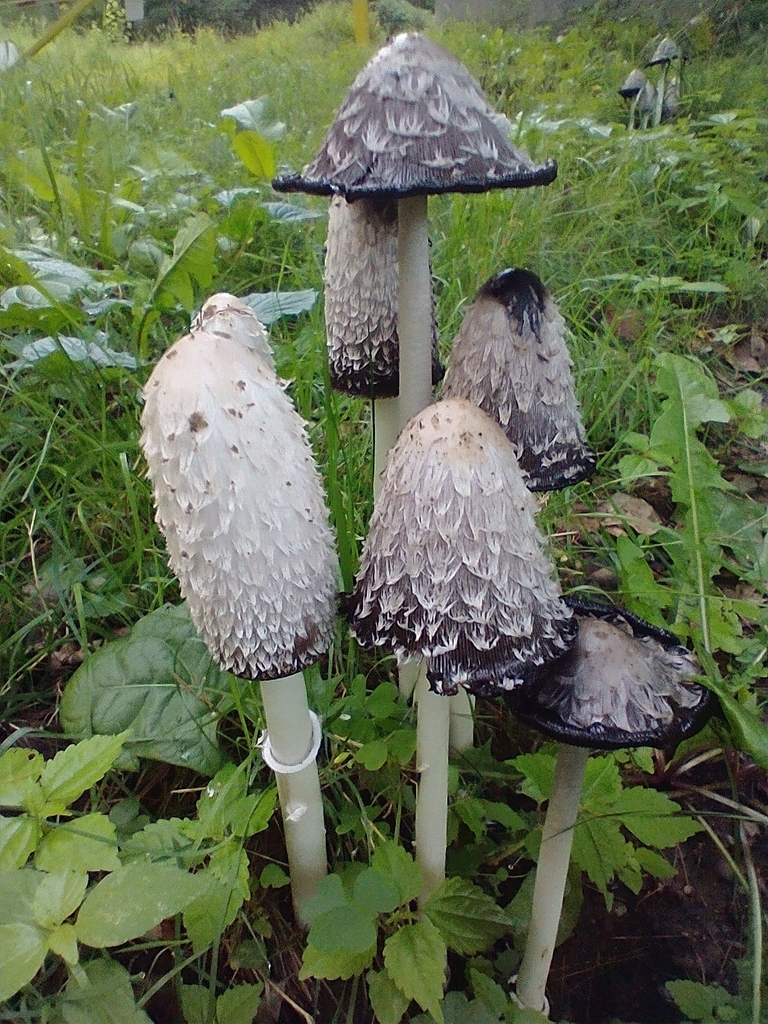
A tall, shaggy white cylinder that pushes up through lawns and roadsides, sometimes even through asphalt. Within hours of picking it digests itself from the bottom up into black ink. It has also been found to trap and digest nematode worms.
Coprinus comatus, commonly known as the shaggy ink cap, lawyer's wig, or shaggy mane, is a species of fungus. The young fruit bodies first appear as white cylinders emerging from the ground, then the bell-shaped caps open out. The white caps are covered with scales, the origin of its common names. The gills beneath the cap are white, then pink, then turn black. This mushroom is unusual because it will turn black and dissolve itself in a matter of hours after being picked or depositing spores. Wikipedia
What it can do
- iAutodigests (deliquesces) its gills into black, spore-laden ink as the spores mature
- iiImmobilises and digests nematodes using spiny cell structures and a toxin (first reported in 2004)
- iiiCan push through hard ground and thin tarmac by growth pressure
- ivAccumulates heavy metals and arsenic from polluted soil
At the table
Eatenyoung white caps (cooked soon after picking)
Good edible when young and white, cooked within a few hours of picking. Lookalikes: the common ink cap (Coprinopsis atramentaria), which contains coprine and causes a severe alcohol reaction (flushing, palpitations, vomiting) if alcohol is drunk with the meal or up to about three days afterwards; and white Amanita and Lepiota species, which have white gills, a volva or ring and white spore prints. Shaggy ink cap gills turn pink then black, and its spore print is black. Avoid collecting it on roadsides or polluted ground.
Fruiting body & spores
Spores
Spore print black; spores ellipsoid, smooth, with a germ pore, about 10–15 × 6–8.5 µm
- Dispersal
- Wind-borne basidiospores shed as the gills liquefy from the cap edge upward
How to cultivate it
Hardiness (USDA zones)
- Light
- Partial shade
- Water
- Keep moist
- Soil
- Composted manure, straw-based compost or rich lawn soil
- Propagation
- Grain spawn mixed into compost
- To harvest
- About 4–8 weeks after casing
- Climates
- Temperate
- 1Mix spawn into pasteurised composted manure or straw compost in a tray or outdoor bed
- 2Incubate at about 22–26 °C until colonised
- 3Cover with a 2–3 cm 'casing' layer of moist soil
- 4Fruit at 15–20 °C with high humidity; harvest while caps are tight and white
Where it lives
Recorded sightings
—
geo-referenced records in GBIF, from museums, herbaria and field observers.
Native range
Cosmopolitan in temperate regions; Europe, Asia, North America, and introduced elsewhere
Drag the globe to turn it. Dots are where records exist, not a range map; darker means more records.
In the old herbals & bestiaries
Woodcuts and engravings matched from the Source Library’s scanned books by name. Plates marked “relative” show a close kin rather than this exact species. Click a plate to read the page it came from, with translation.

Illustrations of Fungi which Grow in Bavaria and the Palatinate around Ratisbon, Vols 1–2
Jacob Christian Schaeffer; C.H. Persoon (ed.) · 1800 · p.121

Illustrations of Fungi which Grow in Bavaria and the Palatinate around Ratisbon, Vols 1–2
Jacob Christian Schaeffer; C.H. Persoon (ed.) · 1800 · p.122

Iconography of the Mushrooms of Paulet
J.H. Léveillé; plates by Paulet · 1855 · p.422
In the stacks
Searching the stacks…
Every page naming Coprinus comatus in the Biodiversity Heritage Library →
Marginalia
Ink caps (this and the common ink cap) were once boiled down for writing and drawing ink, as their name suggests. Commercial cultivation as 'ji tui gu' in China expanded from the 1980s.
Curiosity
Self-digestion is the point: the gills liquefy from the bottom edge up so that each newly exposed layer of spores can drop freely.
Kinship


Fact-checked: 1 correction made to this sheet. Photographs: iNaturalist contributors under the licences shown. Records: GBIF.org. Historical plates: Source Library (CC BY-SA 4.0; originals public domain). Summary text: Nature Library editors and Wikipedia (CC BY-SA). Medicinal and edibility notes are historical and educational, not advice. iNaturalist taxon 47392.