 NL·0563
Herbarium of the Nature Library
- Name
- Danaus plexippus
- Family
- Nymphalidae
- Native to
- North, Central and South America; established in Australia, New Zealand, Pacific islands, Iberia and the Canaries
- Habitat
- Temperate grassland, Meadow, Oyamel fir forest (winter), Farmland edges
Monarch butterfly
Danaus plexippus
Also calledMariposa monarca (Spanish) · Papillon monarque (French) · Jiāngbān dié (Chinese) · Kahuli (Hawaiian, for introduced monarchs)
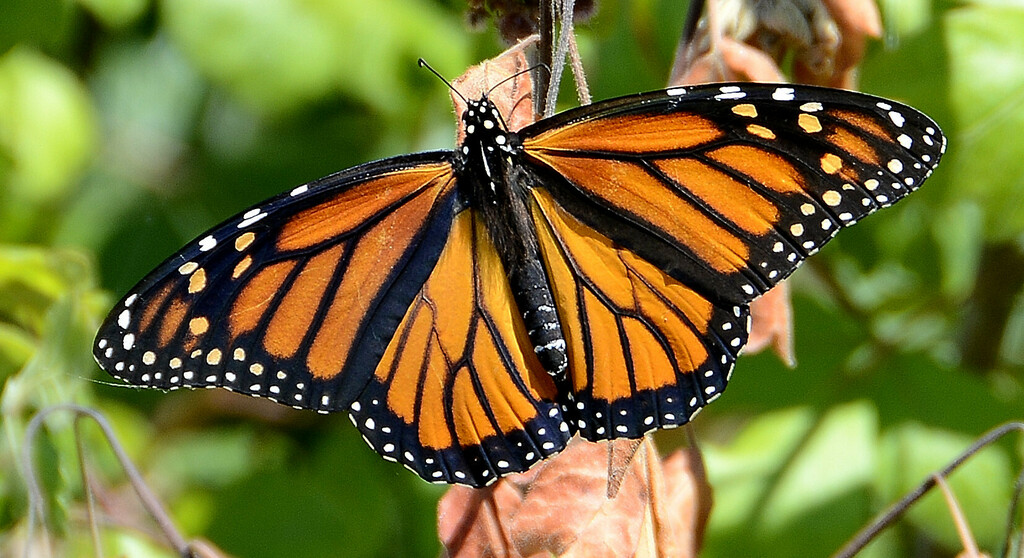
An orange-and-black butterfly whose eastern North American population flies up to about 4,800 km to winter in a few mountain fir forests in central Mexico. No individual makes the round trip: the journey north is completed over several generations by its descendants.
The monarch butterfly or simply monarch is a milkweed butterfly in the family Nymphalidae. Other common names, depending on region, include milkweed, common tiger, wanderer, and black-veined brown. It is among the most familiar of North American butterflies and an iconic pollinator, although it is not an especially effective pollinator of milkweeds. Its wings feature an easily recognizable black, orange, and white pattern, with a wingspan of 8.9–10.2 cm (3.5–4.0 in). A Müllerian mimic, the viceroy butterfly, is similar in color and pattern, but is markedly smaller and has an extra black stripe across each hindwing. Wikipedia
What it can do
- iNavigates with a time-compensated sun compass housed in its antennae and brain
- iiCan sense Earth's magnetic field as a backup compass
- iiiCaterpillars sequester toxic cardenolides from milkweed, making adults distasteful to birds
- ivThe autumn 'super generation' lives up to ~8 months, versus 2–6 weeks for summer generations
- vClusters by the millions on single trees in Mexico's oyamel forests
In the field
Field marks
- aLarge orange butterfly with heavy black veins
- bBlack wing borders with two rows of white spots
- cMales have a small black scent spot on a vein of each hindwing
- dCaterpillar banded yellow, black and white, on milkweed
- Not to be confused with
- Viceroy (Limenitis archippus) is smaller and has a black line crossing the hindwing veins. Queen (Danaus gilippus) is darker chestnut with white spots scattered on the forewing and much thinner black veins.
- Where to see it
- Monarch Butterfly Biosphere Reserve in Michoacán, Mexico (El Rosario, Sierra Chincua); Pacific Grove and Pismo Beach groves in California; Point Pelee and Cape May during the autumn migration
- When
- Mexico roosts Nov–Mar; California groves Nov–Feb; breeding across the US and Canada in summer; southward migration Aug–Oct
Listen
Looking for field recordings…
Life & habits
- Diet
- Larvae eat milkweeds (Asclepias); adults drink nectar
- Habitat
- Open fields and meadows with milkweed; overwinters in high-altitude fir forest or coastal Californian groves
- Size
- Wingspan 8.9–10.2 cm
- Lifespan
- 2–6 weeks for summer adults; up to 8 months for migrants
Migrants enter reproductive diapause, travel south on thermals and tailwinds, and roost in dense clusters that keep them cool but above freezing all winter.
Where it lives
Recorded sightings
—
geo-referenced records in GBIF, from museums, herbaria and field observers.
Native range
North, Central and South America; established in Australia, New Zealand, Pacific islands, Iberia and the Canaries
Drag the globe to turn it. Dots are where records exist, not a range map; darker means more records.
In the stacks
Searching the stacks…
Every page naming Danaus plexippus in the Biodiversity Heritage Library →
Marginalia
The Purépecha and Mazahua people of Michoacán long linked the butterflies' arrival in early November with the Day of the Dead and the returning souls of ancestors. Scientists only located the Mexican wintering grounds in 1975, with help from local residents.
Curiosity
The migratory North American subspecies was listed as Endangered by the IUCN in 2022, then reassessed as Vulnerable in 2023; the species as a whole is Least Concern.
Kinship


Fact-checked: 2 corrections made to this sheet. Photographs: iNaturalist contributors under the licences shown. Records: GBIF.org. Historical plates: Source Library (CC BY-SA 4.0; originals public domain). Summary text: Nature Library editors and Wikipedia (CC BY-SA). Medicinal and edibility notes are historical and educational, not advice. iNaturalist taxon 48662.