 NL·0051
Herbarium of the Nature Library
- Name
- Dionaea muscipula
- Family
- Droseraceae
- Native to
- Coastal plain wetlands within roughly 120 km of Wilmington, North and South Carolina
- Habitat
- Longleaf pine savanna, Pocosin wetland edges
Venus flytrap
Dionaea muscipula
Also calledTippitiwitchet (historic Carolina name) · Dionée attrape-mouche (French) · Venusfliegenfalle (German) · Atrapamoscas (Spanish) · 捕蝇草 bǔyíngcǎo (Chinese) · Hae-torigusa ハエトリグサ (Japanese)
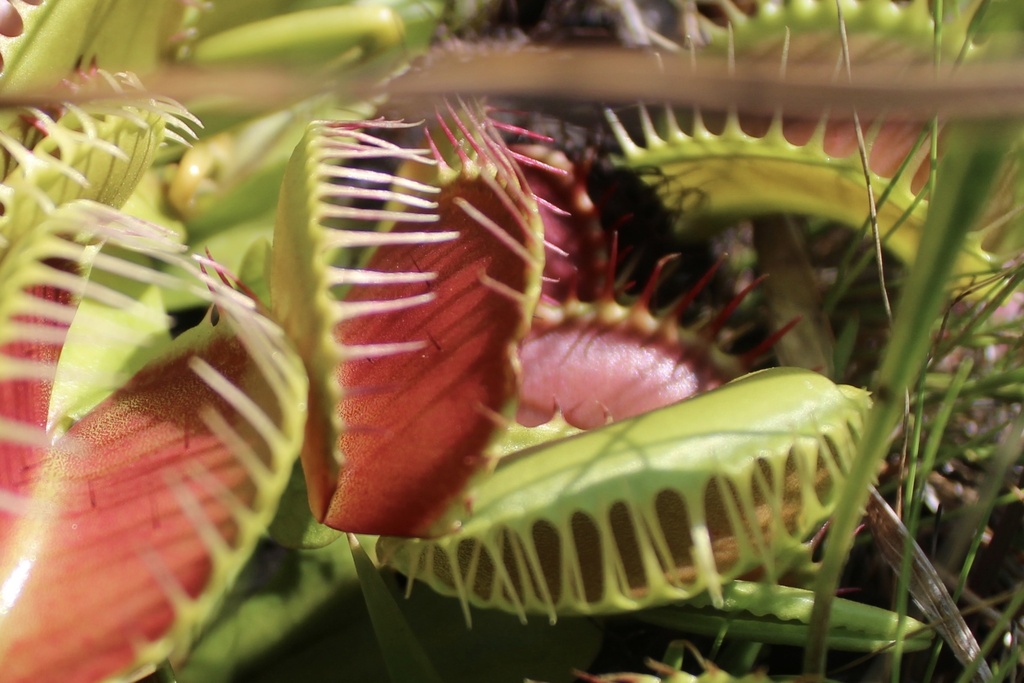
A plant that counts. Its hinged leaf-traps snap shut in about a tenth of a second, but only after two touches of the trigger hairs within about 20 seconds, and it starts making digestive enzymes only after more touches. In the wild it grows only in a small area of the Carolinas.
The Venus flytrap is a carnivorous plant native to the temperate and subtropical wetlands of North Carolina and South Carolina, on the East Coast of the United States. Although various modern hybrids have been created in cultivation, D. muscipula is the only species of the monotypic genus Dionaea. It is closely related to the waterwheel plant and the cosmopolitan sundews (Drosera), all of which belong to the family Droseraceae. Dionaea catches its prey—chiefly insects and arachnids—with a "jaw"-like clamping structure, which is formed by the terminal portion of each of the plant's leaves; when an insect makes contact with the open leaves, vibrations from the prey's movements ultimately trigger the "jaws" to shut via tiny hairs on their inner surfaces. Additionally, when an insect or spider touches one of these hairs, the trap prepares to close, only fully enclosing the prey if a second hair is contacted within (approximately) twenty seconds of the first contact. Triggers may occur as quickly as 1⁄10 of a second from initial contact. Wikipedia
What it can do
- iSnaps its trap in about 100 milliseconds using stored elastic energy that flips the leaf's curvature
- iiCounts trigger-hair touches: two to close, five or so to start full digestion
- iiiSends electrical action potentials through the leaf, much like a nerve
- ivGets nitrogen and phosphorus from prey, which lets it grow in very poor, boggy soils
- vDepends on regular fire to keep competing plants from shading it
At the table
Not eaten. Not significantly toxic.
Fruit & seed
Fruit
Capsule
Ripens: Early summer
Small capsules on a tall stalk, held well above the traps so pollinators are not caught.

Seed
~1 mm
Shiny black pear-shaped seeds
- Dispersal
- Drop near the parent
- Germination
- Surface-sow on damp peat-sand; 2–4 weeks in light and warmth
Photographs from Wikimedia Commons under open licences; hover for the photographer, click for the file.
How to grow it
Hardiness (USDA zones)
USDA 7–10 outdoors (needs winter dormancy). Survives winters down to about -18 °C.
- Light
- Full sun
- Water
- Constantly moist with rainwater or distilled water only
- Soil
- Unfertilised sphagnum peat with sand or perlite
- Propagation
- Seed, leaf pullings, rhizome division
- To harvest
- Mature in 3–5 years from seed
- Climates
- Subtropical, Temperate
- 1Pot in pure peat and perlite (no fertiliser, no potting compost)
- 2Stand the pot in a tray of rainwater in full sun
- 3Never use tap water with dissolved minerals and never fertilise the soil
- 4Give a cool winter dormancy (around 0–10 °C) for 3–4 months
Can it grow where you are?
Where it lives
Recorded sightings
—
geo-referenced records in GBIF, from museums, herbaria and field observers.
Native range
Coastal plain wetlands within roughly 120 km of Wilmington, North and South Carolina
Drag the globe to turn it. Dots are where records exist, not a range map; darker means more records.
In the stacks
Searching the stacks…
Every page naming Dionaea muscipula in the Biodiversity Heritage Library →
Marginalia
Governor Arthur Dobbs of North Carolina described it in 1759, and Charles Darwin called it 'one of the most wonderful plants in the world' in Insectivorous Plants (1875). Since 2014, poaching wild flytraps in North Carolina has been a felony.
Curiosity
Small insects that can wriggle out between the 'teeth' are released on purpose; the trap does not seal for prey too small to be worth digesting.
Kinship


Photographs: iNaturalist contributors under the licences shown. Records: GBIF.org. Historical plates: Source Library (CC BY-SA 4.0; originals public domain). Summary text: Nature Library editors and Wikipedia (CC BY-SA). Medicinal and edibility notes are historical and educational, not advice. iNaturalist taxon 52666.