 NL·0471
Herbarium of the Nature Library
- Name
- Grus americana
- Family
- Gruidae
- Native to
- Wild flock breeds in Wood Buffalo National Park (Alberta/Northwest Territories) and winters at Aransas, Texas; reintroduced non-migratory birds in Louisiana and an eastern migratory flock in Wisconsin
- Habitat
- Boreal wetlands, Coastal salt marsh, Prairie wetlands
On eBird ↗
Whooping Crane
Live sightings near you, the range map, bar charts of when it is seen, and Macaulay Library photos and recordings.
Whooping crane
Grus americana
Also calledGrulla blanca (Spanish) · Grulla trompetera (Spanish) · Grue blanche (French)
The tallest bird in North America, a white crane whose only migratory flock fell to about 15 birds in 1941. Protection of its only wild migratory flock, which nests in Canada's Wood Buffalo National Park and winters on the Texas coast, has brought it back to several hundred.
The whooping crane is an endangered crane species, native to North America, named for its "whooping" calls. Along with the sandhill crane, it is one of only two crane species native to North America, and it is also the tallest North American bird species, with an estimated 22–30+ year life expectancy in the wild. After being pushed to the brink of extinction by unregulated hunting and loss of habitat that left just 21 wild cranes by 1941, the whooping crane made a partial recovery through conservation efforts. The total number of cranes in the surviving migratory population, plus three reintroduced flocks and in-captivity, is just over 830 birds as of 2025. This includes about 560 individuals in the remnant population that migrates between coastal Texas, US, and the Northwest Territories, Canada, which is termed the "Aransas-Wood Buffalo Population" after the protected areas that anchor the population's wintering and breeding ranges, respectively. Additionally, there are about 140 individuals in two reintroduced populations breeding in Wisconsin and Louisiana, US, and an additional 130 individuals in captivity. Wikipedia
What it can do
- iMigrates about 4,000 km between Canada and the Gulf of Mexico
- iiWindpipe up to about 1.5 m long, coiled in the breastbone, amplifying its bugle
- iiiPairs bond for life and defend large winter territories in salt marsh
- ivCaptive-raised cranes have been taught migration routes by following ultralight aircraft (2001–2015)
In the field
Field marks
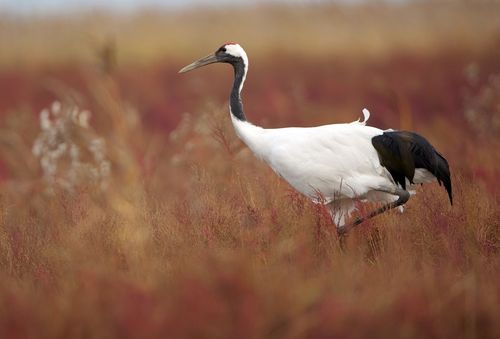
- aSnow-white body and very tall stature
- bBlack primary feathers visible as black wingtips in flight
- cRed crown and black 'moustache' on the face
- dJuveniles mottled cinnamon and white
- Voice
- A loud, clear, trumpeting 'whoop-whoop' unison call that carries several kilometres.
- Not to be confused with
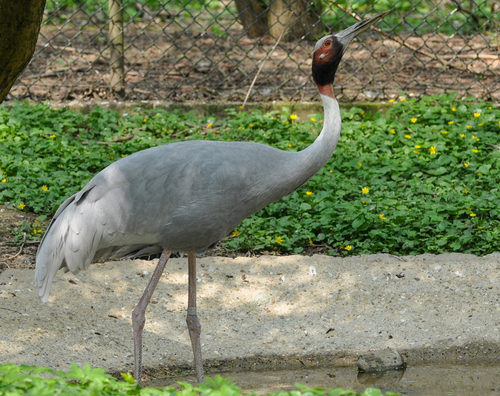
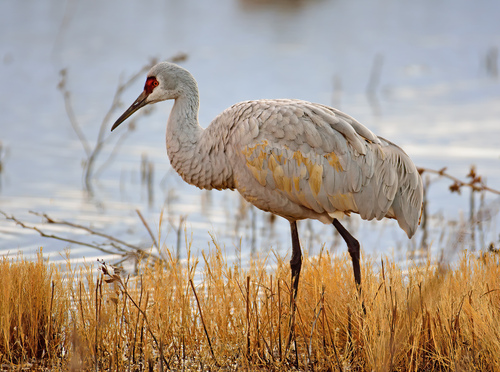
- American White Pelican has black on the whole outer wing and a huge bill. Wood Stork has a dark bare head and black trailing wing edges. Great Egret flies with neck folded. Sandhill Crane is grey.
- Where to see it
- Aransas National Wildlife Refuge and boat tours from Rockport–Fulton, Texas (Nov–Mar); Necedah NWR, Wisconsin (eastern flock).
- When
- Winter at Aransas Nov–Mar; breeding in Wood Buffalo May–Sep
Listen
Looking for field recordings…
Life & habits
- Diet
- Blue crabs, clams, wolfberries and acorns in winter; insects, frogs, fish and plants in summer
- Habitat
- Remote boreal marshes for breeding; coastal salt marshes and bays in winter
- Size
- About 1.5 m tall; wingspan 2–2.3 m; 4.5–8.5 kg
- Lifespan
- About 22–30 years in the wild
Pairs usually lay two eggs but often raise only one chick.
Where it lives
Recorded sightings
—
geo-referenced records in GBIF, from museums, herbaria and field observers.
Native range
Wild flock breeds in Wood Buffalo National Park (Alberta/Northwest Territories) and winters at Aransas, Texas; reintroduced non-migratory birds in Louisiana and an eastern migratory flock in Wisconsin
Drag the globe to turn it. Dots are where records exist, not a range map; darker means more records.
In the old herbals & bestiaries
Woodcuts and engravings matched from the Source Library’s scanned books by name. Plates marked “relative” show a close kin rather than this exact species. Click a plate to read the page it came from, with translation.

In the stacks
Searching the stacks…
Every page naming Grus americana in the Biodiversity Heritage Library →
Marginalia
Its nesting grounds were not found until 1954, when a forest-fire crew spotted cranes in Wood Buffalo National Park; it was among the first species listed as endangered in the United States, in 1967.
Curiosity
The US Fish and Wildlife Service estimated about 540 whooping cranes wintered in and around Aransas in 2025–26, up from roughly 15 in 1941.
Kinship
Fact-checked: 1 correction made to this sheet. Photographs: iNaturalist contributors under the licences shown. Records: GBIF.org. Historical plates: Source Library (CC BY-SA 4.0; originals public domain). Summary text: Nature Library editors and Wikipedia (CC BY-SA). Medicinal and edibility notes are historical and educational, not advice. iNaturalist taxon 34.