 NL·0483
Herbarium of the Nature Library
- Name
- Hippopotamus amphibius
- Family
- Hippopotamidae
- Native to
- Sub-Saharan Africa, in rivers, lakes and swamps from Senegal and Sudan to South Africa; feral population in Colombia
- Habitat
- Rivers and streams, Freshwater lakes, Floodplain, Savanna
Common hippopotamus
Hippopotamus amphibius
Also calledKiboko (Swahili) · Imvubu (Zulu) · Erinmi (Yoruba) · Faras al-nahr, 'river horse' (Arabic) · Hémǎ 河马 (Chinese)
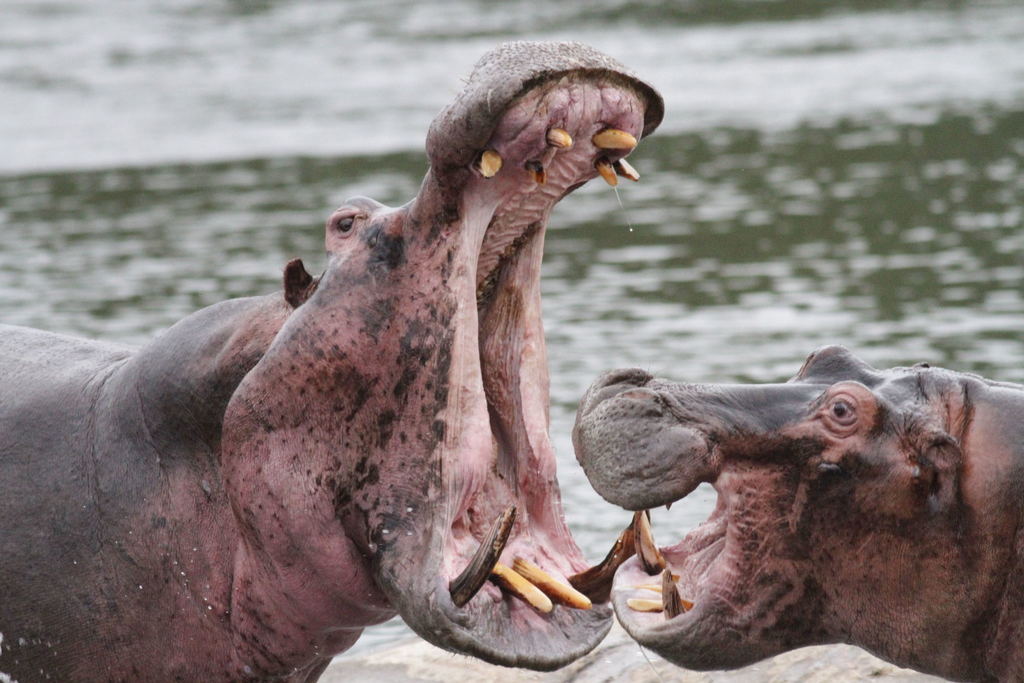
A huge, semi-aquatic grazer that spends its days in rivers and lakes and comes ashore at night to graze. Despite its plant diet it is one of Africa's most dangerous animals to people.
The hippopotamus, often shortened to hippo, further qualified as the common hippopotamus, Nile hippopotamus and river hippopotamus, is a large semiaquatic mammal native to sub-Saharan Africa. It is one of only two extant species in the family Hippopotamidae, the other being the pygmy hippopotamus. Its name comes from the Ancient Greek for "river horse" (ἱπποπόταμος). Wikipedia
What it can do
- iSecretes a red 'blood sweat' (hipposudoric acid) that acts as sunscreen and inhibits bacteria
- iiHolds its breath for about five minutes, walking or bouncing along river bottoms instead of swimming
- iiiMoves huge amounts of grass-derived nutrients into rivers in its dung, fuelling fish and other life
- ivOpens its mouth to about 150° to show tusks up to ~50 cm long
In the field
Field marks
- aHuge, barrel-shaped body
- bGrey-brown skin with pink areas
- cLarge head with eyes and nostrils on top
- dSpends days in water
- Voice
- Loud wheezing honks and grunts
- Not to be confused with
- Pygmy hippo is smaller and lives in West African forests. Never approach on foot; watch from a vehicle, boat or hide, or with a licensed guide.
- Where to see it
- Chobe River (Botswana), South Luangwa (Zambia) and Murchison Falls (Uganda)
- When
- Resident
Listen
Looking for field recordings…
Life & habits
- Diet
- Herbivore: grazes up to ~40 kg of grass a night
- Habitat
- Rivers, lakes and swamps beside grassland
- Size
- Males usually 1,500–3,200 kg; up to ~1.6 m at the shoulder
- Lifespan
- 40–50 years
Males mark territories by spinning their tails to spray dung. Groups of dozens crowd together in the water by day.
Where it lives
Recorded sightings
—
geo-referenced records in GBIF, from museums, herbaria and field observers.
Native range
Sub-Saharan Africa, in rivers, lakes and swamps from Senegal and Sudan to South Africa; feral population in Colombia
Drag the globe to turn it. Dots are where records exist, not a range map; darker means more records.
In the old herbals & bestiaries
Woodcuts and engravings matched from the Source Library’s scanned books by name. Plates marked “relative” show a close kin rather than this exact species. Click a plate to read the page it came from, with translation.

Kircher: China Illustrata (1667)
Athanasius Kircher · 1667 · p.262

Georg Wolfgang Knorr — Deliciae naturae selectae (1771)
Georg Wolfgang Knorr · 1771 · p.352

Garden of Health (Hortus Sanitatis)
Jacob Meydenbach · 1491 · p.653

Ortus sanitatis
1491 · p.731

Flora Sinensis (Chinese-Latin Natural History)
Michał Boym · 1656 · p.69

Garden of Health
Jacob Meydenbach · 1491 · p.729

History of Animals, Book II: On Oviparous Quadrupeds
Conrad Gessner · 1586 · p.723

History of Monsters
Ulisse Aldrovandi · 1642 · p.931

Noah's Ark
Athanasius Kircher · 1675 · p.118

Ortus sanitatis
1491 · p.601
In the stacks
Searching the stacks…
Every page naming Hippopotamus amphibius in the Biodiversity Heritage Library →
Marginalia
In ancient Egypt the hippo goddess Taweret protected women in childbirth, and blue faience hippos were placed in tombs. Many scholars think the Behemoth of the Book of Job was inspired by the hippopotamus.
Curiosity
Pablo Escobar's four hippos in Colombia have grown into a wild herd of over 150, now the largest hippo population outside Africa.
Kinship


Photographs: iNaturalist contributors under the licences shown. Records: GBIF.org. Historical plates: Source Library (CC BY-SA 4.0; originals public domain). Summary text: Nature Library editors and Wikipedia (CC BY-SA). Medicinal and edibility notes are historical and educational, not advice. iNaturalist taxon 42149.