 NL·0492
Herbarium of the Nature Library
- Name
- Hymenopus coronatus
- Family
- Hymenopodidae
- Native to
- Malaysia, Indonesia, Thailand and nearby Southeast Asia
- Habitat
- Tropical rainforest
Orchid mantis
Hymenopus coronatus
Also calledBelalang sembah orkid (Malay) · Lánhuā tángláng (Chinese) · Walking flower mantis (English)
A pink-and-white mantis with petal-shaped legs that looks like a flower. It does not hide on orchids but sits in the open and lures pollinating insects to itself.
Hymenopus coronatus is a mantis from the tropical forests of Southeast Asia. It is known by various common names, including walking flower mantis, orchid-blossom mantis and (pink) orchid mantis. It is one of several species known as flower mantises, a reference to their unique physical form and behaviour, which often involves moving with a "swaying" motion, as if being "blown" in the breeze. The species has evolved to mimic orchid flowers as a hunting and camouflaging strategy, "hiding" themselves in plain view and preying upon pollinating insects that visit the blooms. They then grab their prey with sudden speed. Wikipedia
What it can do
- iAggressive mimicry of a generic flower that attracts pollinators
- iiLured more pollinators than real flowers in field experiments (O'Hanlon et al. 2014)
- iiiTo bee and fly eyes its colour is hard to distinguish from real flowers
- ivCan shift colour slightly between pink and white
In the field
Field marks
- aWhite to pink mantis shaped like an orchid petal
- bWalking legs with broad, petal-like lobes
- cFemales much larger than males
- dSits motionless on or near flowers
Listen
Looking for field recordings…
Life & habits
- Diet
- Bees, flies, butterflies and other flower-visiting insects
- Habitat
- Shrubs and flowers in rainforest
- Size
- Females ~6–7 cm; males ~2.5 cm
- Lifespan
- About 6–8 months
Females are more than twice the size of males; tiny males avoid being eaten by approaching cautiously.
Where it lives
Recorded sightings
—
geo-referenced records in GBIF, from museums, herbaria and field observers.
Native range
Malaysia, Indonesia, Thailand and nearby Southeast Asia
Drag the globe to turn it. Dots are where records exist, not a range map; darker means more records.
In the old herbals & bestiaries
No plate in the Source Library names this exact species, so these show its closest relatives as the old naturalists drew them: same genus, or the same kind of animal. Click a plate to read the page it came from, with translation.

Georg Wolfgang Knorr — Deliciae naturae selectae (1771)
Relative · Georg Wolfgang Knorr · 1771 · p.134

Books on Marine Fishes
Relative · Guillaume Rondelet · 1554 · p.572

Commentaries on the Six Books of Dioscorides on Medical Matter
Relative · Pietro Andrea Mattioli · 1563 · p.280

History of Animals, Book II: On Oviparous Quadrupeds
Relative · Conrad Gessner · 1586 · p.588

Theater of Insects
Relative · Conrad Gessner; Thomas Moffet; Edward Wotton · 1634 · p.350

Historia naturalis Brasiliae
Relative · Willem Piso / Georg Marcgraf · 1648 · p.332

Georg Wolfgang Knorr; Johann Ernst Immanuel Walch — Schnecken und Muscheln (1770)
Relative · Georg Wolfgang Knorr; Johann Ernst Immanuel Walch · 1770 · p.117
In the stacks
Searching the stacks…
Every page naming Hymenopus coronatus in the Biodiversity Heritage Library →
Marginalia
An 1879 account by the traveller James Hingston described a mantis from Java catching butterflies while posing as an orchid, fuelling Victorian fascination with mimicry.
Curiosity
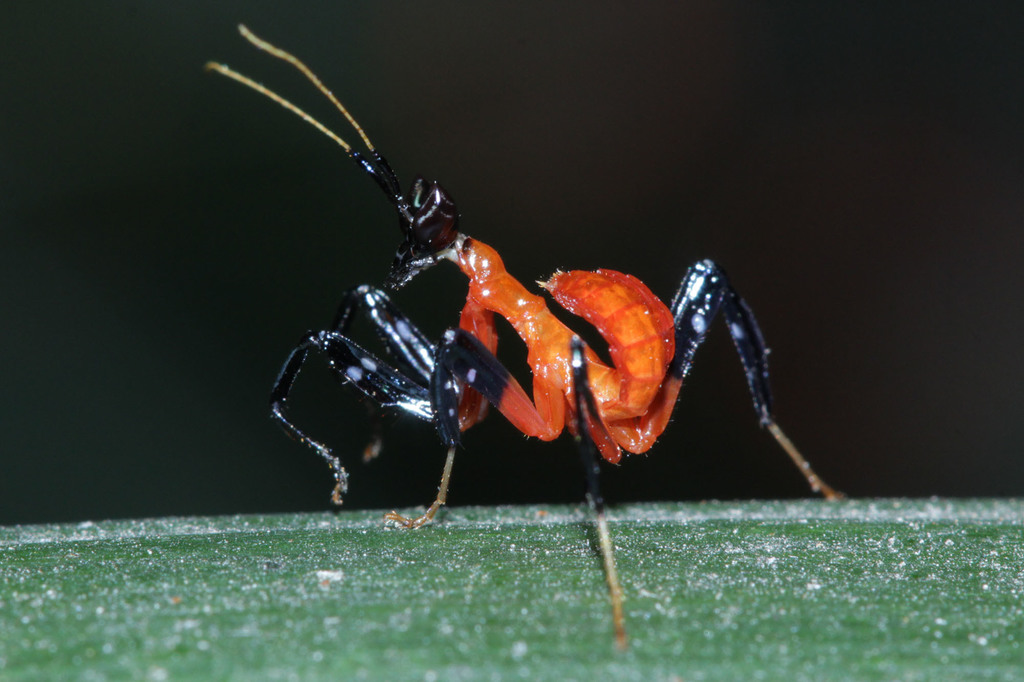
Young nymphs are red and black, mimicking a foul-tasting assassin bug before they turn pink.
Kinship





Fact-checked: 2 corrections made to this sheet. Photographs: iNaturalist contributors under the licences shown. Records: GBIF.org. Historical plates: Source Library (CC BY-SA 4.0; originals public domain). Summary text: Nature Library editors and Wikipedia (CC BY-SA). Medicinal and edibility notes are historical and educational, not advice. iNaturalist taxon 460388.