 NL·0500
Herbarium of the Nature Library
- Name
- Indicator indicator
- Family
- Indicatoridae
- Native to
- Sub-Saharan Africa outside the densest rainforest and driest deserts
- Habitat
- Savanna, Open woodland
On eBird ↗
Greater Honeyguide
Live sightings near you, the range map, bar charts of when it is seen, and Macaulay Library photos and recordings.
Greater honeyguide
Indicator indicator
Also calledGrootheuningwyser (Afrikaans) · Indicateur majeur (French)
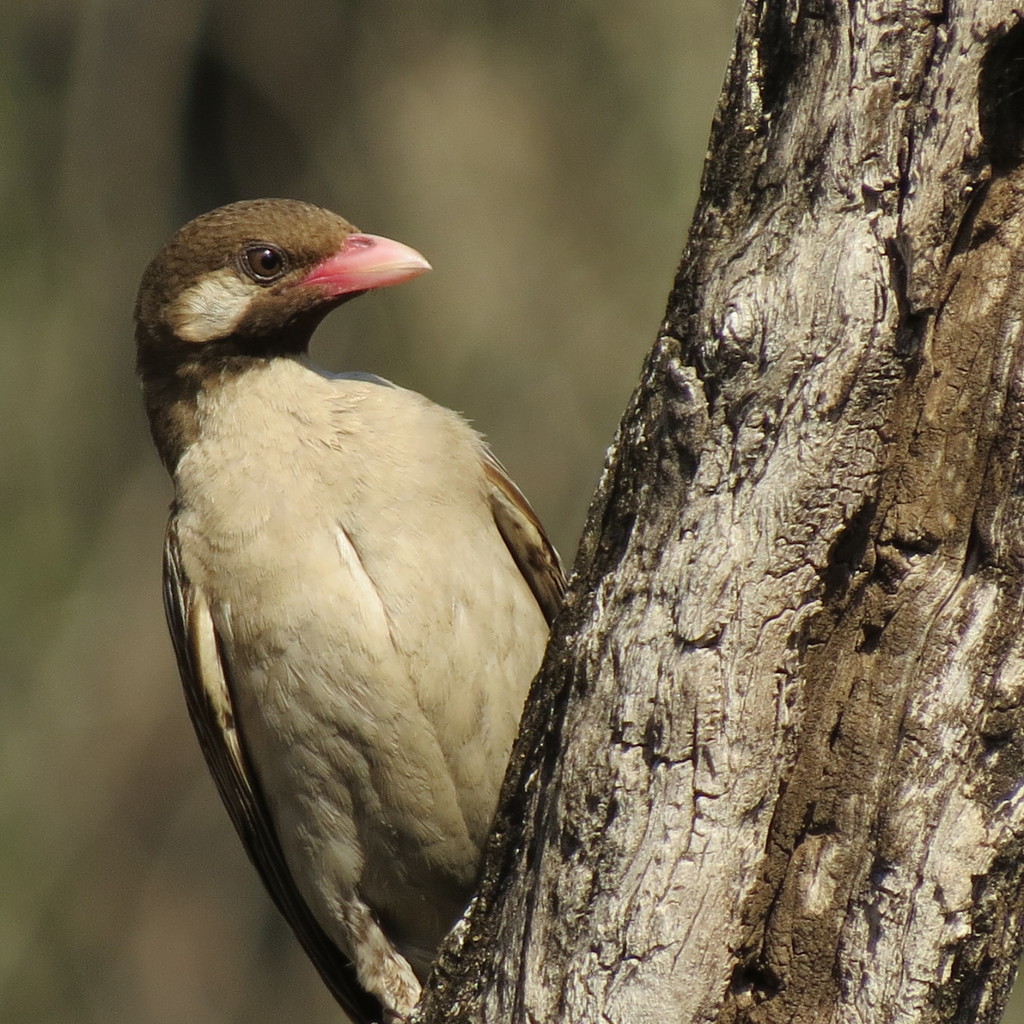
A drab woodland bird with an extraordinary partnership: it leads people to wild bees' nests and feeds on the wax left after the honey is taken. It is also a brood parasite whose chicks kill their foster siblings.
The greater honeyguide is a bird in the paleotropical family Indicatoridae, that is related to the woodpeckers. Its English and scientific names refer to its habit of guiding people to bee colonies. Claims that it also guides non-human animals are disputed. Wikipedia
What it can do
- iGuides humans to bees' nests with a chattering call and short flights
- iiResponds to specific human calls: Yao honey-hunters' 'brrr-hm' trill raises the chance of being guided
- iiiCan digest beeswax, a rare ability among vertebrates
- ivLays eggs in the nests of hole-nesting birds such as bee-eaters and barbets; the hatchling uses a hooked bill tip to kill host chicks
In the field
Field marks
- aMale: pink bill, black throat and white ear patch
- bGrey-brown upperparts with a yellow shoulder patch in males
- cWhite outer tail feathers flashed in flight
- dFemales and immatures plainer; juveniles have a yellow throat and breast
- Voice
- Male song a repeated, far-carrying 'vic-tor' or 'whit-purrr'; the guiding call is a persistent, dry chattering rattle.
- Not to be confused with
- Lesser honeyguide is smaller, olive-tinged, with a stubby dark bill and no black throat. Scaly-throated honeyguide has a scaly-patterned throat. Juvenile greater honeyguides, with yellow throats, can be mistaken for other small yellow-throated birds.
- Where to see it
- Niassa Special Reserve (Mozambique), where Yao honey-hunters still work with it; Hadza country around Lake Eyasi (Tanzania); miombo woodland in Zambia and Malawi
- When
- Resident year-round
Listen
Looking for field recordings…
Life & habits
- Diet
- Beeswax, bee larvae and eggs, and insects
- Habitat
- Miombo and acacia woodland and savanna
- Size
- About 20 cm; 40–55 g
When guiding, it flies ahead in short hops, calling and fanning its white-edged tail, and waits for its human followers to catch up.
Where it lives
Recorded sightings
—
geo-referenced records in GBIF, from museums, herbaria and field observers.
Native range
Sub-Saharan Africa outside the densest rainforest and driest deserts
Drag the globe to turn it. Dots are where records exist, not a range map; darker means more records.
In the old herbals & bestiaries
No plate in the Source Library names this exact species, so these show its closest relatives as the old naturalists drew them: same genus, or the same kind of animal. Click a plate to read the page it came from, with translation.

In the stacks
Searching the stacks…
Every page naming Indicator indicator in the Biodiversity Heritage Library →
Marginalia
Jesuit missionary João dos Santos described honeyguides eating candle wax in a Mozambique church in the 16th century. A 2016 study in Science showed that wild honeyguides learn and answer the Yao people's traditional honey-hunting call.
Curiosity
A 2023 study found that honeyguides in different regions have learned to respond to different local human calls, a cross-species culture.
Kinship





Photographs: iNaturalist contributors under the licences shown. Records: GBIF.org. Historical plates: Source Library (CC BY-SA 4.0; originals public domain). Summary text: Nature Library editors and Wikipedia (CC BY-SA). Medicinal and edibility notes are historical and educational, not advice. iNaturalist taxon 17570.