 NL·0626
Herbarium of the Nature Library
- Name
- Physalia physalis
- Family
- Physaliidae
- Native to
- Warm and temperate waters of the Atlantic, drifting widely; Indo-Pacific 'bluebottles' are now generally treated as separate Physalia species
- Habitat
- Open ocean surface
Portuguese man o' war
Physalia physalis
Also calledGalère portugaise (French) · Carabela portuguesa (Spanish) · Caravela-portuguesa (Portuguese) · Katsuo-no-eboshi (Japanese)
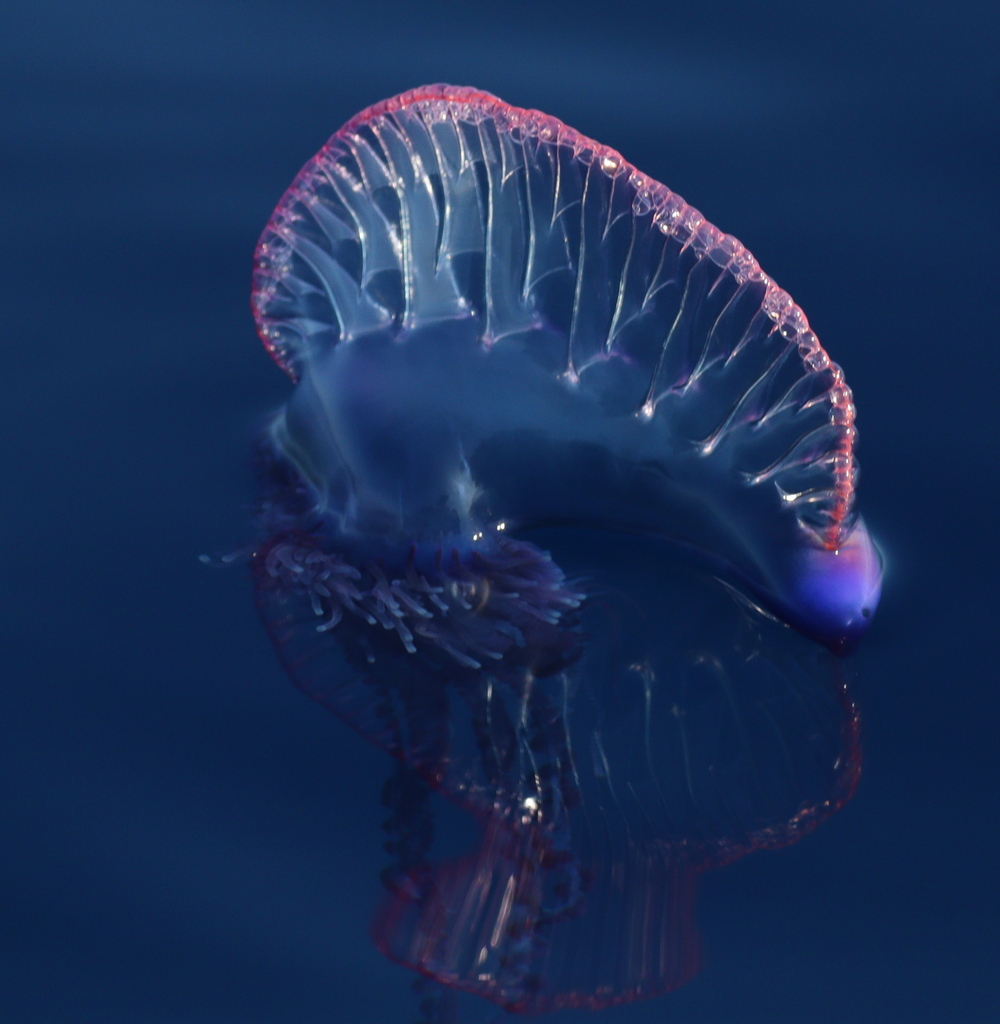
Not a jellyfish but a colony of specialised animals (zooids) that function as one organism, drifting on a gas-filled sail. Its tentacles, often around 10 m and sometimes far longer, deliver an extremely painful sting.
The Portuguese man o' war, also known as the man-of-war, bluebottle, or sometimes called Caravela Portuguesa, is a marine hydrozoan found in the Atlantic, Indian, and Pacific oceans. While it is typically considered the only species in its genus, Physalia, and family, Physaliidae, genetic evidence suggests there may be more. Wikipedia
What it can do
- iColony of zooids specialised for floating, catching prey, digestion and reproduction
- iiInflates its float with gas including carbon monoxide
- iiiSails can be angled left or right, so wind drives different individuals in different directions
- ivStinging cells remain active on stranded or dead specimens
In the field
Field marks
- aTranslucent, blue-violet, gas-filled float with a pink-edged crest
- bLong blue tentacles trailing below
- cOften stranded in rows along beaches after storms
- dNo bell or pulsing swimming
- Not to be confused with
- By-the-wind sailor (Velella velella) is a small, flat blue disc with a rigid diagonal sail and only short tentacles. Blue button (Porpita porpita) is a flat, round disc. Pacific bluebottles (Physalia utriculus) are smaller with a single main tentacle.
- Where to see it
- Atlantic beaches of Florida, the Caribbean, the Canary Islands and occasionally Britain and Ireland after strong westerlies. Do not touch stranded ones: their tentacles still sting.
- When
- Strandings follow onshore winds; Florida mostly winter, Europe often late summer–autumn
Life & habits
- Diet
- Small fish and fish larvae, shrimp and other plankton caught on the tentacles
- Habitat
- Surface of the open ocean; washed ashore by onshore winds
- Size
- Float up to about 30 cm; tentacles commonly about 10 m, recorded to 30 m
Tentacles contract to pull paralysed prey up to digestive zooids beneath the float.
Where it lives
Recorded sightings
—
geo-referenced records in GBIF, from museums, herbaria and field observers.
Native range
Warm and temperate waters of the Atlantic, drifting widely; Indo-Pacific 'bluebottles' are now generally treated as separate Physalia species
Drag the globe to turn it. Dots are where records exist, not a range map; darker means more records.
In the old herbals & bestiaries
Woodcuts and engravings matched from the Source Library’s scanned books by name. Plates marked “relative” show a close kin rather than this exact species. Click a plate to read the page it came from, with translation.

In the stacks
Searching the stacks…
Every page naming Physalia physalis in the Biodiversity Heritage Library →
Marginalia
Sailors named it after the Portuguese caravel or man-of-war, whose rounded sail its float resembles.
Curiosity
The blue sea slug (Glaucus atlanticus) eats man o' war tentacles and stores their unfired stinging cells in its own body for defence.
Kinship





Fact-checked: 1 correction made to this sheet. Photographs: iNaturalist contributors under the licences shown. Records: GBIF.org. Historical plates: Source Library (CC BY-SA 4.0; originals public domain). Summary text: Nature Library editors and Wikipedia (CC BY-SA). Medicinal and edibility notes are historical and educational, not advice. iNaturalist taxon 117302.