 NL·0166
Herbarium of the Nature Library
- Name
- Taxus baccata
- Family
- Taxaceae
- Native to
- Europe, North Africa (Atlas Mountains), western Asia to northern Iran
- Habitat
- Temperate broadleaf and mixed forest, Limestone cliffs, Churchyards
English yew (European yew)
Taxus baccata
Also calledEibe (German) · If (French) · Tejo (Spanish) · Iubhar (Irish/Gaelic) · Ywen (Welsh)
Europe's ancient churchyard tree, some individuals possibly 2,000 years old or more, and one of its most poisonous. Its needles and seeds contain taxine alkaloids that can stop the heart, yet its needles are also the starting material for the cancer drug docetaxel.
Taxus baccata is a species of coniferous tree in the family Taxaceae. It is the tree originally known as yew, though to distinguish it from related species it is sometimes called common yew, European yew, or, in North America, English yew. It is a woodland tree in its native range, which spans much of Europe and parts of West Asia, the Caucasus and Northwest Africa. All parts of the plant except the fleshy aril are poisonous, with toxins that can be absorbed through inhalation, ingestion, and transpiration through the skin. Wikipedia
What it can do
- iLives for many centuries; the Fortingall Yew in Scotland is estimated at 2,000–3,000 years
- iiRegrows from old wood and can send down internal roots inside its hollow trunk
- iiiTolerates deep shade and heavy pruning, which makes it ideal for hedges and topiary
- ivIts elastic heartwood and springy sapwood made the best longbows
At the table
Everything except the red fleshy aril is deadly; the seed inside the aril is toxic if chewed, so arils should not be eaten. Needles (fresh or dried) contain taxine B, causing dizziness, dry mouth, dilated pupils, vomiting, slow or irregular heartbeat and sudden cardiac arrest, sometimes within hours. Clippings are deadly to horses and cattle. Lookalikes: other dark conifers; children may eat the sweet red berries.
In the medicine cabinet
| Tradition | Use |
|---|---|
| Modern medicine | 10-deacetylbaccatin III from yew needles is used to semi-synthesise docetaxel and paclitaxel, chemotherapy drugs for breast, lung and prostate cancers |
| Unani (Himalayan yew, zarnab) | Leaves used for respiratory complaints |
Weight of evidence
Strong. An approved drug, or consistent results in well-run clinical trials.
Active compounds
taxine B, 10-deacetylbaccatin III, taxanes
Fruit & seed


Fruit
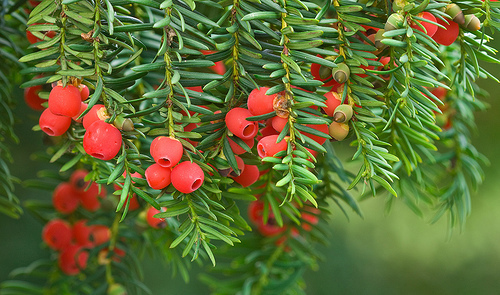
Aril (fleshy cup around seed)
Ripens: Autumn
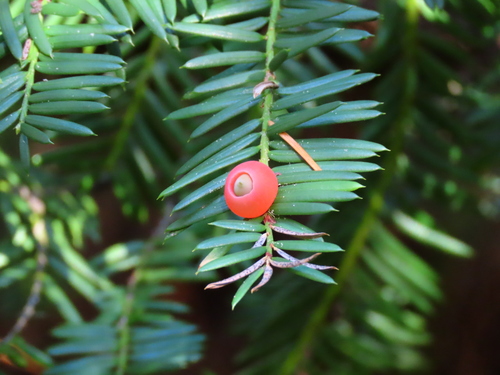
Bright red, juicy cups with a single dark seed visible at the opening.

Seed
~6–7 mm
Hard, dark seed in a red aril
- Dispersal
- Thrushes and other birds eat the arils and pass the seed
- Germination
- Needs warm then cold stratification; often takes two years
Photographs from Wikimedia Commons under open licences; hover for the photographer, click for the file.
How to grow it
Hardiness (USDA zones)
USDA 6–8. Survives winters down to about -23 °C.
- Light
- Full sun to deep shade
- Water
- Moderate; dislikes waterlogging
- Soil
- Any well-drained soil, including chalk
- Propagation
- Cuttings, seed
- To harvest
- Hedge in 5–10 years
- Climates
- Temperate, Oceanic
- 1Take semi-ripe cuttings in late summer
- 2Plant in well-drained soil; yew dies in waterlogged ground
- 3Clip annually for hedges or topiary
- 4Never let livestock or horses near clippings
Can it grow where you are?
Where it lives
Recorded sightings
—
geo-referenced records in GBIF, from museums, herbaria and field observers.
Native range
Europe, North Africa (Atlas Mountains), western Asia to northern Iran
Drag the globe to turn it. Dots are where records exist, not a range map; darker means more records.
In the old herbals & bestiaries
Woodcuts and engravings matched from the Source Library’s scanned books by name. Plates marked “relative” show a close kin rather than this exact species. Click a plate to read the page it came from, with translation.

The Dutch Herbarium or Herbal
Petrus Nylandt · 1670 · p.40

Latin Herbal
1484 · p.299

Herbarius latinus (with Dutch synonyms)
1486 · p.297

Latin Herbal with German Synonyms
1486 · p.300

Herbal of Virtues
1499 · p.299

Commentaries on the Six Books of Dioscorides
Pietro Andrea Mattioli · 1560 · p.701

Commentaries on the Six Books of Dioscorides on Medical Matter
Pietro Andrea Mattioli · 1563 · p.646

Commentaries on the Six Books of Pedanius Dioscorides on Medical Matter
Pietro Andrea Mattioli · 1565 · p.1271

A New Herbal, or History of Plants
Rembert Dodoens (trans. Henry Lyte) · 1578 · p.793

Six Groups of the History of Plants
Rembert Dodoens · 1583 · p.868
In the stacks
Searching the stacks…
Every page naming Taxus baccata in the Biodiversity Heritage Library →
Marginalia
The Clacton spear, about 400,000 years old and among the oldest known wooden artefacts, is made of yew, and Ötzi the Iceman carried a yew longbow. In Britain yews were planted in churchyards, and Shakespeare's Macbeth includes 'slips of yew' in the witches' cauldron.
Curiosity
Paclitaxel (Taxol) was first found in the bark of the Pacific yew in the 1960s; making it from European yew needles meant trees no longer had to be stripped of bark.
Kinship



Photographs: iNaturalist contributors under the licences shown. Records: GBIF.org. Historical plates: Source Library (CC BY-SA 4.0; originals public domain). Summary text: Nature Library editors and Wikipedia (CC BY-SA). Medicinal and edibility notes are historical and educational, not advice. iNaturalist taxon 47553.