 NL·0318
Herbarium of the Nature Library
- Name
- Tridacna gigas
- Family
- Cardiidae
- Native to
- Tropical Indo-Pacific: Great Barrier Reef, the Philippines, Indonesia, Micronesia and Melanesia; extinct in several former parts of its range
- Habitat
- Coral reef, Lagoon
Giant clam
Tridacna gigas
Also calledKima (Malay/Indonesian) · Taklobo (Tagalog) · Shako-gai (Japanese) · Bénitier (French)
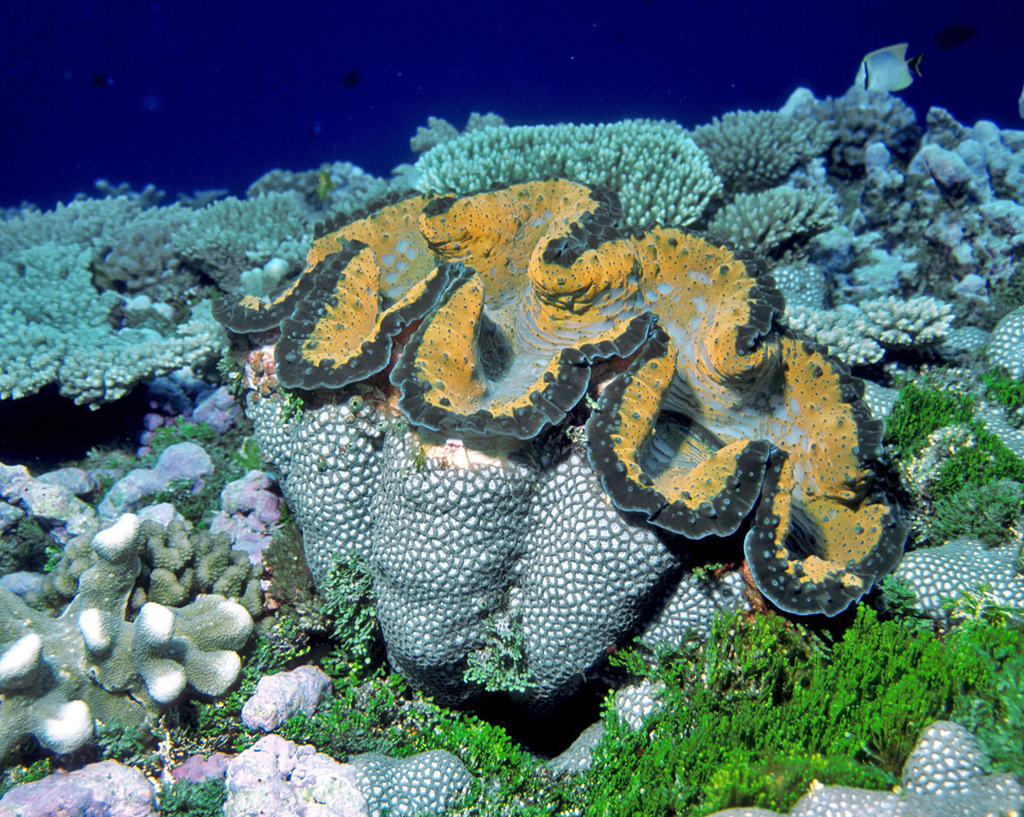
The largest living clam, reaching over 1.3 m long and 200 kg, that farms algae in its own flesh. Sunlight on its colourful mantle feeds the algae, which in turn feed the clam.
Tridacna gigas, the giant clam, is the best-known species of the giant clam genus Tridacna. Giant clams are the largest living bivalve molluscs. Several other species of "giant clam" in the genus Tridacna are often misidentified as Tridacna gigas. Wikipedia
What it can do
- iHosts symbiotic zooxanthellae algae in its mantle, which supply most of its food
- iiIridescent cells in the mantle spread and shield light for the algae
- iiiOne of the longest-lived invertebrates, possibly over 100 years
- ivFilters plankton from seawater
In the field
Field marks
- aHuge, heavy shell with four to six broad, deep folds
- bWavy, interlocking shell margin
- cGolden-brown to olive mantle with iridescent blue-green spots
- dLies free on the bottom; large adults cannot close fully
- Not to be confused with
- Smooth giant clam (Tridacna derasa) has a smoother shell with lower ribs. Fluted giant clam (T. squamosa) has rows of scale-like flutes. Small giant clams (T. maxima, T. crocea) are much smaller and bore into coral.
- Where to see it
- Reefs of the northern Great Barrier Reef (e.g. Lizard Island), Palau, and restocking sites in the Philippines (Bolinao, Pangasinan).
- When
- Year-round
Life & habits
- Diet
- Sugars from symbiotic algae, plus filtered plankton
- Habitat
- Sandy patches and reef flats in clear, shallow water, usually less than 20 m deep
- Size
- Shell up to about 1.4 m; weight over 200 kg
- Lifespan
- Possibly 100 years or more
Adults sit hinge-down on sand, unattached, and spawn by releasing clouds of eggs and sperm into the water.
Where it lives
Recorded sightings
—
geo-referenced records in GBIF, from museums, herbaria and field observers.
Native range
Tropical Indo-Pacific: Great Barrier Reef, the Philippines, Indonesia, Micronesia and Melanesia; extinct in several former parts of its range
Drag the globe to turn it. Dots are where records exist, not a range map; darker means more records.
In the old herbals & bestiaries
Woodcuts and engravings matched from the Source Library’s scanned books by name. Plates marked “relative” show a close kin rather than this exact species. Click a plate to read the page it came from, with translation.


In the stacks
Searching the stacks…
Every page naming Tridacna gigas in the Biodiversity Heritage Library →
Marginalia
Giant clam shells serve as holy-water fonts (bénitiers) in European churches, notably the pair in Saint-Sulpice, Paris, said to be a gift from the Republic of Venice to King Francis I.
Curiosity
The 'man-eating clam' that traps divers is a myth; adults close too slowly to trap anyone, and there is no reliable record of a death.
Kinship





Photographs: iNaturalist contributors under the licences shown. Records: GBIF.org. Historical plates: Source Library (CC BY-SA 4.0; originals public domain). Summary text: Nature Library editors and Wikipedia (CC BY-SA). Medicinal and edibility notes are historical and educational, not advice. iNaturalist taxon 114396.