 NL·0176
Herbarium of the Nature Library
- Name
- Zingiber officinale
- Family
- Zingiberaceae
- Native to
- Domesticated in Island Southeast Asia or southern China; unknown in the wild. Cultivated throughout the tropics
- Habitat
- Tropical rainforest margins, Farmland
Ginger
Zingiber officinale
Also calledAdrak (fresh) / Sonth (dried) (Hindi/Urdu) · Shunthi / Vishvabheshaja (Sanskrit, 'universal medicine') · Zanjabīl زنجبيل (Arabic) · Shēngjiāng 生姜 / Gānjiāng 干姜 (Chinese) · Jahe (Indonesian) · Jengibre (Spanish)
A reed-like tropical herb whose knobbly, pungent rhizome was one of the first spices traded from Asia to the Roman world. It is not known in the wild, and has been carried around the world by people.
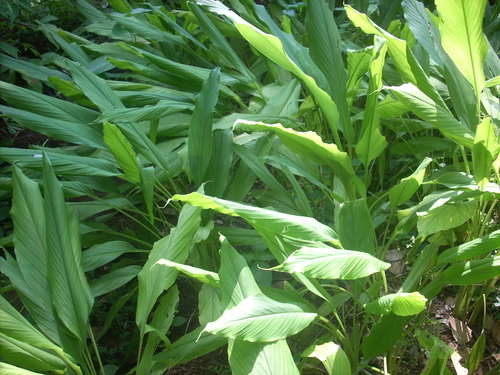
Ginger is a flowering plant whose rhizome, ginger root or ginger, is widely used as a spice and a folk medicine. It is an herbaceous perennial that grows annual pseudostems about one meter tall, bearing narrow leaf blades. The inflorescences bear flowers having pale yellow petals with purple edges, and arise directly from the rhizome on separate shoots. Wikipedia
What it can do
- iGingerols in the fresh rhizome turn into hotter shogaols when dried or cooked
- iiActs against nausea, probably through serotonin (5-HT3) receptors in the gut
- iiiRarely sets seed; spread worldwide entirely by rhizome cuttings
At the table
Eatenrhizome · young shoots · flowers (some varieties)
Widely eaten. Large doses can cause heartburn.
In the medicine cabinet
| Tradition | Use |
|---|---|
| Ayurveda | Shunthi to kindle digestive fire (agni), for nausea, colds, joint pain and as a carrier in many formulas |
| Traditional Chinese Medicine | Fresh ginger (shengjiang) to induce sweating in colds and stop vomiting; dried ginger (ganjiang) to warm the interior |
| Unani | Zanjabil as a digestive and carminative, for phlegm, and as an aphrodisiac |
| Modern phytotherapy | Powdered rhizome for pregnancy nausea, motion sickness and post-operative and chemotherapy nausea |
Weight of evidence
Moderate. Some clinical trials with promising but limited or mixed results.
Active compounds
[6]-gingerol, [6]-shogaol, zingerone, zingiberene, paradols
Seed
Seed
Seed is very rarely produced in cultivation
- Dispersal
- Human propagation of rhizomes
- Germination
- Not grown from seed
How to grow it
Hardiness (USDA zones)
USDA 9–12 (container elsewhere). Survives winters down to about -7 °C.
- Light
- Part shade
- Water
- High; reduce in dormancy
- Soil
- Rich, loose, moist but well-drained
- Propagation
- Rhizome pieces with plump buds
- To harvest
- Young ginger at 4–5 months; mature at 8–10 months
- Climates
- Tropical, Subtropical
- 1Soak a fresh organic rhizome overnight and cut into pieces each with a bud
- 2Plant 5 cm deep in warm compost, buds up
- 3Keep warm (above 20 °C) and moist in dappled shade
- 4Harvest when leaves yellow, or dig 'baby ginger' earlier
Can it grow where you are?
Where it lives
Recorded sightings
—
geo-referenced records in GBIF, from museums, herbaria and field observers.
Native range
Domesticated in Island Southeast Asia or southern China; unknown in the wild. Cultivated throughout the tropics
Drag the globe to turn it. Dots are where records exist, not a range map; darker means more records.
In Gerard's Herball, 1597

First Booke · Chap. 38 · p. 54 · read the page →
Of Ginger.
John Gerard, The Herball, or Generall Historie of Plantes, London, 1597. What England's best-known herbal said of ginger, in its own spelling.
- The vertues
- Ginger, as Dioscorides reporteth, is right good with meate in sauces, or otherwise in conditures: for it is of an heating and digesting qualitie, it gently looseth the bellie, and is profitable for the stomacke, and effectually opposeth it selfe against all darknes of the sight, answering the qualities and effects of Pepper. It is to be considered, that greene canded or condited Ginger is hot and moist in qualitie, prouoking venerie: and being dried, it heateth and drieth in the third degree.
- The place
- Ginger groweth in Spaine, Barbarie, in the Canarie Ilands, and the Acores. Our men which sacked Domingo in the Indies, digged it vp there in sundry places wilde.
- The time
- Ginger flourisheth in the hot time of sommer, and loseth his leaues in winter.
- The temperature
- Ginger heateth and drieth in the third degree.
- The names
- Ginger is called in Latine Zinziber.
Gerard wrote within Galenic humoral medicine, and his opinions, including about the peoples of the Americas and their crops, are those of 1590s London. His “vertues” are history, not advice. Transcription: Source Library (CC BY-SA 4.0). The whole chapter in the Herball Room.
In the old herbals & bestiaries
Woodcuts and engravings matched from the Source Library’s scanned books by name. Plates marked “relative” show a close kin rather than this exact species. Click a plate to read the page it came from, with translation.

History of the Plants of New Spain, Volume 3
Francisco Hernández (1517-1587) · 1946 · p.387

Itinerary, Voyage or Ship-travel to the East or Portuguese Indies
Jan Huyghen van Linschoten · 1595 · p.191

Tractado de las Drogas y Medicinas de las Indias Orientales
Cristóvão da Costa · 1578 · p.290

The Embassy of the Dutch East India Company to the Tartar Cham
Johan Nieuhof · 1665 · p.418

De Indiae utriusque re naturali et medica
Willem Piso · 1658 · p.255

De Indiae utriusque re naturali et medica
Willem Piso · 1658 · p.591

本草綱目圖3卷. [2]
Li Shizhen · 1596 · p.29

農業全書 11巻. [4]
Miyazaki Yasusada · 1697 · p.19

Illustrated Compendium of Materia Medica (Vol. 6)
吳其濬 · 1848 · p.69

Unwritten Literature of Hawaii: Sacred Songs of the Hula (bilingual)
Nathaniel B. Emerson · 1909 · p.256
In the stacks
Searching the stacks…
Every page naming Zingiber officinale in the Biodiversity Heritage Library →
Marginalia
The Analects record that Confucius 'was never without ginger when he ate'. Zanjabil is named in the Qur'an (76:17) as a flavouring of the drink of paradise.
Curiosity
Ginger's name has travelled through Sanskrit śṛṅgavera ('horn-shaped'), Greek zingiberis and Latin zingiber to English.
Kinship


Photographs: iNaturalist contributors under the licences shown. Records: GBIF.org. Historical plates: Source Library (CC BY-SA 4.0; originals public domain). Summary text: Nature Library editors and Wikipedia (CC BY-SA). Medicinal and edibility notes are historical and educational, not advice. iNaturalist taxon 122971.