- Animals
- ›Arthropods
- ›Hexapods
- ›Insects
- ›Winged and Once-winged Insects
- ›Butterflies and Moths
- ›Butterflies
- ›Gossamer-winged Butterflies
- ›Coppers
- ›Lycaenini
- ›Lycaena
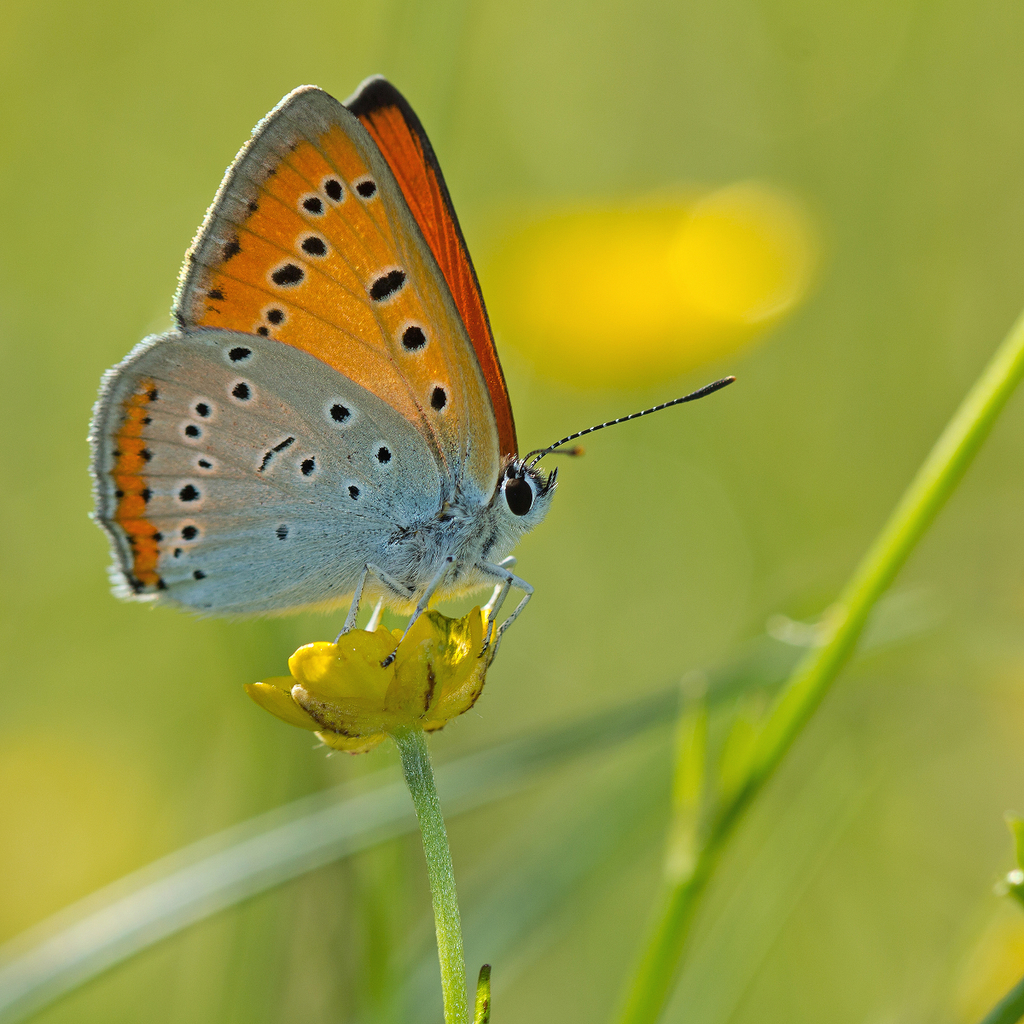
Large Copper
Lycaena dispar
Large copper (Lycaena dispar) is a butterfly of the family Lycaenidae. Lycaena dispar is widely distributed across temperate Eurasia from western Europe to the Amur region, Korea and Manchuria. While it is currently in severe decline in north-western Europe, it is expanding in central, northern and eastern regions.
Three European subspecies are commonly recognized: L. dispar dispar (single-brooded), the now-extinct English subspecies; L. d. batavus (usually single-brooded), the Dutch subspecies; and L. d. rutilus (double-brooded), which is widespread across the rest of the continent. Several Asian subspecies extend the range eastward. The species has been declining in many European countries mainly as a result of habitat loss.
From the article Large copper on Wikipedia (CC BY-SA), quoted section by section
Description
Lycaena dispar is a large lycaenid butterfly with a wingspan of 44–52 mm. The species exhibits strong sexual dimorphism. Males have bright orange wings with narrow black margins and white fringes. The short androconia (sex brands) are located near the leading edge of the forewing. Females have broader dark brown margins on the forewings with a parallel row of dark spots. Both sexes have distinctive silvery-blue hindwing undersides patterned with black spots and an orange submarginal band. This silvery underside distinguishes L. dispar from related species such as Lycaena virgaureae and L. hippothoe, which inhabit drier environments. The subspecies can be differentiated by size, extent of black markings, and the length of the orange band on the hindwing underside. The extinct English subspecies (L. d. dispar) was notably variable in size and had larger spots on the underside than continental European forms.
Range & habitat
Lycaena dispar occurs between latitudes 40° and 60° across Eurasia. The species is currently found in: Armenia, Austria, Azerbaijan, Belarus, Belgium, Bulgaria, China, Croatia, Czech Republic, Estonia, Finland, France, Georgia, Germany, Greece, Hungary, Italy, Kazakhstan, Republic of Korea, Latvia, Lithuania, Luxembourg, Moldova, Mongolia, Montenegro, Netherlands, Poland, Russian Federation, Serbia, Slovakia, Slovenia, Switzerland, Türkiye, Ukraine and Uzbekistan. The species shows contrasting population trends across its range: severe decline in north-western Europe, stability or expansion in central and northern Europe, and mixed status in Asia.
Wikipedia: “Current range”
What it does
Most European populations are bivoltine with two generations annually: May–June and late July–early September, with peak flight in July. Northern populations (e.g. Estonia) are univoltine, while southern populations may produce a partial third generation. The species overwinters as half-grown third-instar larvae, which enter diapause triggered by temperatures below 15°C and photoperiod cues. Larvae resume feeding in early May when temperatures exceed 25°C. Heavy mortality occurs during the overwintering period, particularly from prolonged flooding.
Wikipedia: “Life cycle”
Listen
Looking for field recordings…
Where it lives
Recorded sightings
—
geo-referenced records in GBIF, from museums, herbaria and field observers.
Drag the globe to turn it. Dots are where records exist, not a range map; darker means more records.
In the old herbals & bestiaries


In the stacks
Searching the stacks…
Every page naming Lycaena dispar in the Biodiversity Heritage Library →
This page is assembled live from iNaturalist, GBIF, Wikipedia, the Source Library and the Internet Archive. It is not yet part of the hand-edited codex. iNaturalist taxon 104875.