- Animals
- ›Cnidarians
- ›Sea Anemones and Corals
- ›Hexacorallians
- ›Stony Corals
- ›Table and Staghorn Corals
- ›Montipora
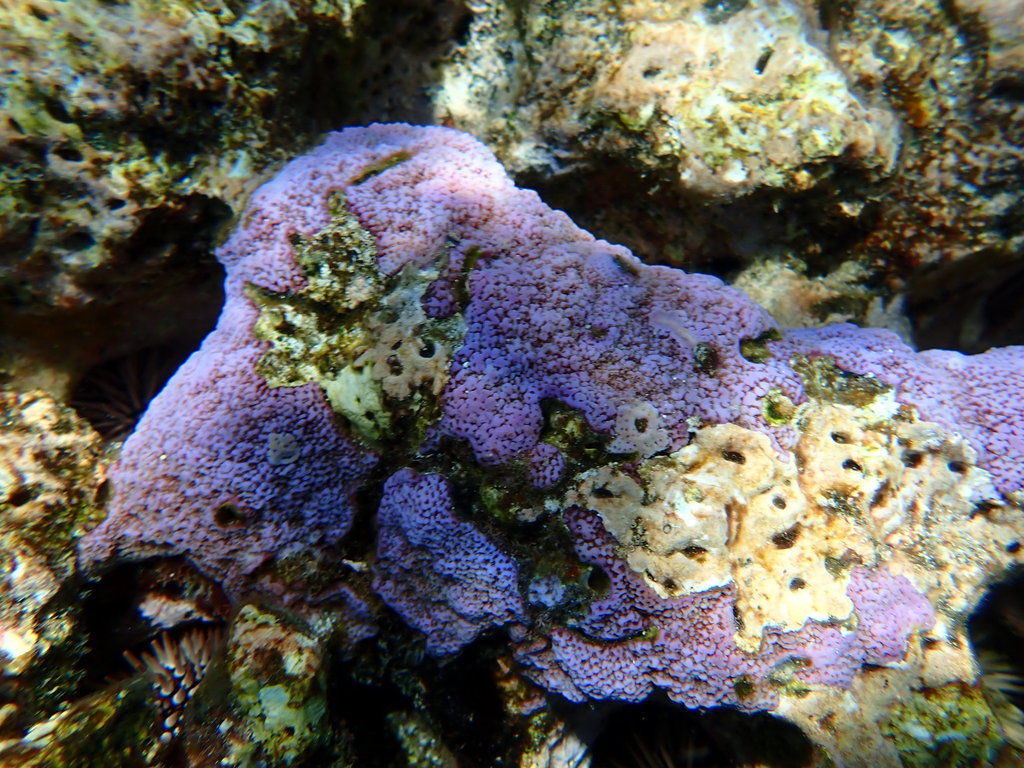
Blue Rice Coral
Montipora flabellata
Montipora flabellata, known by the common name blue rice coral, is a species of coral in the family Acroporidae. It is found growing on coral reefs in tropical parts of the Indian and Pacific Oceans. It is known to be endemic to the Hawaiian Islands. Its Hawaiian name translated to Polū laiki ko'a, polū meaning blue, laiki meaning rice, and ko'a meaning corals in ʻŌlelo Hawaii.
From the article Montipora flabellata on Wikipedia (CC BY-SA), quoted section by section
Description
Usually blue (which may photograph pink), also brown or purple. Colonies are encrusting, with irregular lobes. The reproductive traits of Montipora fabellata (Studer 1901) show a narrow distribution and are typically restricted to shallow water with high wave energy and irradiance with an encrusting growth form. Colonies are encrusting, with irregular lobes. Corallites are small (0.5 mm diameter). Papillae cover the colony surface and are sometimes fused into ridges. Septa are poorly developed. Encrusting lilac, pink, blue, or rarely brown sheets with calices immersed between irregular ridges of fused rods. Fluorescent blue color is only present in photographs taken with sunlight.
Wikipedia: “Morphology and anatomy”
Range & habitat
Found in Hawaiʻi and the Central Pacific. The species is endemic to Hawaiʻi and currently under review for listing as threatened or endangered species under the US Endangered Species Act. There are recordings of highest predicted cover for M. flabellata along the east coasts of Kauai and Oʻahu and wave sheltered areas of Maui Nui. It is also relatively abundant statewide but typically has a very restricted niche, one of high wave energy, water flow, and high UVR exposure. Common in shallow water exposed to surge. The species likes shores with high wave action, such as winter 'big wave' surf in habitat characteristic of M. flabellata., making it an ideal location to inhabit. This hard coral is common in shallow water exposed to surge, in the highest wave energy environments. M. flabellata is less common and more restricted to shallow reef habitat, colonies of the species were found between 1 and 4 m (0 and 10 ft) depth. The species is a broadcasting, simultaneous hermaphrodites that release egg-sperm bundles. Most coral where spawning was linked to the new moon, M. flabellata does not appear to follow a similarly correlated lunar phase environmental cue. Both light and heavy M. flabellata spawns were spread throughout most of the summer in years monitored and without a clearly delineated lunar phase. There is no clearly defined beginning or end of gametogenesis in M. flabellata. …
Wikipedia: “Distribution and habitat”
Where it lives
Recorded sightings
—
geo-referenced records in GBIF, from museums, herbaria and field observers.
Drag the globe to turn it. Dots are where records exist, not a range map; darker means more records.
In the stacks
Searching the stacks…
Every page naming Montipora flabellata in the Biodiversity Heritage Library →
This page is assembled live from iNaturalist, GBIF, Wikipedia, the Source Library and the Internet Archive. It is not yet part of the hand-edited codex. iNaturalist taxon 106090.