- Plants
- ›Vascular Plants
- ›flowering plants
- ›monocots
- ›Agaves, Orchids, Irises, and Allies
- ›Orchids
- ›Orchidoid Orchids
- ›Diurideae
- ›Prasophyllinae
- ›Genoplesium
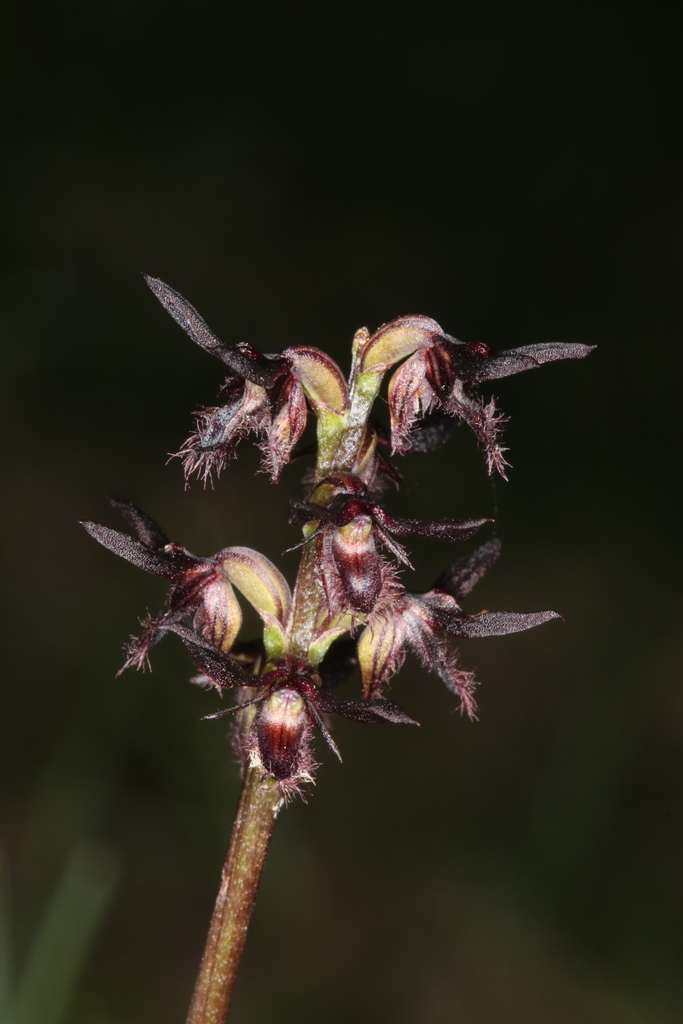
Genoplesium ostrinum
Genoplesium ostrinum, commonly known as the purple midge orchid, is a species of small terrestrial orchid that is endemic to New South Wales. It has a single thin leaf and up to ten dark purple flowers with darker stripes and a hairy labellum which vibrates in the slightest breeze.
From the article Genoplesium ostrinum on Wikipedia (CC BY-SA), quoted section by section
Description
Genoplesium fimbriatum is a terrestrial, perennial, deciduous, herb with an underground tuber and a single thin leaf 150–280 mm (6–10 in) long with the free part 10–22 mm (0.4–0.9 in) long. Between three and ten dark purple flowers are crowded along a flowering stem 10–30 mm (0.4–1 in) long and much taller than the leaf. The flowers are about 10 mm (0.4 in) long, 8.5 mm (0.3 in) wide and as with others in the genus, are inverted so that the labellum is above the column rather than below it. The dorsal sepal is 6 mm (0.2 in) long, 3 mm (0.1 in) wide with darker stripes, a pointed tip and hairy edges. The lateral sepals are 7.5 mm (0.3 in) long, 1 mm (0.04 in) wide with a humped base and spread widely apart from each other. The petals are 4 mm (0.2 in) long, 1.5 mm (0.06 in) wide and striped with hairy edges. The labellum is about 5 mm (0.2 in) long, 1.5 mm (0.06 in) wide with its tip curled upwards and long hairs on its edge. The labellum quivers in the slightest breeze. Flowering occurs between February and April.
Range & habitat
The purple midge orchid grows with shrubs or grasses in woodland between Tallong and Braidwood.
== References ==
Wikipedia: “Distribution and habitat”
Where it lives
Recorded sightings
—
geo-referenced records in GBIF, from museums, herbaria and field observers.
Drag the globe to turn it. Dots are where records exist, not a range map; darker means more records.
In the stacks
Searching the stacks…
Every page naming Genoplesium ostrinum in the Biodiversity Heritage Library →
This page is assembled live from iNaturalist, GBIF, Wikipedia, the Source Library and the Internet Archive. It is not yet part of the hand-edited codex. iNaturalist taxon 1062124.