 NL·0682
Herbarium of the Nature Library
- Name
- Dynastes hercules
- Family
- Scarabaeidae
- Native to
- Lesser Antilles (notably Guadeloupe and Dominica) in the strict sense; the wider Dynastes hercules complex ranges from southern Mexico through Central America to the Andes and Amazonia
- Habitat
- Tropical rainforest, Montane forest
Hercules beetle
Dynastes hercules
Also calledScarabée Hercule (French) · Escarabajo Hércules (Spanish) · Herakuresu-ōkabuto (Japanese)
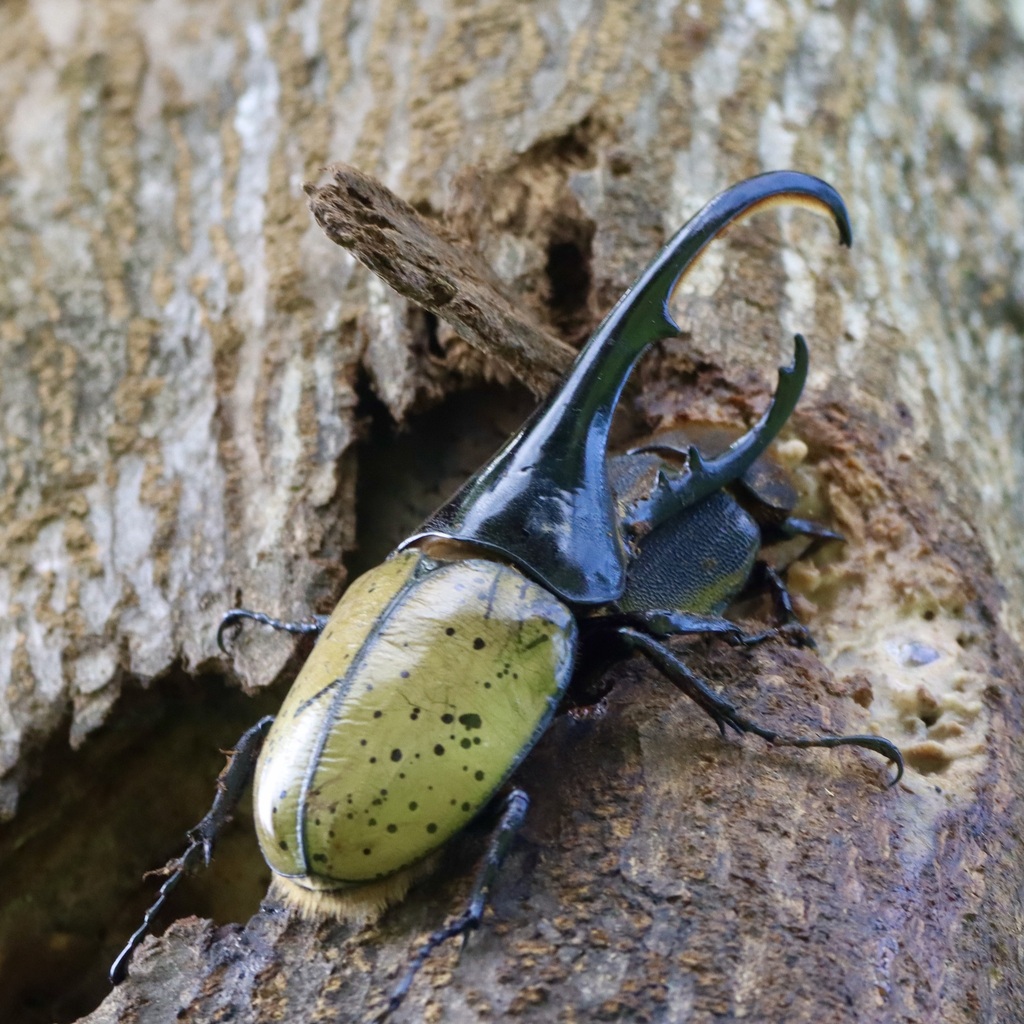
The longest of all beetles: horned males can reach about 17 cm, more than half of it horn. It ranges from southern Mexico to Bolivia and the Lesser Antilles; some recent studies split the mainland forms into separate species, leaving D. hercules in the strict sense on the Lesser Antilles.
The Hercules beetle is a species of rhinoceros beetle native to the tropical forests of southern Mexico, Central America, South America, and the Lesser Antilles. It is the longest extant species of beetle in the world, and is also one of the largest flying insects in the world. Wikipedia
What it can do
- iLongest beetle in the world, males up to about 17 cm including the horn
- iiWing cases change from olive-yellow to black as humidity rises, through changes in a porous layer in the cuticle
- iiiMales use their pincer-like horns to lift and throw rivals
In the field
Field marks
- aMale: very long, forward-curving thoracic horn with a brush of golden hairs underneath, opposed by a shorter upcurved head horn
- bWing cases olive-green to yellowish with scattered black spots (black when humid)
- cHead, thorax and horns glossy black
- dFemales hornless, dark and often hairy
- Not to be confused with
- Mainland Hercules beetles (D. h. lichyi, septentrionalis, occidentalis and others), treated by some authors as separate species, differ subtly in horn and colour and by range. Neptune beetle (D. neptunus) is all black with extra short horns. Elephant beetles (Megasoma) lack the long thoracic horn.
- Where to see it
- Montane rainforest of Guadeloupe and Dominica; widely exhibited in insect zoos.
Listen
Looking for field recordings…
Life & habits
- Diet
- Adults eat rotting fruit; larvae feed on decaying wood
- Habitat
- Moist rainforest, where larvae develop inside rotting logs
- Size
- Males about 5–17 cm including horn; females about 5–8 cm
- Lifespan
- Larval stage up to about 2 years; adults about 3–6 months in captivity
Rival males lock horns, lift one another and slam the loser down or off the branch.
Where it lives
Recorded sightings
—
geo-referenced records in GBIF, from museums, herbaria and field observers.
Native range
Lesser Antilles (notably Guadeloupe and Dominica) in the strict sense; the wider Dynastes hercules complex ranges from southern Mexico through Central America to the Andes and Amazonia
Drag the globe to turn it. Dots are where records exist, not a range map; darker means more records.
In the old herbals & bestiaries
No plate in the Source Library names this exact species, so these show its closest relatives as the old naturalists drew them: same genus, or the same kind of animal. Click a plate to read the page it came from, with translation.

In the stacks
Searching the stacks…
Every page naming Dynastes hercules in the Biodiversity Heritage Library →
Marginalia
Linnaeus named it Scarabaeus hercules in 1758 after the Greek hero. In Japan, rearing Hercules beetles bought from breeders is a popular hobby.
Curiosity
The yellow colour comes from a spongy layer in the wing case; when it soaks up water it turns transparent and the black layer beneath shows through.
Kinship





Fact-checked: 4 corrections made to this sheet. Photographs: iNaturalist contributors under the licences shown. Records: GBIF.org. Historical plates: Source Library (CC BY-SA 4.0; originals public domain). Summary text: Nature Library editors and Wikipedia (CC BY-SA). Medicinal and edibility notes are historical and educational, not advice. iNaturalist taxon 1065735.