- Animals
- ›Arthropods
- ›Crustaceans
- ›Typical Crustaceans
- ›Malacostracans
- ›Decapods, Isopods, and allies
- ›Decapods and Krill
- ›Decapods
- ›Crabs, Lobsters, Shrimps, and Allies
- ›Spiny and Slipper Lobsters
- ›Spiny Lobsters
- ›Panulirus
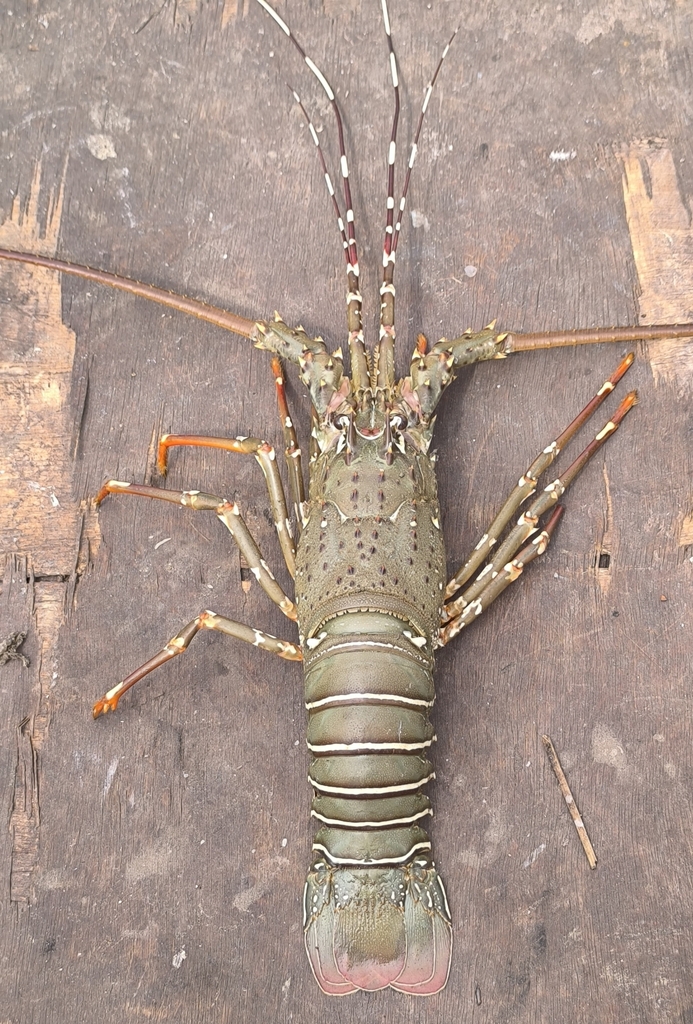
mud spiny lobster
Panulirus polyphagus
Panulirus polyphagus, the mud spiny lobster, is a species of crustacean that lives on shallow rocky reefs and muddy substrates in the tropical Indo-Pacific region. The International Union for Conservation of Nature has assessed its conservation status as being of "least concern".
From the article Panulirus polyphagus on Wikipedia (CC BY-SA), quoted section by section
Description
Panulirus polyphagus grows to a length of about 40 cm (16 in). The antennal plate bears two large spines and there are no transverse grooves on the abdominal segments. Distinctive colour features by which this species can be distinguished from other spiny lobsters include a greenish-grey background colour and a thin white band near the hind edge of each segment. In Europe, the otherwise similar native species, the north eastern Atlantic spiny crawfish (Panulirus regius), has four large spines on the antennal plate, and smooth grooves on the abdominal segments.
Range & habitat
Panulirus polyphagus has a wide distribution in the tropical Indo-Pacific region. Its range extends from India and Pakistan, through the Philippines and Indonesia to northwestern Australia and southeastern New Guinea. It is usually found on rocky reefs or on muddy seabeds, often at the mouths of rivers, at depths down to 40 m (131 ft) and exceptionally to more than double this depth. This spiny lobster is sometimes imported into Europe and may be found at markets in continental Europe and the United Kingdom.
Wikipedia: “Distribution and habitat”
Where it lives
Recorded sightings
—
geo-referenced records in GBIF, from museums, herbaria and field observers.
Drag the globe to turn it. Dots are where records exist, not a range map; darker means more records.
In the stacks
Searching the stacks…
Every page naming Panulirus polyphagus in the Biodiversity Heritage Library →
This page is assembled live from iNaturalist, GBIF, Wikipedia, the Source Library and the Internet Archive. It is not yet part of the hand-edited codex. iNaturalist taxon 108368.