- Animals
- ›Arthropods
- ›Hexapods
- ›Insects
- ›Winged and Once-winged Insects
- ›Butterflies and Moths
- ›Butterflies
- ›Swallowtails and Parnassians
- ›Swallowtails
- ›Fluted Swallowtails
- ›Papilio
- ›Pterourus
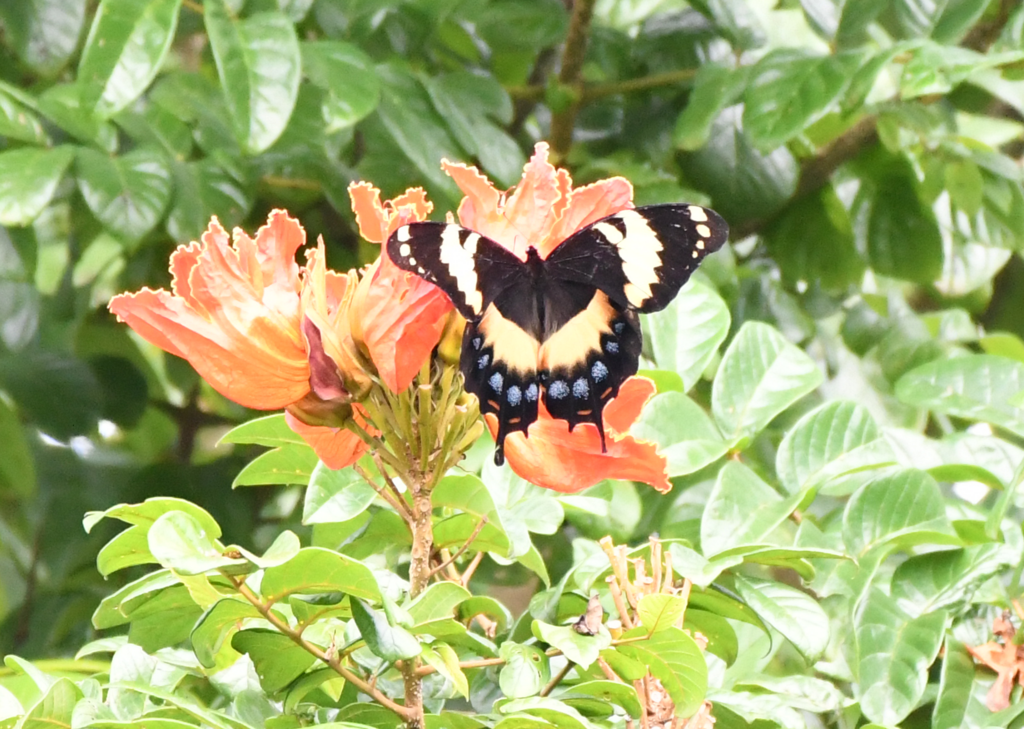
Jamaican Giant Swallowtail
Papilio homerus
Papilio homerus, commonly known as the Homerus swallowtail or Jamaican swallowtail, is the largest butterfly species in the Western Hemisphere. The species is endangered and faces a potentially bleak future. Only two small populations of the Homerus swallowtail remain in a fraction of their original environment. It is endemic to Jamaica where the butterfly simultaneously serves as an icon of national pride and a need for conservation efforts. Over the past half century, the Jamaican swallowtail has been featured on various postal stamps and the Jamaican $1000 bill. In the face of rapid habitat destruction from human disruption and illegal collecting, the Jamaican swallowtail is listed on the Threatened Swallowtail Butterflies of the World by the International Union for Conservation of Nature (Red List) and is protected under international and national level legislation.
The butterfly is named in honor of the Greek poet Homer. The adult butterfly has been described by researchers as "gigantic and magnificent." Females are larger than males and can have a wingspan of 15 cm (6 in). Adults can be seen from morning to afternoon soaring among the canopy of the Neotropical Jamaican rainforests. Its brown-black wings feature a large yellow band and blue and red spotting, making the butterfly easy to spot from far away.
From the article Papilio homerus on Wikipedia (CC BY-SA), quoted section by section
Range & habitat
P. homerus is endemic to Jamaica, which is located in the Neotropical realm. It previously occupied half of the 14 parishes of Jamaica but can only be found as two or three small populations today. While many researchers have previously claimed that there are only two remaining strongholds, one author argues that there are three distinct populations: a central, eastern, and western population.
Central population. The Central population has most likely disappeared. The last observation of P. homerus in this region was in 1925. This is also the least understood of the three populations. The region that they had inhabited consists of plateaus at an elevation of 600 to 1,000 m (2,000–3,300 ft). The population was located centrally around Mt. Diablo, which is located 70 km from both of the other populations. Thus, this population likely served as a key means of allowing gene flow between the three populations to prevent genetic bottlenecking, the genetic isolation of a subset of any given population. The population has been lost to anthropogenic habitat disruption. With deforestation and the expansion of developments bordering much of the remaining forest land, the climate of the region is more arid. This less than 100% humidity results in developmental defects in pupae reared in the lab. …
Wikipedia: “Geographic range and habitat”
What it does
New larvae hatch from the egg, consume the chorion, and feed on the leaf of oviposition. They are typically found alone, but can share the same leaf with upwards of five other larvae. When the larvae reach the fourth instar, they move onto other, younger leaves to feed. Larvae have also been observed drinking water droplets after heavy rains.
Wikipedia: “Larval behavior”
At the table
Although, H. catalpaefolia and H. jamaicensis have been known to be the host-plants, the access to these plants now seem to be restricted. Currently, there is no confirmed larval food plant species known. However, oviposition has been observed on Ocotea species plants that are found in all three geographies known to have recently been occupied by the populations of Jamaican swallowtail.
Wikipedia: “Larval food plant”
Listen
Looking for field recordings…
Where it lives
Recorded sightings
—
geo-referenced records in GBIF, from museums, herbaria and field observers.
Drag the globe to turn it. Dots are where records exist, not a range map; darker means more records.
In the stacks
Searching the stacks…
Every page naming Papilio homerus in the Biodiversity Heritage Library →
This page is assembled live from iNaturalist, GBIF, Wikipedia, the Source Library and the Internet Archive. It is not yet part of the hand-edited codex. iNaturalist taxon 108384.