- Animals
- ›Arthropods
- ›Hexapods
- ›Insects
- ›Winged and Once-winged Insects
- ›Dragonflies and Damselflies
- ›Damselflies
- ›Coenagrionoid Damselflies
- ›Narrow-winged Damselflies
- ›Paracercion
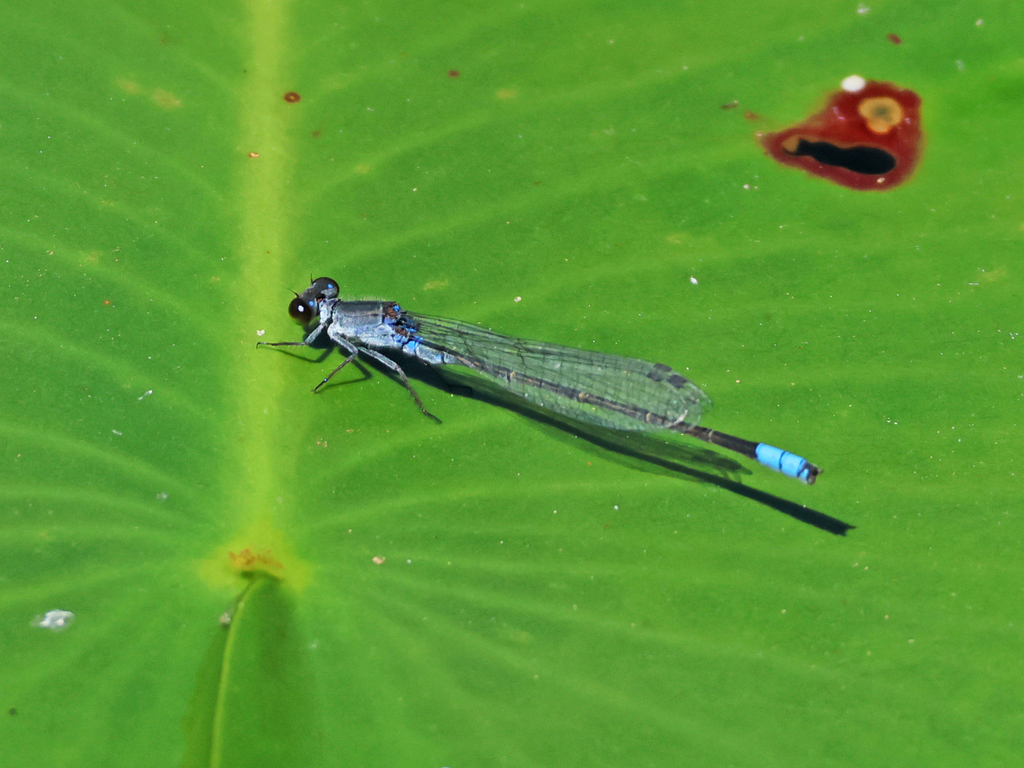
Dusky Lilysquatter
Paracercion calamorum
Paracercion calamorum, the dusky lilly-squatter, is a species of damselfly in the family Coenagrionidae. It has a range that extends from southern far-eastern Russia to Japan, and to India and Indonesia. The nominate subspecies P. c. calamorum is known from central and eastern China, Korea and Japan. The subspecies P. c. dyeri occurs in southern China, Hong Kong, Taiwan, Indonesia, India, Nepal, and Thailand.
From the article Paracercion calamorum on Wikipedia (CC BY-SA), quoted section by section
Description
It is a medium-sized damselfly with brown-capped yellowish green eyes. Its thorax is black on dorsum without any or very fine azure blue antehumeral stripes, which are very broad in Paracercion malayanum. Lateral sides of thorax are greenish blue with a fine black line on the upper part of each lateral suture. In old males, all these marks are obscured by bluish white pruinescence. Its wings are transparent and pterostigma is yellow, framed with heavy black nervures. Its abdomen is azure blue with broad black dorsal marks up to segment 7. Segment 2 has a distinct broad dorsal spot connected narrowly to a fine apical ring. This mark will help to distinguish it from Pseudagrion species. Segment 10 has a narrow mid-dorsal black streak. Female is dull in colors. Its abdomen is similar to the male. But the lateral ground colour is greenish-yellow and segments 8 and 9 are broadly black on dorsum. Segment 10 is bluish-green. Female also get pruinosed when aged.
It breeds in stagnant and weedy ponds, resting flat on floating grasses and lotus leaves. Eggs are inserted well within the up-curled rim of the lotus leaf or any other floating vegetation.
Wikipedia: “Description and habitat”
Listen
Looking for field recordings…
Where it lives
Recorded sightings
—
geo-referenced records in GBIF, from museums, herbaria and field observers.
Drag the globe to turn it. Dots are where records exist, not a range map; darker means more records.
In the stacks
Searching the stacks…
Every page naming Paracercion calamorum in the Biodiversity Heritage Library →
This page is assembled live from iNaturalist, GBIF, Wikipedia, the Source Library and the Internet Archive. It is not yet part of the hand-edited codex. iNaturalist taxon 108420.