- Animals
- ›Arthropods
- ›Hexapods
- ›Insects
- ›Winged and Once-winged Insects
- ›Butterflies and Moths
- ›Butterflies
- ›Brush-footed Butterflies
- ›Milkweed Butterflies
- ›Tiger and Crow Butterflies
- ›Tiger Butterflies
- ›Parantica
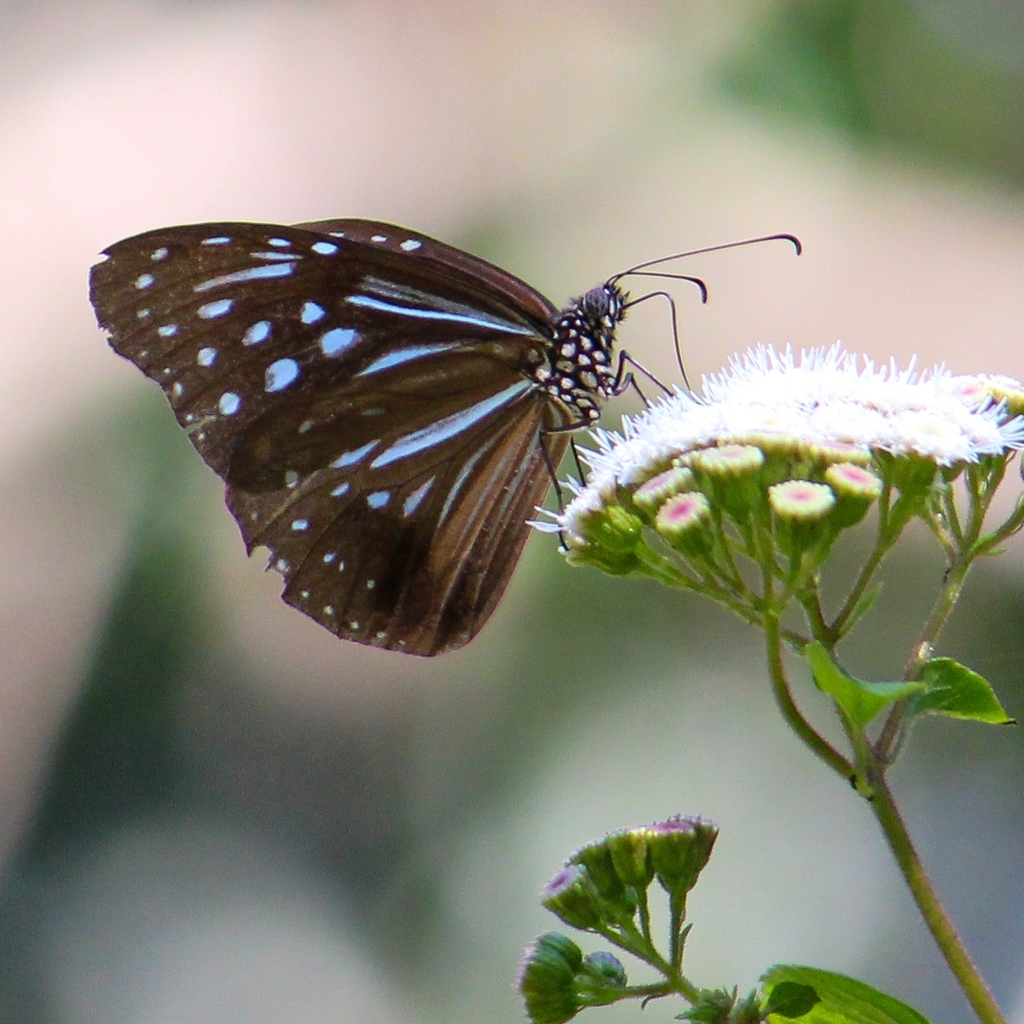
Nilgiri Tiger
Parantica nilgiriensis
Parantica nilgiriensis, the Nilgiri tiger, is a butterfly found in the Western Ghats of India south of the Konkan. It belongs to the danaid group of the brush-footed butterflies family.
Parantica nilgiriensis is a near-threatened (IUCN 2.3), butterfly endemic to the high altitudes of the Western Ghats of southern India, belonging to the family Nymphalidae and sub-family Danainae. It is restricted to the shola forests, south of Nilgiri Hills, in the temperate zones of the mountains, above 1500 m, though the species occasionally shows up in home gardens and open country to visit flowering plants. It rarely flies as low as 1000 m (Larsen 1987). Though Mark Alexander Wynter-Blyth (1957) mentions it as a common species, it has seen a rapid decline in the density of its population over the last few decades, owing to rapid destruction of its habitats, mostly due to tea-monocultures in the mountain ranges.
From the article Parantica nilgiriensis on Wikipedia (CC BY-SA), quoted section by section
Description
"Upperside fuliginous black with bluish-white markings and spots. Forewing; two streaks in interspace 1, coalescent at base and generally at their apices, a narrow streak, with two faintly indicated streaks above it, in cell; five discal spots and above them a long streak in interspace 5; a shorter one in 6; some coastal spots and subterminal and terminal series of spots, the former series curved inwards opposite apex of wing, the four lower spots conspicuously larger than the others; the latter series incomplete, the spots small. Hind wing: interspaces la, lb, and 1 with narrow streaks, double in the last; the cell with a much broader, outwardly bluntly pointed streak, and beyond this in the interspaces a radiating series of elongate spots with a sub terminal series of smaller spots and a terminal very incomplete series of dots. Underside similar, ground-colour browner, the spots more clearly defined. Antennae black; head and thorax black spotted with white; abdomen brownish above, dusky white below." Wingspan: 80–90 mm. Both male and female are dull brownish black with dirty white markings above. The streaks are narrower and the spots smaller than those of P. aglea and T. limniace. The markings are much less extensive than the background. Cells are dark with a pale streak. …
What it does
Egg-laying behaviour: The adult female flies continuously around healthy host plants, occasionally stopping to lay eggs on suitable fresh leaves. It fixes itself on the edge of the leaf using its forelegs, maintaining slow wing beats to keep it alighted, slowly bends its abdomen downwards to lay the egg on the underside of the leaf. It lays several eggs in a session, laid singly, at times with two or more eggs on a single leaf, always maintaining some distance between individual eggs. Adult behaviour: "The flight is rapid, low and erratic for a Danaid, giving the impression that it may not be protected species. It is often seen in numbers on flowering trees or on the occasional Lantana in clearings in Sholas. From time to time it is also met with sipping moisture from water seepages in vertical banks in the forest or along clear brooks, something that may also be observed in other montane butterflies." Host plants: Tylophora tenuis and T. indica. It does not seem to feed on Calotropis sp. which its close cousin P. aglea feeds on.
Wikipedia: “Behaviour”
Listen
Looking for field recordings…
Where it lives
Recorded sightings
—
geo-referenced records in GBIF, from museums, herbaria and field observers.
Drag the globe to turn it. Dots are where records exist, not a range map; darker means more records.
In the stacks
Searching the stacks…
Every page naming Parantica nilgiriensis in the Biodiversity Heritage Library →
This page is assembled live from iNaturalist, GBIF, Wikipedia, the Source Library and the Internet Archive. It is not yet part of the hand-edited codex. iNaturalist taxon 108628.