- Animals
- ›Arthropods
- ›Hexapods
- ›Insects
- ›Winged and Once-winged Insects
- ›Butterflies and Moths
- ›Butterflies
- ›Gossamer-winged Butterflies
- ›Blues
- ›Typical Blues
- ›Polyommatina
- ›Polyommatus
- ›Agrodiaetus
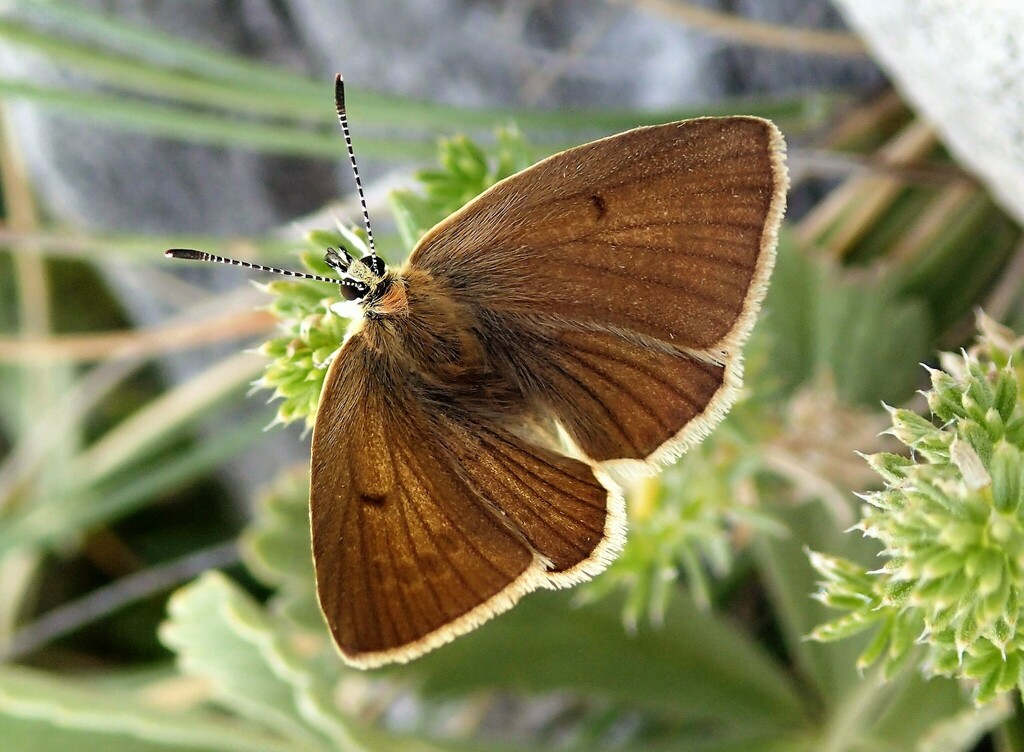
Higgins’s Anomalous Blue
Polyommatus nephohiptamenos
Polyommatus nephohiptamenos, or Higgins's anomalous blue, is a butterfly of the family Lycaenidae described by J. Brown and John G. Coutsis in 1978.
It has an IUCN Red List status of near threatened.
From the article Polyommatus nephohiptamenos on Wikipedia (CC BY-SA), quoted section by section
Description
The Higgins's anomalous blue (Polyommatus nephohiptamenos) is in the family Lycaenidae. It was described by Brown and Coutsis in 1978. Polyommatus nephohiptamenos was thought to possibly be a subspecies or form of Polyommatus ripartii, Ripart's anomalous blue. A 2016 paper confirmed that it was a distinct species based on distinct COI mitochondrial DNA barcodes and ecological differentiation. The fringes of the male are whiter than with P. ripartii.
Range & habitat
P. nephohiptamenos is endemic to Europe, found only in mountains of northern Greece and occasionally of southern Bulgaria. It is found in a small area at higher altitudes of the Phalakron Massif in Greece and Bulgaria. It has a dot-like distribution range. It has been found on Mount Pangeon and Mount Phalakro in Greece, and Mount Orvilos on the border between Greece and Bulgaria, and Mount Alibotush and Kitka Planina in Bulgaria. It is probably limited to less than 10 locations within an area of occupancy under 100 square kilometres (39 sq mi). It is usually found above the tree line, mostly between 1,500 to 2,000 metres (4,900 to 6,600 ft) in calcareous grasslands with many flowers.
Wikipedia: “Habitat”
What it does
P. nephohiptamenos has one generation per year. It feeds on the perennial sainfoin Onobrychis montana ssp. scardica, which is endemic to the Balkans. The caterpillars hibernate while still small, and feed on the new leaves of the sainfoin the next spring. The butterfly flies in mid-July and August. The butterfly may be threatened by intensified grazing, abandonment and wildfires. It has an IUCN Red List status of near threatened.
Wikipedia: “Life cycle”
Listen
Looking for field recordings…
Where it lives
Recorded sightings
—
geo-referenced records in GBIF, from museums, herbaria and field observers.
Drag the globe to turn it. Dots are where records exist, not a range map; darker means more records.
In the stacks
Searching the stacks…
Every page naming Polyommatus nephohiptamenos in the Biodiversity Heritage Library →
This page is assembled live from iNaturalist, GBIF, Wikipedia, the Source Library and the Internet Archive. It is not yet part of the hand-edited codex. iNaturalist taxon 109993.